Thursday, October 17, 2019

Harvest Season: Stomping Grapes

        As soon as I stepped into the bin of grapes in the big winemaking warehouse of T2 Cellar in Seattle, I felt like one of the peasants depicted in Medieval illuminated manuscripts: stomping the grapes in large barrels, dancing a jig to the lively tune of fiddles while brawny lads haul more bins of grapes from the vineyard and everyone—men, women, youths, and children—enjoys a festive harvest on a sunny autumn day.
        It wasn't quite like that, especially because in those days the men did the stomping because women, of course, wouldn't be lifting their skirts and showing their legs. Also, although it was a sunny autumn day in Seattle, we were indoors, in a very clean warehouse where T2 Cellar makes its wine. There wasn't a speck of dirt anywhere, and my son, Ela, and I cleaned and sanitized our feet in four sequenced buckets before stepping onto the grapes.

 (I wondered what kind of sanitization the peasants did to their feet.) Everything else was pretty much as it was centuries ago. We were stomping on the grapes because the grapes needed to be pulverized, and, as in days of yore, there was no better way to do it than with the feet. 

        This being the era of machines, however, and hand (or in this case foot) labor being more costly for the winemaker than machines (unless the winemaker has willing friends to come and help for the fun of it), winemakers now use a machine, called a destemmer, 
Todd Threlkeld, with Grenache grapes, destemmer in the background

which does the work of foot-stomping for the Granache and Sangiovese grapes T2 Cellar uses for red wine. The destemmer will juice the grapes and send them through tubes into storage jars in one smooth process. The foot-stomping was for the Marsanne grapes, a white-wine variety, which weren't numerous enough for T2 Cellar's large press and unsuitable for the small basket press, which doesn't press white clusters very well. Therefore, Todd Threlkeld, head winemaker, told me, "the stomping was not a lark but the most efficient and effective way to process a small amount of grapes"—fortunately for me, because it was a lot more fun to squish grapes with my feet than to pour grapes into a machine.
          Just as in Medieval days, there was music, if not fiddlers on the ground, then contemporary rock music on the stereo, that had us jumping and dancing like the peasants, at least for a while. 

Pretty soon I began thinking this was a lot of work, after all, until an experienced wine-maker told me it wasn't necessary to jump. We just had to squeeze the grapes until no more balls of grapes rolled under our feet. After that I stepped firmly but quietly onto the grapes, pressing hard, taking small steps, chasing with the next step the grapes that escaped towards the edges of the bin.
          When all the grapes had been brought to submission, when there were no more rolling balls of grapes underfoot, 
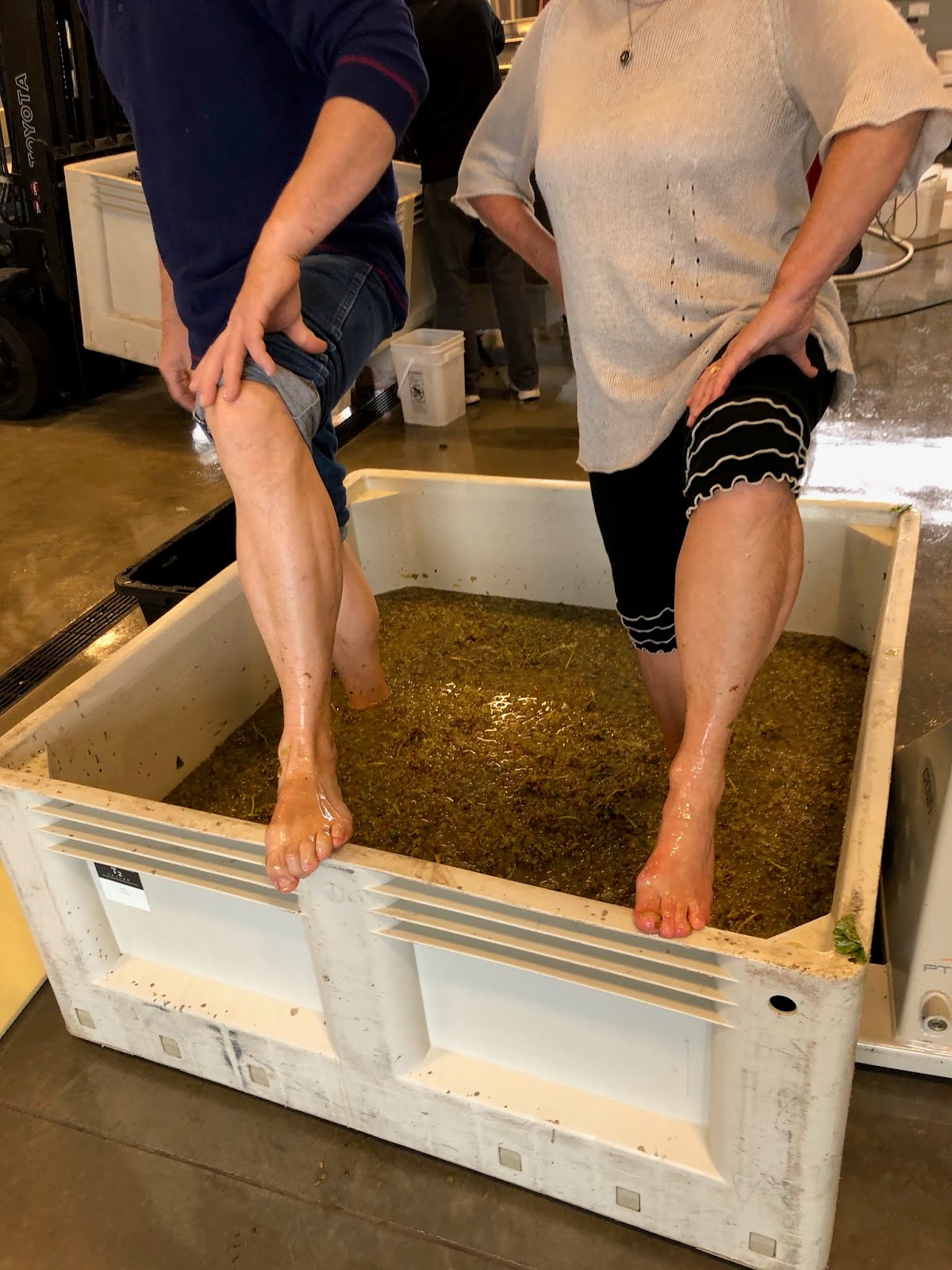
we poured the resulting pulp into a press, another ancient piece of equipment, and turned the crank to press pulp into juice, which we then poured into large jars.

 Now I was catapulted not into the Middle Ages but to my father's basement, where I used to help him bottle his wine when I came to visit from Oregon. He would have enjoyed this day with me.
          After pulping, pressing, and pouring, the six of us working on winemaking that day had delicious dolmas and falafels from a near-by Greek deli, washed down with some tastes of T2 Cellar wine. Good wine. The next time I go to Seattle, I want to go to T2 Cellar and have some white wine from Marsanne grapes. I'll lift my glass to the light and squint, seeing in the wine my bare feet stomping the grapes in the bin like a peasant at harvest in a vineyard.


Thursday, October 10, 2019

Inside Things

          Take a child to an apple tree and pick an apple. Cut it horizontally and open the broken halves. Look! Do you see the secret star inside? The child's delight will reinforce your own sense of wonder at the beauty inside things of nature.
         Beauty, of course, is everywhere in nature, but the hidden beauties—the patterns and surprises inside things—are the best of all. When I was a child, my father cut a pine cone lengthwise. Look! Inside! Another tree, with a trunk tapering towards its top and branches to the sides.
          A geode is boring on the outside—rough in texture, dull in color, interesting only in being unusually round. Break it open and find purple crystals rising like teeth in the mouth of a sea monster or clustering like petrified forms of the swaying tentacles of an anemone.
          The wonder elicited by the beauty of crystalline teeth inside a geode is enhanced by what the imagination does with the slightly menacing image of a sea monster, but when my leg slipped into a crevasse when I was mountain-climbing in the Alps and I looked down into the inside of a glacier, the danger was real but the beauty so surprising it blinded fear. The depth was unimaginable. As it plunged, the inside of the glacier echoed a deeper and deeper blue, from light-brightened turquoise to light-deprived turquoise and on beyond where I could tell what color it was. The color inside snow was as surprising as crystals inside a rock or a star in an apple, so surprising and so beautiful I never thought of the danger I might have been in. But maybe I had the luxury of not paying attention to the danger because I was roped to my companions. Or maybe I saw only the beauty because I was twenty years old and unaware of mortality. Whatever the reason I was able to concentrate on the beauty inside a glacier, I am grateful for it.
          Everything has something inside. Inside a seed is a tree; inside a bud is a flower. Inside a raindrop is a rainbow. Inside your eyes is your soul. Maybe a bear becomes angry if you look him in the eye because he doesn't want you to see inside his bare soul. A dog, on the other hand, has such confidence in his dogness he will beg you to look inside his eyes. When I looked at an owl through my binoculars, straight into his big owl eyes, he stared back into mine, then flew away and didn't return to the tree outside my bedroom for years. Was it what he saw in me or what he didn't want me to see in him that kept him away? His privacy? Or my rudeness?
         I could, if I wanted, reveal what's inside my heart, but how could I even know what's inside a bucketful of stars? What wonders of color or pattern might be inside a grain of sand? Look deep, look deeper, look deeper still: the beauty inside of things has no end.

Thursday, October 3, 2019

Hemp Galore

          To drive through the Applegate this late summer is to be deluged with the odor—the stink, some say—of cannabis. For some people the smell evokes those times, in days of yore, when someone wafted a bud under our noses before rolling it into a joint. In this case, though, the marijuana smell doesn't come form the smoking variety but from hemp. The Applegate is awash in hemp.

          To the astonishment of Applegaters, hemp fields sprang up all over the valley this summer (hemp is planted late in the season), stretching on both sides of the river to the hills. The first signs were the ugly strips of black plastic covering the fields. From hiking trails above the valley, they looked like shimmering lakes. Then the seedlings went in. Signs went up: "Hemp. No THC." This was not marijuana. It would not make you high. No use stealing it. Hemp grows fast, like the weed it is called. It grows short, bushy, and sticky (with CBD: cannabinoids). It emits a strong odor.
          Hemp has a variety of uses. It makes a great fabric. I can't wait till enough of it is grown to put hemp clothing on the market. Of course, everyone talks about hemp rope, but the main, maybe only, purpose for the hemp grown in the Applegate is medicinal. There seems to be a good market for CBD oil, made from the stalks, leaves and flowers of hemp, and for hemp oil, made from the seeds. Some Applegate hemp fields have already been shorn to the ground, but carloads of harvesters are working in others, so maybe both products come from Applegate hemp. 
          My visitor from Tennessee last month bemoaned the legalization of marijuana because it took a source of income away from the small-time growers (mom-and-pop, he called them, apparently without noticing the irony) and put it in the hands of Big Industry. I don't particularly think it's a good idea to make one's living through illegal means, either, so we disagreed on that topic, but apparently even the hemp grown in the Applegate is already in the hands of Big Industry, whoever they are. The fields of hemp we see so extravagantly spread throughout the valley are mostly on leased land, which, though probably leased for a pretty penny, are no doubt making a ton of money more for the grower than for the landlord. Some hemp money does, of course, trickle down into the hands of local field workers, baristas, and other merchants. 

          Everyone is talking abut boom and bust. There is no way, the argument goes, that the market can sustain so much product. Oregon's marijuana is a case in point. The large backlog of unsold marijuana has caused the state to put a moratorium on further licenses. People clack their tongues and say the hemp crash is sure to come. There is much head-wagging and tongue-clacking in the Applegate these days. 
          I miss the innocuous and uncontroversial hayfields in the Applegate, but I like seeing our valley kept agricultural, whether with hemp, grapes, or hay. Tomatoes were once the major crop; the air then was redolent of ketchup. Now it smells like cannabis. In some places, if the sun is hot, it might smell like grapes. Sometimes you can still catch the odor of fresh-cut hay. The Applegate is a beautiful place, partly for its mountains and forests and partly for Oregon's wonderful land-use laws, established in 1969, requiring comprehensive land-use plans for every city and county. These laws have helped us keep agricultural lands for agriculture and forested lands for forests, preventing unsightly sprawl  in our beautiful countrysides.

Thursday, September 26, 2019

Lost in the Emigrant Wilderness

          Deep in the Emigrant Wilderness Area (north of Yosemite), after four days of backpacking, I was now standing at the top of a granite ridge, surveying the miles and miles, acres and acres, of wilderness around me. As far as the eye could see, it saw granite—mountains and valleys of granite; humps, steps, shelves, and peaks of granite; miles and miles of granite splotched here and there by green stands of trees that managed somehow to get a toehold in the granite. The distances were vast. I thought, "If two people were lost in there, no one would ever find them."
Not the scene I was looking at, but another place in the Emigrant Wilderness, showing the granite
          The thought was sobering because my backpacking partner and I were, at the moment, lost. We had no idea where on the map we were. We had gone off-trail, over the mountain and across the granite, thinking to go to Red Can Lake, but the lake we had come to was not Red Can. Now, looking into the granite slabs and mounds we had crossed to get where we were, I saw that retracing our steps would be impossible. There was no going back, and, not knowing where we were, we didn't know how to go forward, either.
          For a brief moment, there on the ridge, looking into the chasms and peaks of granite, a flame of fear fluttered through me.
Another place off-trail in the Emigrant Wilderness
          But that was all. It was true that we were lost, but we had found a lake, which would have to be on the map somewhere. We were lost, but I was pretty sure we could find ourselves again.
          We decided it would be smart to find a way out before making camp at the lake for the night, so we left our packs at a campsite and started looking for a route to a main trail or, best, to the historic cabin and barn we had passed in the forest hours and hours earlier in the day, another lifetime earlier, when we knew where we were.
          Not far from our campsite, we discovered a line of cairns. Following it, we went up the mountain, to the ridge from which I surveyed the vastness of the wilderness. Apparently the cairns would take us over the ridge to the other side, except we didn't want to go up any farther; we wanted to go down, to known territory, so we left the ridge and went back to the lake to try the other direction.
          Now we followed the stream flowing from the lake down the mountain. Pretty soon we crossed the stream to climb on the rocks, where the walking was easier and where we found another line of cairns, this time heading down the mountain. At a vantage point, my hiking partner gazed at a distant clump of trees and said, "That's where the cabin is. I'm sure of it."
          I hoped he was right as well as sure. He had been sure before. For the past couple of hours he had been studying map and compass, trying to figure out why he wasn't also right.
          Back at the campsite, I sat on a rock to write in my journal. He disappeared with his compass and map. Twenty minutes later he was back. "I think I know where we are," he said. He showed me Five-acre Lake on the map.
         Everything fell into place: the shape of the lake, the contour lines of the ridge, the stream leading to the woods where the cabin was. If we were really at Five-acre Lake, it looked like the line of cairns we had followed to the top of the ridge would take us over the top and down to Leighton Lake and that the streambed-and-cairns trail would, as predicted, take us to the old cabin.
         I was tempted to go up and over the ridge the next day. The high mountains were so beautiful! And I would love to swim in Leighton Lake. But more than anything, I wanted to be on a trail marked on the map. 
          The next morning I took a swim in pretty, little Five-acre Lake.
Morning swim
Then we put on our packs and headed down. The stream led us to the cairns, as yesterday, and the cairns led us down the granite to the forest, where we still had to do some trail-finding to get through the woods.
          Suddenly I saw a barbed-wire fence in front of me and, just beyond it, the cabin and barn.
          I have never been so happy to see barbed wire. We were found! We gave each other a joyous hug, then hefted our backpacks again for the continued hike to the trailhead. Even the snow that fell later that afternoon, as we lay in the tent weathering what we thought was rain, was small potatoes of inconvenience compared to being lost in the wilderness, even if only for half a day.
          Bob is good with a map and compass, but I was relieved to hear him say he thought he would get a GPS before he went into the wilderness again.

Thursday, September 19, 2019

Hawaiian Rhythms

        Holualoa. Kamehameha. Aloha kakahiaka. Mahimahi. Ukulele, which isn't pronounced "yook-a-LAY-lee,' but "oo-koo-LEH-leh."
        The paucity of consonants and preponderance of vowels in the Hawaiian alphabet—seven consonants (h,k,l,m,n,p,w), the usual five vowels—force a syllabic repetition that falls on the ear like the rhythms of the Hawaiian landscape—the endless drum of surf, the incessant warble of birds, palm trees curling and uncurling in the wind. The swirl of syllables is as constant and repetitious as the tunnels of waves surfers ride, as the endless summer of Hawaiian weather. Like hula dancing, like ukulele music, the language partakes of the landscape in Lotus-land repetitions, beautiful rhythms of words that croon a spell of Hawaii.
        Forbidden by Hawaii's conquerors and missionaries to be spoken, the language survived in hula dancing, which, according to internet research, depended more on the chant that accompanied it than it did on the movements of hips and hands. Chanting the words kept them alive. Now there are Hawaiian immersion schools, at least for the first three years, and although only one person I asked (and I asked a lot of people) knew any Hawaiian, and although she said she only knew a little, I found the language everywhere.
        Place names and road names were inevitably Hawaiian. "Henry Street" sounded like a foreign language. Reading signs everywhere I went, I practiced the sounds of the language, working out its rules: Pronounce every letter. Make a glottal stop at an apostrophe. Extend the sound of a vowel with a macron (long mark) over it. Accent the penultimate syllable. There are never any consonant clusters, though there are vowel clusters galore: "kamamaina" (native-born), "aloha'auinala" (good afternoon).
        The repetition of syllables makes the words difficult to remember. Was the word for children "keiki" or "kieki"? Was the word for help "kokua" or "kukoa"? I was caught in a whirlwind of syllables, always a vowel at the end of a word, always a vowel following a consonant, but which vowel in which syllable? Seeing a word in its component parts made it easily pronounceable: see "Kamamaina" as "kamama" (accent on the penultimate syllable), followed by "eena": kamamaina. The famous humuhumunukunuku'apua'a (trigger fish) looks intimidating, but following the rhythms smooths it into pronounceability:  humu, humu, nuku, nuku, a pua'a (remembering always to accent the next to the last syllable and to mimic waves). Rolling it over your tongue, you feel the rhythms of the deep in which the fish swims.
        When I stepped off the plane into the open-air (roof but no walls) airport of Kona, I heard my first two Hawaiian words: the ubiquitous "aloha" and then "mahalo," "thank you," at the end of the usual airport announcement about gate and boarding. The other Hawaiian phrases I had learned were never needed, though I did call Mike my ku'uipo (sweetheart) while we were there. I never found the opportunity to tell his grandchildren that they could call him "kuku pane" (grandfather), which is a pity because I think any child would love the chance to call an adult "kuku pane." It was useless to have learned "O wai kou inoa" (What's your name?), as I did for one item of my 75x75 project (see post on January 24, 2019), but learning to count to 75 (100, really) in Hawaiian enabled me to mumble house numbers as I walked down a street. That was as useful as it got.
        Although I never heard any more Hawaiian than "aloha" and "mahalo," I saw a lot of Hawaiian. Besides street signs and place names, I occasionally found long paragraphs written in Hawaiian, as on a large mural at a shopping center. In that way I learned that "aloha" means "love" as well as "hello" and that "aloa" means "sacred," and "pa'aloa" "very sacred," along with other scattered phrases and words.
      Finally, at the Tropical Botanical Gardens gift shop, near Hilo, I found a Hawaiian phrase book. I bought it, even though I was leaving Hawaii the next day, so I could keep the language at my fingertips and, to some extent, on my tongue. Therefore I know that, at this moment of writing this blog post, on this particular auinala (afternoon) at my hale (house), there is uila and hekili (lightning and thunder) outside, though it's just an iki 'ino'ino (a small storm) with some kauanoe (misty rain). Speaking the words takes me back to Hawaii, to its endless surfs and winds, its repetitions of waves and flowing scents, its cooing doves, chirping tree frogs, and endlessly swimming, brilliantly colored tropical fish.

Thursday, September 12, 2019

Perfect Storms

        A few years ago, camping at Ruby Lake (11,121 feet) in the John Muir Wilderness Area, I awoke in the night to intense, bright flashes of lightning, flung from the hovering clouds with all the force of Zeus's vengeful arm. Thunder, like the heavens' loudest timpani, matched audially the blinding lightning, crashing over the tent without a pause between flash and crash. Fists of wind and rain pounded the tent. I cringed in my sleeping bag. I screamed. My hiking partner threw an arm over me: "Here! Creep, wretch, under a comfort/serves in a whirlwind."
        Then I heard a sound I had never heard before nor have heard since, a rushing, terrifying roar, growing louder with the Doppler effect until it was over the tent and I knew what it was: hail pounding across the lake with the force of elephants. Hail battered the tent, then gave way to a torrential downpour of rain that battered it just as hard. 
        The next morning I crawled shakily from the tent, which still had water on the floor. It had been an unusually severe storm. In Sebastian Junger's book The Perfect Storm, I learned that scientists define a "perfect" storm as a rare tempest caused by an unusual combination of meteorological phenomena. I don't know if meteorologists would tell me that the storm I experienced at Ruby Lake fell into that category, but to me, cowering in my tent on a bluff above the lake, it was certainly an unprecedented, powerful combination of meteorological phenomena. 
        But I wouldn't call it a "perfect" storm. It was much too frightening. I would call a perfect storm the sort that swept around my own house last night. 
        The lightning was the goddess-glow, not the Thor-and-Zeus kind, and the thunder was distant and playful, following the lightning as an afterthought. Because the lightning was so far away, there was no fear of fire, especially when the clouds kindly dropped a brief light rain that dampened the earth. Even if lightning did strike a match to a tree, it would find the kindling around that tree too wet to start a fire. The wind was merely zephyrous, not the rip-roaring, branch-strewing kind. After the sultry sulk of humidity released its bad humor with the fall of rain, the clouds closed in over the light, but the sun shone behind their blackness, light and dark playing tag, and then suddenly I looked up, and the air was entirely orange, a dense tangerine color that saturated vision. As quickly as it had come, it fell into disuse; the air returned to normal dark-storm color, and the rain poured down. I ran to close the windows, but the rain was falling so straight I left them open. The fresh taste of rain hung in the air inside the house.
        It was a lovely storm, full of sensual pleasures. It watered the earth and cleared the air of its humid sulk. It started no fires and caused no damage. It instigated no fear. It was a perfect storm.

Thursday, September 5, 2019

Kona Coffee

        One morning in Hawaii Mike suggested that, instead of drinking the ordinary and not very good brewed coffee at the airb&b where we were staying, we take a drive to find a good coffee. Envisioning a latte on some coffee house lanai overlooking the ocean, we googled "good coffee near Kona" and were directed, to our surprise, into the hills above Kona, on a narrow, winding road, and then up a driveway with a house at one edge and only one small sign saying not "Coffee on the Lanai" but "Coffee tours." A little unsure about Google's accuracy, we continued up the driveway.
        We came to a small house-like building, from which a small, hurried woman rushed out to greet us. "Are you here for the tour?" she asked, shoving laminated one-page guides into our hands. "It's self-guided."
        We explained that we were just looking for a cup of coffee, and she said we could have complimentary coffee after the tour, which we really should do. She was slightly hunched in her hurry and had hair so tightly pulled into a bun it might have slanted her eyes. She was enthusiastic about the tour, to say the least.
        It wasn't what we were there for, but we were there, and so we did the tour, which turned out to be pretty interesting—past the coffee bushes with beans just turning red

(harvest comes when they are burgundy, the woman had told us) and into the open-sided building with the shaker that took the paper husk off the bean, leaving the parchment (which seems like backwards terminology to me); then to the drying shed, where beans are strewn on the floor and stirred every few days while they are drying; then to the size separator, which was only a series of sieves of different sizes—size determining quality.

Everything seemed very low-tech.
        Back in the small barn cum large shop, we had our coffee, which the woman identified for us as (a) air-roasted coffee (very light, roasted in a popcorn-popper sort of process), dark roast coffee (roasted enclosed, to let the smoke saturate the bean), and vanilla-macadamia coffee, infused, she told us, sneering slightly, not with those sticky syrups that Starbucks uses, but with essential oils. It was all exceedingly good. She had reason to be proud of Holualoa Kona coffee, which is organic and still made by the family that started the business.
        The walls were lined with historic pictures of workers in days gone by, the women in their long dresses, the men in their mustaches, horses pulling wagons. There was a second-place ribbon from a coffee competition and a schematic outline of the history of coffee, everything on the funky rather than the slick side of things—except for the coffee, which was packaged in gold-foil bags and graded from "estate" through premium, excellent, and good to "rubbish," according to our guide.

        I was impressed enough with the coffee that I bought a bag of green beans (estate grade) for my son,
 who roasts his own beans and is either a coffee snob or a coffee expert, depending on your point of view. It was not cheap, as you can imagine, and mailing it to Washington after I got back stateside cost another $10, but it was all worth it when Ela roasted the beans and tried the coffee.
        He texted me: "Kona coffee.   Y-U-M." And then, "Like wow. Really fantastic." He said he was contemplating mortgaging the house so he could fly to Hawaii and get more. He said if only he were a stingy person! Then he wouldn't have to share his coffee beans with his coffee-afficionado buddy, as he was going to do. 
        Going to the Holualoa Kona Coffee Company's Kona Le'a Plantation was one of those surprise finds that tourists love to stumble onto. The tour was fun, the coffee was good, and nothing I brought home from Hawaii could have pleased my son more than those green Holualoa Kona coffee beans.