Friday, January 3, 2020

Playing Janus: 2019 and 2020

          At the beginning of the New Year I like to play Janus, the two-faced Roman god of gateways and transitions, whose one face looks back at the year past and the other ahead at the year to come.
          So, looking back at 2019: The biggest and best thing to happen was that I got married. Huge celebration.
Wonderful ceremony on the Applegate River with friends and family coming from all over the country. The wedding with its accompanying events was certainly the high point of 2019, but there were other peaks, too: taking a three-day hut-to-hut cross-country ski trip in the Central Cascades,
hiking 75 miles (with Mike) for my 75x75 project, finishing that project (to do 75 things of 75 repetitions each during my 75th year of life), and then celebrating that accomplishment with a wonderful 75th birthday party at my house with many friends. Other peaks were Mike's and my trip back East to introduce our respective families to each other, a trip to Hawaii for Mike's family reunion,
and other, more usual, family visits.
          But 2019 was a roller coaster year. Until only just before the wedding, Mike was in chemo for esophageal cancer. The good news came halfway through January: that the chemo was working. Chemo has a lot of down sides, but nothing mattered nearly so much when we knew the tumors were shrinking.
         Death struck in other places, though. My good friend Chris Bratt died, at home, basically because his good, big heart was worn out. He died singing. My dear friend Barbee Heilman died, of cancer, in her home in Tennessee, after an intense illness, during which she showed us all how to die well. And my friend, former student, and knitting teacher, Vera Hulme, died after a short illness and a long life. In addition, Mike had two close friends die during the year, one by suicide, the other by cancer. That was a lot of death to face in one year.
          And then 2019 came to an end with a New Year's Eve that lasted till 4:00 in the morning. I'm kind of proud of still being able to do something so off routine, although the debauchery, I have to admit, was pretty tame. Mike and I were just simply so involved in a diabolically difficult jigsaw puzzle that we didn't think of going to bed until we were so bleary-eyed we couldn't see the pieces any more. It took us about an hour to finish the puzzle the next day.
New York City skyline, in anticipation of a trip to NYC in 2020
          That's what Janus showed me with his looking-back face, all those highs interspersed with sorrows. When I turn with Janus's other face towards 2020, I hear Mike making a resolution to stay healthy: no more chemo, no more broken bones or falls off cliffs. I wholeheartedly support that resolution. Mine (besides the usual lose weight and do more yoga) is to not lose things, like all the earrings and hats I lost last year and the mail or tools or cell phone I spend too much time looking for around the house. This year will be different. Firmly resolved.
          But, alas, not so firmly adhered to. On New Year's Eve I left my hat at the chic-rustic bar in Medford where Mike and I went after the Rogue Valley Symphony concert, and yesterday I lost an earring on a walk. Mike retrieved the hat for me, and I'll take the same walk today that I took yesterday and see if I can find the earring, but how am I going to keep to my resolution with such a poor start?
          All in all, though, it's what I take away from looking back that is most important to apply to looking forward. The many joys and occasional sorrows of 2019 all have the same lesson: "Lif is læne," as the Anglo-Saxons used to say—life is fleeting. Never procrastinate love.


Thursday, December 26, 2019

Christmas Day 2019

          When it turned out that Mike's family and mine were scattered in various places doing various things for Christmas this year and that we would therefore be having our first Christmas together with just each other, I said, "Let's eat, drink, and be merry!" (Mike is my husband, as of last May. See posts on May 23 and May 30.)
          Food would be the focus. For days I pored over cookbooks before choosing an easy bacon-and-tuna linguine for Christmas Eve dinner and savory crepes (made with cornmeal and beer) with sausage for Christmas morning breakfast. For Christmas dinner we would have a pumpkin-and-persimmon soup, a beef tagine over butternut squash, a salad of beets, cauliflower, and carrots, and, for dessert, the Christmas-present cakes, two days in the making, now waiting in the freezer. (See my food blog, foodaspoem.blogspot.com for a description.)
          A few days later I left the Ashland Food Coop with my shopping bags overflowing with beautiful food: onions and oranges, squashes and pumpkins, cartons of cream, wedges of cheese, chocolate. The butcher at Cartwright's Market helped me select the best meat for the tagine, a Moroccan dish of short ribs in a rich sauce of broth, wine, prune juice, and spices. I maybe wasn't returning home with the fluttering quails and live turtle that Babette brought across the sea from France to Denmark for her feast in the movie Babette's Feast, but I was returning home with some of the excitement she felt, too, about preparing to cook good things to eat.
          On Christmas Eve Mike arrived at my house with his best bottle of wine and with brandy for the eggnog. After dinner (which Mike liked a lot, though I cautioned him that it wasn't the Christmas meal), we watched Babette's Feast because I had been thinking so much about it and because Mike had never seen it. Mike wasn't to expect quite cailles en sarcophage, I said, but our meal, too, would take hours to make. And though I understood Babette's having no need for her guests to rave over the fantastic meal she had prepared for them (her expressing herself with her art being satisfaction enough), nonetheless, I told Mike, I hoped he wouldn't just talk about the weather while he was eating my hours-in-the-making Christmas dinner, as Babette's guests had done. Unlike Babette, if the food was good, I wanted acknowledgement that it was so. 
          On Christmas Day the eating, drinking, and being merry started with coffee, homemade bread from my neighbor, and homemade nectarine-lime jam from Mike's daughter, Zoey. Then we opened gifts, then had our crepes with sausage, which weren't as good as I had thought they would be, but no matter. On with the merriment!  
          After brunch and before delving into the four hours of dinner preparation, Mike and I took a long walk up the mountain. The fresh air and physical exertion were just what we needed. It was 3:00 when we got home.
          And then didn't we make a flurry in the kitchen!
Mike, sous-chef, cut up the pumpkins and onions while I prepared the persimmons and gathered the spices and cream for the persimmon-and-pumpkin soup. While the soup was cooking, I cleaned the kitchen. Mike prepared the meat for the tagine. I sautéed onions and measured wine, broth, and juice into the pot. While the meat simmered in the sauce, I cleaned the kitchen (again). We sipped eggnog with brandy. We prepared and cooked the squash. I decided we had enough to eat without the salad and was glad enough not to have to be cooking beets. I sautéed more onions and put them in a beef broth for the couscous. Complex odors circulated through the kitchen. We set the table with a green tablecloth and white candles. Mike poured the wine. 
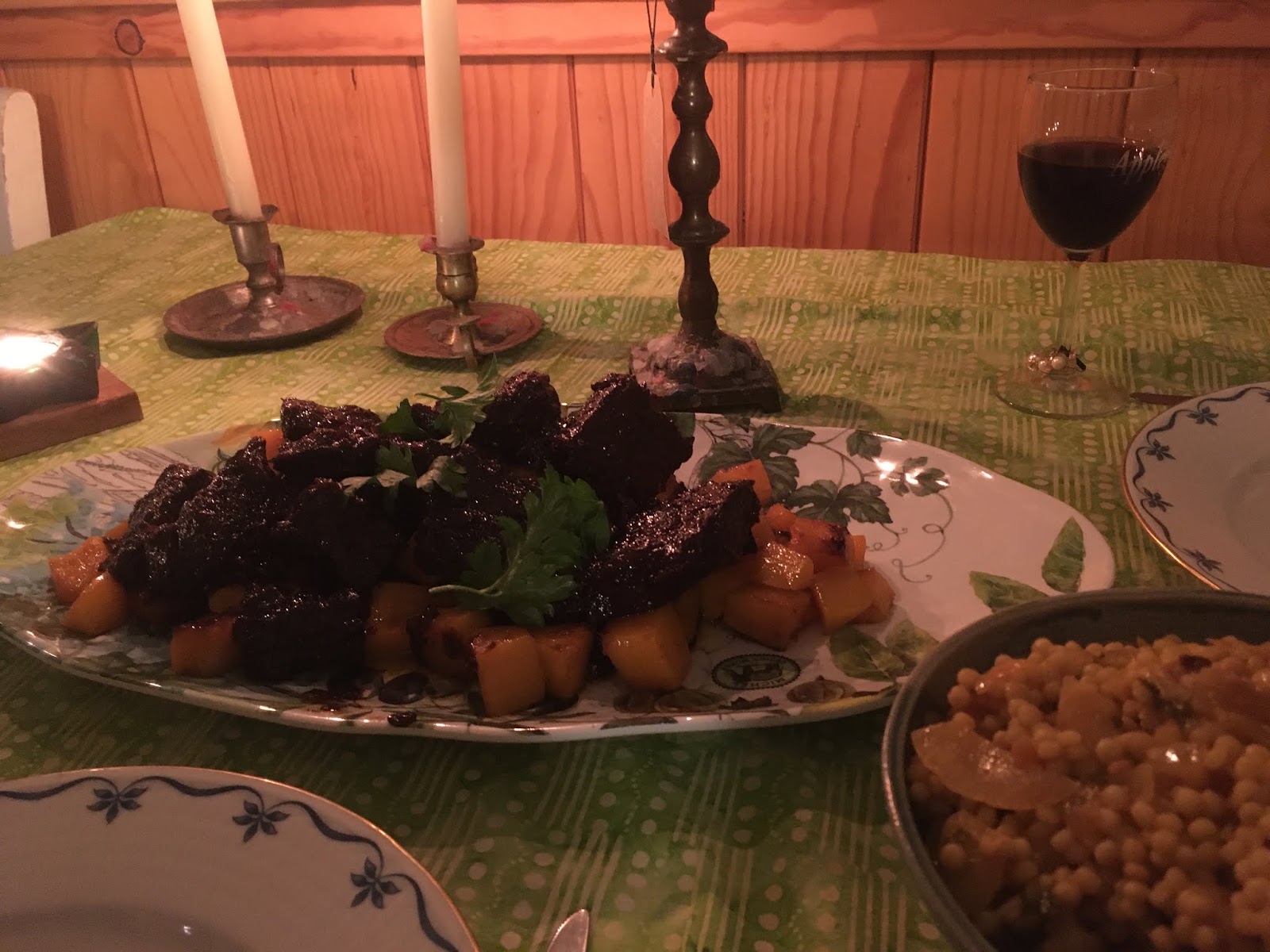
          We toasted "Merry Christmas" to each other. We took a moment to appreciate the beautiful food before us: the yellow-orange soup and the dark meat shining with its glaze of spices, juices, and broths on a platter of dark orange, honey-glazed butternut squash in front of a bowl of couscous pearls flecked with mint.
 And then we ate.
          It was utterly delicious. The soup was silky smooth and brisk with pumpkin and persimmon flavors. The tagine was dark and rich, flavored with cinnamon, cumin, all-spice, and ginger, perfectly complemented by the squash and minted couscous. 
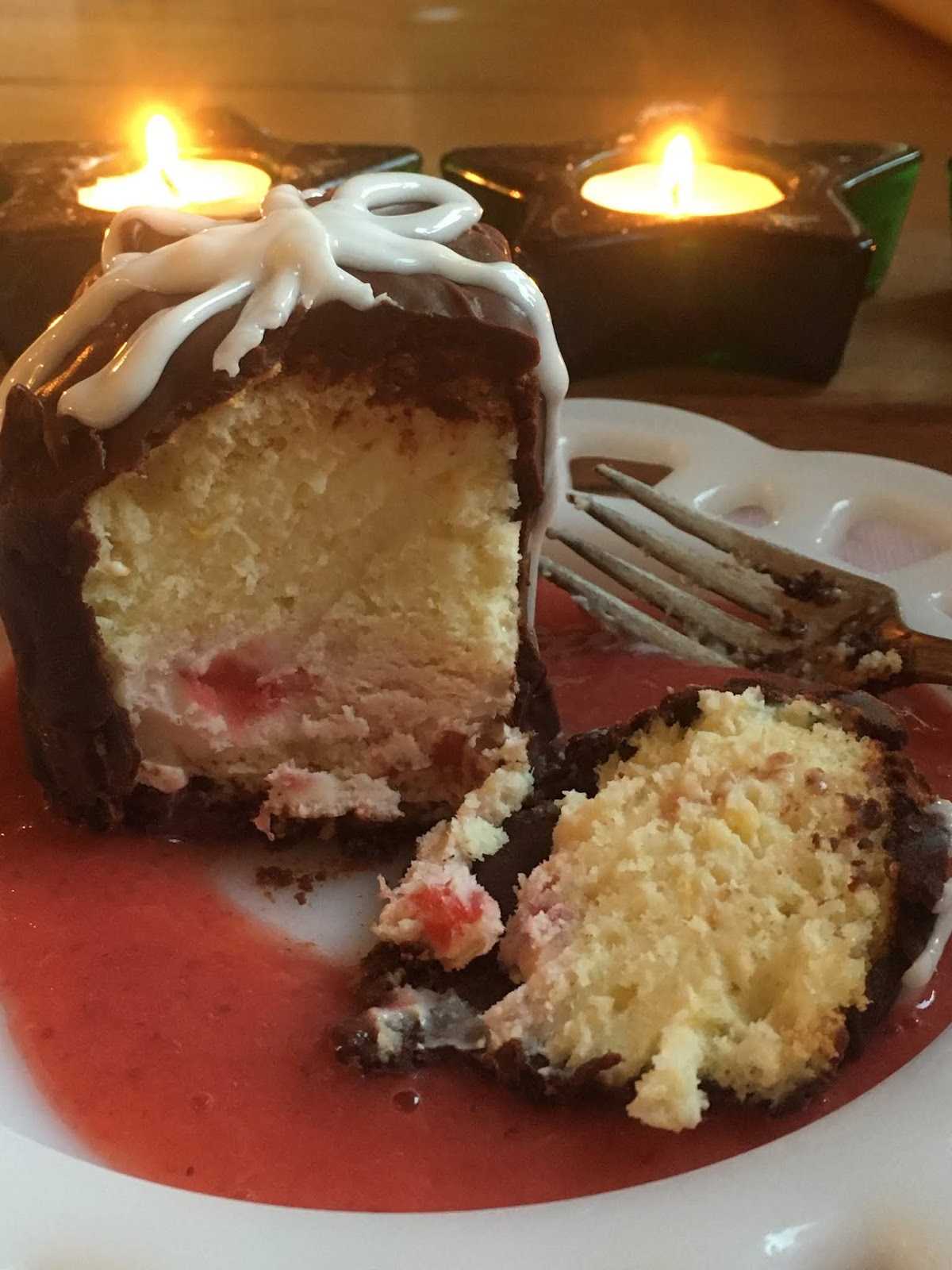
The piece de résistance was the dessert, little squares of cake, with strawberry ice cream and lemon curd sandwiched between cake layers, covered with a rich, brandy-laced chocolate ganache with strips of white icing made to look like ribbons on a package. They were superb.
          It was all superb. We had spent the day eating, drinking, and being merry. Our first Christmas together was a grand celebration.
          The after-dinner port was almost superfluous.

Thursday, December 19, 2019

There's More Than One Way to Decorate a Christmas Tree

          I've heard that the best thing an individual can do to counter climate change is to plant trees. Therefore, it seems that cutting a tree out of the woods for a Christmas tree would only add to the climate problem. One less tree equals that much more carbon in the atmosphere.
          But in my woods small evergreens bunch together in tight clumps and spend years of their lives struggling to outdo one another to rise to greatness, like the big trees around them. To free up the space around two or three of them would be to encourage their growth into the kind of big trees that do the most good for the environment. Therefore, when I take my bow saw and go into the woods to look for a Christmas tree, I look for an expendable tree whose departure from the forest will be good for the forest and for the planet.
          The result this year was that I came from the woods with a spindly thin tree on my shoulder. Of course, all wild trees are more sparsely limbed and leaved (needled) than trees on a Christmas tree lot, but my tree this year is especially flimsy. Most of the ornaments would have to go close to the trunk if they weren't to weigh the branches to the floor. Even ordinary glass balls would be too heavy for these scrawny branches.
          My mother used to say, every year when I was a child, "Let's organize the ornaments by color this year." Every year the children, stuck in tradition, as children tend to be, would ignore her and place the well-loved ornaments anywhere they wanted. But my mother's boldness to try something different encouraged me to do the same. When I set up my Christmas tree and saw how skimpy and delicate it was, I thought, "The only way to make this tree work is to use paper ornaments," something I had in abundance after making seventy-five origami ornaments as one item for my 75x75 project (see thingstodoinmy75thyear.blogspot.com)—even after giving at lot away at my seventy-fifth birthday party. Besides, I still had the origami ornaments my son and I made when he was a child (those forty-year-old ornaments) and the stars and polygonal paper balls he made in sixth grade. With those, Christmas lights, and tinsel, I thought I could deck the tree with holiday cheer.
          It worked beautifully. 

Paper cranes are the most numerous ornaments, but sparrows, roses, lilies, frogs, butterflies, and crabs also hang on the branches, in addition to a couple of rabbits, a reindeer, a sailboat, two elephants, a giraffe, a peacock, a bear, several pinwheels, dragonflies, a swan, and a whale.
There are paper stars and ribbon stars and pointy polygon paper balls, a red-and-white one and a blue-and-white one. Ornaments are made form glossy colored paper, double-sided colored paper, and plain origami paper of all colors placed haphazardly on the tree (no attempt at color coordination). Limbs hardly notice the weight. They stay uplifted and light. Tiny white Christmas lights sparkle evenly around the tree. For the final touch, tinsel dangles from the tip of every limb.
          The tree is delicate and lovely. The tinsel sparkles and twinkles; the ornaments dangle with dainty appropriateness. Every morning when I wake up, I plug in the lights and am enchanted all over again.
          I am free to feel enchanted because I'm not weighed down with the guilt of cutting down a tree necessary to the forest. And I can agree with my mother, too: there's more than one way to make a Christmas tree beautiful. Next year maybe I'll try the color theme.

Thursday, December 12, 2019

How Old Does One Have to Be to Learn Social Skills?

        One of the items on my list of seventy-five things of seventy-five repetitions each that I set myself to do before my seventy-fifth birthday (see thingstodoinmy75thyear.blogspot.com) was to have conversations with seventy-five strangers. This was not an easy task for me. I'm genial enough, on the whole, but I don't have the social skill of some admirable people who can seemingly talk to anyone and make that person feel comfortable and interesting. I'm better at it than I was as a kid, especially after my seventy-five conversations with strangers last year, but it still takes an effort.
         Apparently, though, some people simply have that skill by virtue of who they are. A six-year-old, for instance, hasn't had time to develop the awareness of social skills. A six-year-old just is who he is. I think I might be able to start a conversation with a six-year-old because I'm pretty good with children, but, basically, my fallback position is not to say anything.
          Therefore, after an excursion during the Thanksgiving holiday with Mike's family (see last week's post), when I found myself standing in the open door of the car next to six-year-old Morgan, who was already in his car seat, I was just waiting for everyone else to straighten out their gear and put things in the car and find their places. I wasn't thinking about starting a conversation. But affable Morgan took advantage of the moment to say to me, "I noticed that you like to knit. What other crafts do you like to do?"
         I was astonished. It was a surprisingly mature way of relating, not only to observe that I had been knitting during the weekend but to transpose that observation and make the reasonable assumption that I must also do other crafts—and then to use that knowledge to start a conversation!
          I recovered from my surprise fast enough not to lose the relationship opportunity Morgan was offering, but not so smoothly that I could answer appropriately. The first thing that came to mind was that I liked to sew, so that's what I said, but if I had thought more clearly, I would have realized that that wasn't likely to lead to the conversation Morgan wanted to start. He stumbled for a minute trying to find a response, so I quickly added that I liked paper crafts, too. Morgan brightened. There was a conversational gambit he could hang onto! He said he liked to make origami. I had just finished making seventy-five origami ornaments (for the 75x75 project), so we had a nice little conversation about what we had made and what was most difficult or most fun.
          He's just a kid. His social sills with his sister and cousins are no better than those of any other child's. He fights and teases; he plays tricks and wants another child's toys. So how had he already developed such easy social skills with adults? He's like his grandfather and his father, who both have that conversational ability, so it must be an inherited trait. (My father, for instance, was notorious for not being able to make small talk.) I think it is a beautiful trait. If Morgan demonstrated how easy it is to start a conversation with a stranger (just pay attention and make connections), he also showed me how valuable it is. Having had that small interaction with Morgan, I'll feel like we're friends when I see him again. And maybe, having been tutored by example, I'll be able to find the conversational opener myself that time.

Thursday, December 5, 2019

Being an In-law

        Being married, I see now, brings with it certain obligations. I am now an in-law. When Thanksgiving plans turned out to be four days with Mike's two daughters and their families—a husband and two children each, plus the daughters' mother (Mike's ex, as one might say)—on Tenmile Lake, up the Oregon coast, I left my little house on the mountain and its eight inches of new snow (!) to spend the holiday as an in-law.
        In the Coogle family my three brothers-in-law and one sister-in-law were known as "out-laws." I thought it was an apt term because we were a tight-knit family, with shared in-jokes and a boisterous way of being together that bespoke decades of knowing how to relate to each other. Now, finding myself suddenly inside another such family, I could sympathize with being an "out-law."
        There was, for instance, a lot of family talk at the house on the lake: reminiscences of the girls' growing up on the commune in the Applegate, talk about what their classmates were doing now, memories of vacations together. There were the family jokes: teasing Dad (that would be Mike) for not liking mashed potatoes for Thanksgiving, good-natured ribbing between the sisters. I listened and observed and enjoyed the interactions from the outside. I was "in" the family "by law" and felt completely a part of the Thanksgiving holiday, but I was, like Bruce, Billy, Jack, and Linda, an outsider all the same.
         Of course, I could hardly realistically fulfill the role of mother-in-law (stepmother-in-law, really) to Mike's daughters, for instance. The term had no meaning in the reality of these two grown women, mothers of two children each, with their own mother fulfilling every role that a mother at that time should. Instead, I related to my new (step)daughters-in-law by admiring Zoey's imaginative activities with the children—the crafts she brought, the scavenger hunt she organized for our walk through the forest—and praising Allegra's excellent cooking and handling of the kitchen. For Thanksgiving dinner we had a delicious smoked ham, accompanied by all the Thanksgiving dishes (except cranberry sauce, which wouldn't go well with ham), as well as Russian vegetable pie, a family favorite. We would have had apple and pecan pies in addition to the banana, pumpkin, and chocolate pies except that the night before Thanksgiving mice helped themselves to those two pies, which had to be thrown away. In a twinkling Thanksgiving morning Allegra's and Zoey's mother had made a peach pie and Allegra had made a pumpkin cheesecake to take their places. Smoked salmon and cream cheese for hors d'oeuvres, home-reared lamb for another dinner, chocolate chip pancakes and coffee cake for breakfast—good things to eat kept rolling from the kitchen. Well-fed guests are happy guests. Allegra's guests smiled all weekend.
        I could also hardly manifest the role of stepgrandmother-in-law, new in the family as I was and no one special to Mike's four grandchildren, who ranged in age from four to eight. I was just another adult in the house, with no disciplining, game-playing, or book-reading privileges, although the children did give me good-night hugs before they went to bed. As with all children, I would have to earn their love and respect; I would have to prove to them my place in the family, what being G-Pop's wife meant to them, who I was and could be in relation to them.
         I did make inroads. They loved the black bottom (chocolate) banana cream pie I made for Thanksgiving dinner. Food is always a good way to make friends with a child, and I put checkmarks in the score box for that one.
        On the last day of the holiday I was sitting near the stove working a New York Times crossword puzzle on my computer. The kids were playing with their toys, rambunctiously, as usual, and underfoot, as always, since the house was very small with few places for escape. Then I realized that the oldest boy, Quincy, had left the children's games and was standing over my shoulder. He asked what I was doing. I explained how to work a crossword puzzle, and even though it was a pretty darn difficult puzzle, even for me, I started asking him for help with the clues. Then his cousin Morgan joined us, and as the three of us brainstormed words, Rosie, the four-year-old girl, just climbed into my lap and sat there while we talked about words. "What's another way to say, "'Good job'?" Someone suggested the Spanish words, but they didn't fit. "What were the Wonderland cake words?" "What do you learn in Boy Scouts?"
        It was a magical moment with the children. I kept them in that aura for as long as I could until the boys inevitably lost interest and wandered away and Rosie climbed out of my lap, and I was alone again. But for some long precious moments, grandmother-in-law was one of the world's sweetest roles.

Wednesday, November 27, 2019

Thankful for a Childhood in Nature

         This morning, the day before Thanksgiving, with eight inches of fresh beautiful white snow on the ground at my house, I'm thankful for snow. Its beauty in the silence of early morning reminds me how grateful I am for a childhood that taught me to use my senses.

        I was born on a California island, where the Pacific Ocean laid the cadence of its heartbeat over mine, but I spent a childhood in the South, where I learned to use my senses. The sense of smell, for instance, I learned to use on my grandparents' Kentucky farm—tobacco curing in barn rafters, barnyard manure of cattle and hogs, hay being baled in the fields—and at my home in the north Georgia woods, with the smell of sweet gum bark, sun warmed pine needles, and the heavy, damp moss I replanted in my secret rock garden. I knew the sweetness of wild azaleas from hiking on the Appalachian Trail, the fetid thick smell of the Okefenokee Swamp from canoeing there, and underground dankness form spelunking in Alabama caves. Now on the mountain where I have lived for almost five decades, I know the vivid fetid smell of Oregon grape blossoms, the vanilla smell of Pondrosa pine, the pungency of incense cedar, and the acrid stink of the stink bug.
          In my childhood my mother taught me to belong to the land by naming what I see and hear: a green figure in a green sheath—a jack-in-the-pulpit; a flash of red in a dogwood tree—a cardinal; a three-syllable whistle from the woods at dusk—a whippoorwill. From those lessons I learned to name my neighbors in nature on my mountain in Oregon: shooting star, pedicularis, ox-eyed daisy, Applegate paintbrush. I know the meadowlark's trill, the drumming of grouse, the whir of a rufous hummingbird in my honeysuckle. I know the barred owl sweeping through the firs, the great blue heron flying into my swimming hole, and the osprey splashing into a lake to rise with a fish.
          When my sisters and I caught a chameleon, my father showed us its color-changing magic. When we brought home from the woods a black and yellow, hard-shelled creature we called a turtle, he explained why it was a terrapin. When bees swarmed on a tree limb, he wiped them bare-armed into his hive, telling us, "Swarming bees don't sting." He taught us to recognize copperheads, black snakes, and garter snakes, to walk unafraid in the woods. Today, therefore, I honor the bears and cougars in my woods, the snakes in my garden, and the bats at my house. I swim in the cold mountain lakes of the wilderness as much at home as newts and dragonflies.
         During the barefoot summers of my Georgia childhood, I tread lightly on the earth, recognizing thorns and caterpillars before stepping on them, squishing my toes in the mud of warm summer rains. Here on the Oregon mountain, my foot recognizes sharp pebbles, the pointed tips of oak leaves, and the hard carapaces of scorpions and stink worms before it crunches down.
          After a childhood in the South, I returned, like migrating salmon and monarch butterflies, to the place where birth rhythms called—to the West Coast. In this almost half-century of living here in the Siskiyou Mountains, I have had reason, time and again, to recall these lessons of that childhood—lessons of nature and of the senses—and to be grateful for them, as they have been the foundation of my life.

Thursday, November 21, 2019

Isn't It Supposed To Be Winter?

        I hate to be curmudgeonly. I'm not a grump, really. I generally have a bright outlook. I've been called a glass-half-full person. So I've tried, not very successfully, not to complain about this gorgeous autumn weather everyone says we're having. And it has been, really. Glorious hiking weather, and I've taken advantage of it as much as possible. And I love it.
        For a while. Through, say, September, or even mid-October. But it's November, ye gods, and this warm, sunny weather has gone on and on and on. Will winter never come?
        Yesterday I went into the garden and found, to my great surprise, a rose bush with eight blossoms on it. That bush hadn't bloomed since I put it in the ground last spring, when it gradually lost all its blossoms and then drooped and sighed and languished until I finally got the right kind of irrigation on it (thanks to Mike's help), when it perked up but never bloomed again. Now it must have thought it was still summer (as well it might, since it can't read calendars, and determines summer by warmth more than by daylight hours, maybe), and so it put out midsummer energy and all those blossoms.

        They are a gorgeous deep pink, a rich sunrise color. I picked the two best blossoms and brought them inside, where I enjoy them as no curmudgeon ever could.
        But it's November, for God's sake. 
        Two days ago we did actually get some rain, slow and slight, but it was recognizably rain. Things got wet
        Now we're back to that everlasting sun, though the temperatures have, I am glad to say, dropped ten degrees or so. Actually, since I'm not a curmudgeon, I'll say that chilly sunny days are my favorite kind of November days. (A little colder would be even nicer.) But these days should come after days if not weeks of dreary, gray, rainy, drizzly, what most people would call miserable weather. After that, chilly sunny days are glorious, especially when there's snow on the ground and blue skies above. 
        We can enjoy this kind of autumn, but let us not be anthropocentric. We all need the rain, in whatever form it comes. I would give up these sunny November days for days of rain. Even my rose bush would be happy with a good hard rain.