Thursday, March 31, 2022

Cross-country Skiing in Alaska, Part 4: The Extras—Talkeetna, the Iditarod, an Old Friend

    The twelve of us on this Sierra Club outing (see previous three posts) gathered first at a hotel in Anchorage, then spent the next night in Talkeetna. I immediately fell in love with this tiny, heavily-snowed-in, historic town at the foot of Denali. We stayed at the authentically rustic Roadhouse Inn,

                                                                                        photo by Diana Coogle
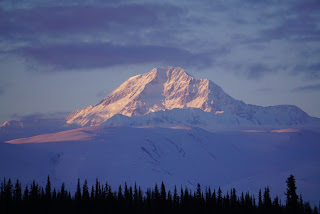
built in 1917, where backpackers and climbers of Mt. Denali often stay. Denali was out (as they say) the day we were there, shining majestically against a blue sky at the far end of the frozen Talkeetna River, with royal attendants Foraker and Hunter beside it.
                                                                                        photo by Patricia Carlson
L to R: Foraker, Hunter, Denali 
After a walk through the snow (floundering where the snow wasn't packed down),
              photo by Patricia Carlson
Rachel Shiozaki (one of our group) 
That's me trying to walk in the snow behind her.
some of us stopped in the Talkeetna Brewery for one of their renowned blueberry mojitos.
                                                                      photo by Patricia Carlson
Me with the blueberry mojito that matches my clothes.
That evening, we had the good fortune of a gorgeous sunset over Denali. 
                                                                                Photo by Natalie Schoeppler
     After five days of skiing at the Denali View Inn, we returned to Anchorage, driving in from the north. The setting was stunningly beautiful, the city tucked under massive, snow-covered mountains.
                                                                    photo by Patricia Carlson
The next 
day was the beginning of the Iditarod, with its ceremonial start in downtown Anchorage. 
    Snow fell steadily all day. Perfect! We ought to be seeing those sled dogs and their bundled-up mushers in snow. The crowd at the ceremony was jovial and well wrapped in Alaska-wise cold-weather outfits—fake furs, hats and mittens, blankets muffling babies in strollers.
Melinda, from our group, with man in Alaska wear
The dogs were excited. The 
owners and trainers and mushers were excited. The announcers were excited. The crowd was excited. This year was the Iditarod's 50th anniversary, so the mood was particularly buoyant.
    The dogs were eager for the race.
                                                                 photo by Louise Suhr
 Note the booties
They are, after all, athletes, and the mushers love them and take good care of them. Bret Sass, who won this year's race, also won the Vet's Choice award for his dog care in 2015 and 2019. His bio on the Iditarod website says he lives "with his dogs" (no mention of wife, children, or other human inhabitants) on a 1970s homestead in Alaska. PETA (People for the Ethical Treatment of Animals) had a small protest in the crowd at the race, but no one paid them any attention, and, really, it looked like they didn't have a leg to stand on when it came to the Iditarod's canine athletes.
                                                                                                photo by Louise Suhr
    After watching a dozen or so sled-dog teams dash off for Willow, Alaska, and the real, not just ceremonial, start of the race, I had had enough. Besides, I was having lunch with a friend whom I hadn't seen for many years, a native-born Alaskan who had returned to Anchorage many years ago after living in Oregon. Anna is a school administrator and a musician. When I walked to the brewery where we were to have lunch, she handed me two gifts: a couple of CDs of her music and a gorgeous Alaska hat—fake fur, of course, I'm glad to say, but warm and adorable with little ears on the cap, long extensions that I could wind around my neck as a scarf, and pockets at the ends of those extensions for cold hands. When I wore it into the restaurant, two different people said, "What a cute hat."
                                                   Photo by unknown passer-by
    I would love to have had it while I was skiing, but I wore it on the flight home so it could say, "See? I've been in Alaska!" It's spring in Oregon now, but I'm hoping it will be cold enough to wear this wonderful hat next winter—or maybe when I return to the Denali View Chalet. In the meantime, I like to see it, dangling its long scarf-like extensions, in my closet, a great remembrance of a wonderful time in Alaska, not only that lunch with Anna, but the Iditarod, Talkeetna, the Denali View Chalet, the Sierra Club group, and all that beautiful skiing in the incomparable landscape of the Alaska Range and Mt. Denali.

Thursday, March 24, 2022

Cross-country Skiing in Alaska, Part 3: Story-telling

     One afternoon during my stay at Denali View Lodge (see two previous posts), when people were relaxing in the living room after skiing, Eric, the chalet's owner, held up a book from the side table: "This is the Milepost," he said. "It shows mile by mile what there is to do and see on the Alcan Highway."

    I was just walking into the room. I stopped in my tracks.
    "I know the Milepost!" I cried, beside myself with excitement. "I was on the Alcan in 1959." People looked at me with dropped jaws. Most of them weren't even born in 1959. 
    I was in a frenzy of memories. "The whole family—five children and two parents—in a station wagon, from Atlanta, Georgia, to Fairbanks, Alaska, camping out all the way. It was the summer I turned fifteen, the year Alaska became a state." 
    The stories poured out faster than my tongue could tell them—how primitive the Alcan was in 1959, the Milepost such a small book compared to the volume Eric had. A flat tire on the way back to Whitehorse, then another within an hour, my father hitchhiking with the flat tire on a road where a car might come by once an hour. Being in the Fourth-of July parade in Anchorage in what the Chamber of Commerce had hoped to be a 49-car procession (we were the 46th and last state to show up). My mother collecting wildflowers everywhere we went and painting them at a picnic table at each campsite. Swimming in Muncho Lake, which stayed in memory for a long time as the coldest lake I had ever swum in. (I've been in colder since.) On and on. 
    I was only telling bits and pieces of stories, everything tumbling out too fast. But one story, the time my sister was bitten by a wolf, could not be truncated, so I told it in its entirety. My audience was enthralled. (I told this story on my blog on May 17, 2018.) 
    The next night Phil, the cook, matched the wolf story with his grizzly bear story, about being attacked in his tent by a curious young grizzly, who, Phil said, turned aggressive once he got in the tent. The bear had Phil's thigh in his jaws before a friend in a nearby tent heard his cries and came to the rescue with bear spray, which, on the third application in the bear's eyes, drove him off. 
Phil (right) telling his bear story
    Another evening I read my essay about cross-country skiing at Crater Lake from my book Living with All My Senses. I gave the book to Eric and Frédérique when I left, thinking that stories about living in a cabin without electricity would be a fitting addition to the books on the side table—bear stories, with Phil's story in it; a book about treehouses, with a chapter on the treehouse Eric built when he first came to Alaska; and the Milepost, among others.
    I'm not sure exactly how it came up, but on another night, after dinner, we discovered that both Phil and I knew, by memory, Robert Service's poem "The Cremation of Sam McGee," so he and I did a double recitation, each of us taking a verse in turn. It's an engrossing story about mushing with a corpse on the cold, inhospitable Dawson Trail. The rhymes and rhythms are spellbinding, and the end, with Sam McGee, revived at his cremation, happy to be warm again at last, is a sudden turn to humor. Reciting it there with a man who had been bitten by a grizzly bear, with the snow piled up beyond the window sills and my muscles still sore from the day's ski—it was a perfect blend of poetry, landscape, and circumstance.
    Come to think of it, all the story-telling was a perfect blend of poetry, landscape, and circumstance.

(I tell other Alaska stories in blog posts on June 30, 2016 [Fourth-of-July parade]; February 4, 2016 [wildflowers my mother painted]; and February 16, 2017 [stories about my two-year-old brother with us in Alaska.])

Next week: Cross-country Skiing in Alaska, Part 4: The Extras—Talkeetna, the Iditarod, and others

Thursday, March 17, 2022

Cross-country Skiing in Alaska, Part 2: Lodging and Company

    No matter how much I enjoyed the skiing during the Sierra Club outing "Cross-country Skiing in the Shadow of Denali" (see last week's post), the trip would never have been the success it was if the Denali View Chalet hadn't been so accommodating and the participants so compatible.

                                                                                        photo by Diana Coogle
Denali View Chalet

 There were ten of us plus two leaders,  and I could hardly have found a friendlier, more  harmonious group of people to hang out with for a week. There were five women from Washingtron State: Louise and Susan, Piera and Sonia, and Sonia's sister, Melinda, all terrifically good skiers; the assistant leader, Natalie, from Bend, Oregon, and her co-worker at the Sierra Club, Rachel, from San Francisco; two men— Howard, who was the trip leader, and John, two years younger than I, also a terrific skier; and the two women I roomed with, Carol, who is an ophthalmologist, and Patti, who has made some amazing and impressive solo backpacking excursions.
    Patti and Carol were excellent roommates in a small room with two single beds and a bunk bed. We all kept our belongings neat, respected differing sleep patterns, didn't complain about night sounds, and enjoyed chatting and exchanging stories from our lives. Everyone in the group was respectful, cheerful, and both interested and interesting. Though none of us ever talked politics (why would we?), when Natalie fulfilled one of her tasks as assistant trip leader by informing us of an important environmental issue in Alaska (Conoco's Willow Project), no one hesitated to write BLM in protest, using the cards Natalie thoughtfully provided. Every person I skied with was a great ski partner.

                                                            photo by Louise Suhr
Front to back: Piera, Carol, me, Patti, Rachel
    This coterie was filled out by our cook, Phil, and the owners of the Denali View Chalet, Eric and Frédérique. You can imagine all there is to do to run a lodge in the Alaska wilderness, inaccessible by road. The shoveling of snow off the front entrance. Small electric lights by solar energy (in Alaska?!); a huge wood-burning stove that heated the entire chalet. No bathroom, just an outhouse—guests and residents alike walk through a deep snow-cave to get to it.
                                                        photo by Diana Coogle
The outhouse. Note the steps down through the snow.
    There was a sauna down by the lake. Every afternoon Eric started a fire in its stove so it would be hot when everyone was back from the day's ski. There was also a shower next to the sauna, but instead of jumping in the shower, I preferred rolling in the snow after working up a good sweat.
                                                       photo by Patricia Carlson
I'm skiing on the frozen lake. The sauna is directly in front of me.
The long trail to its
right leads to the chalet, at the top of the bluff.
    No chore seemed too demanding for Eric. No task exhausted him. He did everything with ease and pleasure.
    Phil, the cook, was equally pleasant. He kept the kitchen immaculate. He had snacks on the table for us for each day's excursions and hors d'oeuvres before dinner. The food was excellent—chicken marinara, real strawberries in the fresh-spinach salad, slices of cantaloupe (in Alaska! How times have changed!), always something for dessert.
                                                                                            photo by Louise Suhr
I had thought maybe I would lose weight during that week due to all the exercise I would be getting, but I hadn't factored in the counter-balance of such good food—and of the worked-up appetite!
 
    Meals were served at two tables. I liked it best when Eric or Phil joined the table where I was sitting so I could hear their stories and ask questions about the chalet and Alaska.
                                                                                           photo by Patricia Carlson 
I am in front. L-R, clockwise from me: Sonia, Carol, Louise, John.

Phil is at the head of the other table. From him, L-R, clockwise:
Susan, Piera, Howard, Rachel, Natalie, Melinda, Eric (chalet owner).
    Built in the 1970s by Sepp Weber, who is in his nineties now and still skis in occasionally, the chalet is a model of precision and craftsmanship.
                           photo by Patricia Carlson
The ladder to the upstairs bedrooms
with a carved moose behind it
    It was easy to understand how things worked. When you came back from a ski trip, you stuck your skis in the snow at the chalet entrance.
                                                                                        photo by Patricia Carlson
You took off your boots in the mud room and hung your coat on the coat rack inside the chalet. On the other side of the coat rack was a small alcove with a basin at one end and an on-demand water heater—for washing faces and brushing teeth. Immediately in front of you was a ladder to three small upstairs bedrooms. (Phil has a tiny room off the mud room—Sepp's room, for Sepp when he is there. Eric and Frédérique sleep in a tiny room behind the ladder. There were also two cabins close to the chalet.) In the main room was a sitting and lounging area, two large dining tables, and a kitchen alcove. Above the wood-burning stove was a circular device with clips for hanging wet gloves, gaiters, and hats. A large pot of water stayed on the stove for hot water for doing dishes. Every detail had been considered.

                                                                                        photo by Patricia Carlson
Frédérique facing the camera. Phil with back to camera.
Kitchen to Phil's right.
    Chickadees and woodpeckers flew constantly around the bird feeder near one of the windows. Someone was also keeping the feeders full of seed.
    Everything ran so smoothly it was easy to forget how far from "civilization" you were except there was all that snow out the window and, on a small side table, books about Alaska.
    True to its name, Denali View Chalet is perched on a bluff overlooking now-frozen Koto Lake. To the right and above the lake, visible from my bedroom window, rose Denali, absolutely stunning.
                                                        photo by Diana Coogle
    Denali is the highest mountain in North America, but if mountains were measured from base to summit, instead of from sea level to summit, Denali would be the highest mountain in the world. I felt the deep privilege of being in her presence for a week, likewise of being at the chalet for a week and of being with such a great group of people.

Next week: Cross-country Skiing in Alaska, Part 3: Story-telling

Friday, March 11, 2022

Cross-country Skiing in Alaska, Part I: The Skiing

                                                                                    photo by Patricia Carlson
Three of the skiers on the Sierra Club cross-country
ski trip  in Alaska. I am the skier in front.

 
    I have just come home from a week of cross-country skiing in Alaska, with eleven other skiers on a Sierra Club trip. How strange it is to see yellow daffodils and pink-blossoming fruit trees after living in that stark, black-and-white—spruce-trees-and-snow—incomparably beautiful landscape of the Alaskan wilderness.

                                                        photo by Diana Coogle
    Sometimes the only color in that black-and-white world came from skier's garb. Sometimes that world was bathed with color from a blue sky or at sunset or sunrise. 

                                                                                    photo by Patricia Carlson
Sunset, as seen from the chalet

    The skiing, "under the shadow of Denali," as the brochure put it, was magnificent. Denali, North America's highest mountain, was stunning. When she threw off her cloud cape, she glowed white in the day, pink in the sunset. 
                                                                                            photo by Louise Suhr
Denali at sunset, as seen from the chalet

 I skied alongside birch woods and across open plains stretching so far I marveled at Alaska's vastness. I herring-bone-stepped up steep small hills and glided ecstatically down. 
    It was a world apart, those days at the Denali View Chalet, a world where a Russian war on Ukraine, a rampage of COVID, hate and enmity didn't exist. The only aggression might come from the moose who, we were told, were bad-tempered because they are hungry and tired of heaving their large bodies through the deep snow. They are apt to be mean, we were warned in a tone of understanding for the moose's plight at this time of year. 
    My pre-trip anxieties dissolved quickly. The rented boots fit fine. I skied nine miles to the lodge without difficulty and was rewarded with a mug of hot mulled wine. Classic cross-country skiing, in set tracks,
                                                            photo by Diana Coogle
Here you can see, to the left of the trampled snow,
 the wide path cut by the sled, with ski tracks inside it.

was a great deal like the back-country skiing I usually do, and I saw at once that we would have skied very few miles if we had been breaking trail through all that deep snow! I learned new techniques and new terminology for climbing hills when I couldn't place my skis wide enough to herring-bone up them: I could either take off my skis and post-hole up (digging holes with every step) or army-crawl up, on my hands and knees, with my skis in one hand, poles in the other. 

    Coming down was heavenly. 

    Mostly, though, we were skiing on the flat,

                                                            photo by Diana Coogle

—not my best kind of skiing, but, still, I skied nine miles the first day, then six and a half the next, eleven the next, seven the next, and on the last day nine miles back to the trailhead. I skied over vast, snowy fields; at the edge of birch woods; under a blue sky dominated by Denali and the other peaks of the Alaska range, and through magical snowfall.

                                                                                    photo by Patricia Carlson
Skiing in snowfall. I am behind Carol.

Over and over again, day after day, as I skied the trails, I said to myself, never quite beyond awe, "I am skiing in the Alaska wilderness!" It was that much a world apart.

Next week: Cross-country skiing in Alaska, Part 2: Denali View Chalet


Thursday, February 24, 2022

And Then It Snowed

      When I woke up to a couple of inches of snow at my house on Monday, I immediately offered to lead a Grants Pass Nordic Club ski trip to Summit Sno-Park in the Cascades between Medford and Klamath Falls. At first it looked like no one was interested, but I was going to go, solo or accompanied, because I needed to ski. I hadn't skied since the first of the year, and I needed to know I was ready for a week of cross-country skiing, classic style, in Alaska next week.
    At the last minute, three other people joined me: Jesse, who has skied with the Club for many years; Monika, who is a hot-shot athlete and does a lot of downhill as well as backcountry skiing; and Monika's mother, Elsa, who is 82 years old and grew up on cross-country skis in Norway.
Monika, Elsa and me
    The snow doesn't come any smoother and more perfect than it was on Tuesday. Our skis slid along the trail with perfect ease.
I am in front, Jesse behind me
We skied a long way up the road, then turned into the forest and skied through the big firs to the shelter built by the Rogue Group Sierra Club, Grants Pass Nordic Club, and Southern Oregon Nordic Club in the 1960s, a good place to sit down and have a bite to eat—and a sip of the firewater Elsa had brought to share.
Jesse in front of the shelter
    We took a different trail on the way back to the sno-park, down the mountain through the trees, down hills with smooth loop-de-loops and up hills that required step-climbing.
Elsa skiing through the trees
We were following blue diamond signs tacked to trees to stay on the trail. At one point, the blue diamond had an arrow pointing to the left, so we turned there, alongside a tree plantation. I don't have a good sense of direction, but I didn't remember skiing past a tree plantation at Summit before. Monika said, "This doesn't feel right. This is entirely the wrong direction." So we turned back to the blue diamond with the arrow, which Elsa looked at more closely and discovered, as she had suspected, that the bottom of the sign had come unnailed and the wind had turned the arrow the wrong direction. Back on the trail, we skied easily and smoothly back to the car.
    Monika figured we had skied six and a half miles. I will have to ski nine miles the first day in Alaska. Did I feel like I could ski another two and a half miles? Well, yes, I thought I could do that. I would be tired, but I could do it. Monika pointed out that I had done those six and a half miles climbing hills up and down and that the classic cross-country skiing I'll be doing in Alaska will be flatter. Maybe six and a half miles in the Oregon backcountry equals nine miles skiing in tracks on flatter terrain. 
    I was going to ski again today, but I think I'm ready enough. Instead, I've spent a leisurely day packing my gear. I hope the snow in Alaska on Sunday, our first day of skiing, is as good as it was last Tuesday. When the snow is good in Oregon, the skiing couldn't be any better. The Alaska Range is sure to be spectacular, but the Oregon mountains are pretty beautiful in the snow, too.
Brown Mountain from our trail

Thursday, February 17, 2022

Is It Spring Already?

    In his poem, "The Peace of Wild Things," Wendell Berry talks about getting out of bed when "despair of the world" prevents sleep. He goes and lies down in the grass by a pond and lets the peace of wild things, "who do not tax their lives with forethought of grief," flow into him. He rests, he says, "in the grace of the world" and is free.
    I like to lie in the peace of wild things, too, but lately their peaceful lack of worry about the future weighs heavily on me. I feel not free but burdened with responsibility. Wendell's poem was published in 2012. Certainly we were aware of climate change then, but in the last decade my grief for the future has grown exponentially. 
     Last Saturday, hiking up the Little Grayback trail, I saw two shooting stars in bloom and a manzanita bush in full flower. Today as I walked up the mountain I live on, I saw pedicularis (elephant's trunks) already emerging. And birds are singing in the trees again. I have been seeing robins all winter. 
    Usually I rejoice at the signs of spring, but they bring little peace and pleasure to me now because it shouldn't be spring already. It's only the middle of February, for God's sake. Usually if signs of spring appear too early, I'm worried about a late frost. "No, no! Too early!" I tell the flowers and fruit trees. "It'll get cold again. Go back. Go back."
    But now I'm not worried about a late frost. I'm worried because it's all out of whack. Shooting stars should not be coming out in February. Birds should not be returning in February. Manzanitas always bloom early, but not this early. Spring in the middle of February? We haven't had winter yet. 
    Most of all, if it's so warm that the wildflowers are already out, what is going to happen to us in July? The snow that fell in southern Oregon in late December has miraculously stayed at the highest elevations, but, as my friend Janeen points out, usually the mid-elevation peaks would also have snow. This year they are bare. Temperatures in the 100s, drought, wildfire—how early, I wonder, will those summer plagues appear this year and how often?
    Not long ago scientists were predicting that the warming trends would be disastrously irreversible in however many decades, adding that it would probably happen even faster than they were predicting. But now even I feel the avalanche effect of climate change. It is here and now and it affects and will affect us all. If you don't have the wildfires of the west, you have tornadoes in the midwest, hurricanes on the east coast, floods anywhere, all with more ferocity than ever. California is seeing the worst drought in 1200 years. Florida is already beginning to drown. Island nations are losing land. The tundra is thawing. Even if you don't see climate change phenomena where you live (but you will), you will certainly feel the effects of all the people seeking new places to live as their homes become uninhabitable. 
    Thomas Berry (no kin to Wendell), says, "The human is that being in whom the universe comes to itself in a special mode of conscious reflection." We have failed our responsibility of being that consciousness. I want to go around apologizing, to the wild things who in their individual beings bring us peace, for what we have done to their world as well as our own.
 

Thursday, February 10, 2022

Cross-country Skiing in Alaska

    Looking through the Sierra Club catalog of national and international trips last fall, in my usual "if-only" daydreaming, I read about a cross-country ski trip in Alaska, billed as "in the shadow of Denali." 
    It sounded enchanting: Ski nine miles to the Denali View Chalet, "a true wilderness lodge," the web site says, with "rustic and remote Alaska charm," no road access, forty miles south of Denali. The Sierra Club group—twelve in all—would stay at the lodge for a week, skiing every day on a multitude of trails. The aurora borealis would be visible. There would be snow! The food, I was told, was to rave about, and there was a sauna down by the lake. The day after we returned to Anchorage would be the first day of the Iditarod, so we would be able to see that, too. 
    If only. 
    But why not? 
    I signed up.
    I was excited for months. In early winter I started preparing.
    Because my feet for years have slid around inside my ski boots, I thought I would ski better if I could find better-fitting boots, so I went looking. But there were no boots my size in the whole Rogue Valley and none even at REI nationwide. (It's a supply chain problem.) Finally, though, boots arrived, and I tried on a size 38 (too small) and a size 39 (too big). Okay, fine. I've been skiing with my current boots for years. They'll do.
    The trip information sheet said to check with the trip leader if we wanted to bring our own skis, so I sent her the specs for my skis and asked if I could use them. She said I could. 
    Then I watched an REI seminar on cross-country skiing and found out that the skiing I love is called backcountry skiing. (I had thought I didn't do backcountry because I don't use skins.) Cross-country skiing is skiing in set tracks over groomed trails. That's not the skiing I do.
    Then the trip leader injured her leg and had to quit the trip. The new trip leader told me there was no way I could use my own skis because we would be cross-country, not backcountry, skiing, in tracks. My skis were too wide for the tracks. They would get stuck in the snow. 
    I was dismayed. I don't even like skiing in tracks. I like skiing through the woods, figuring out how to manage obstacles, snowplowing down steep hills. Can you even snowplow in tracks?
    Now I was panicked because I would have to rent cross-country skis, boots, and poles, and my feet are so hard to fit! What would I do if I got to the rental shop in Anchorage and the boots didn't fit? To minimize the possibility, I tried on boots for classic cross-country (not backcountry) skis at a local ski rental shop. Size 38 was definitely too small. Size 39 would do. It would have to do. I would take lots of moleskin.
    I made a reservation at REI in Anchorage to rent cross-country (not backcountry) skis, boots, and poles and breathed a huge sigh of relief. I wouldn't have to sit in the lodge while everyone else went out on the trails, after all. I would be skiing, too. And who knows? Maybe I'll like cross-country skiing.
    My excitement has returned. I'll be in the snow. I'll be skiing, and it'll be a new adventure. I'll see the aurora borealis. I'll eat the good food of the Denali View Chalet. I'll sweat in the sauna by the lake, then roll, steaming, in the snow. I'll ski under the massive peaks of the Alaska Range—Denali, Foraker, Hunter. Oh, doesn't it sound fantastic! I can't wait.