Friday, October 7, 2022

Watching the trees

     I am generally a pretty even-keeled person. There's not a lot that storms my boat.
    But watching trees die distresses me no end. It's happening all over Southern Oregon and is especially noticeable in our Ponderosa pines. Everywhere, Ponderosas are turning brown. It's true that the pines lose needles at this time of year, anyway, but what I'm seeing goes beyond the normal cycle. The trees are dying. I wring my hands; I lament; I wail, and the trees turn browner and browner. Some are already but trunks and branches. I weep for the trees.
    I have a beautiful Ponderosa in front of my house. In winter frost etches the needles in silver. The sun sets every needle, every limb a-glimmer. In summer the sun slides behind the tree, shading the deck where I'm eating my lunch. The tree is the tallest in the view from my house, towering over the California live oak and apple tree in front of it and the madrone beside it. I have loved this tree for years. Its needles are browning, slowly, but there's still a chance it will live, given rain. But day after day goes by this October, and the sky is blue nd cloudless and the weather is warm.
    Caterpillars have invaded the madrone beside the pine. At first there was one nest on one branch; now four or five branches are webbed with nests. The tree looks weak, stressed.
    I have numerous California live oaks around my house, a species I don't see often in other places, much less at other homes. They are thick-leaved, sturdy trees and were seemingly invulnerable. Now, however, for the first time since I have lived on this mountainside, the leaves are turning brown. Oh, that just doesn't happen to these trees! I am so distressed.
   The trees on Humpy Mountain, my immediate view, seem dry and pale, even at that distance. 
    I have six or eight dead firs and pines close to my house that need to be taken down. Other neighbors and friends have talked about cutting down dead trees on their property.
    Drought. Climate change. 
    It distresses me beyond words, but all I can do is watch it happen, pray for rain (in my own way), and wish with all my heart that things would get better.

Monday, October 3, 2022

Hiking the Alta Via 1: Day 10, Second Half

From the rest stop at Rifugio Pian de Fontana to trail's end at La Pissa bus stop

    The original plan, last February, when we were planning this trip, was to take the exciting via ferrata route from Rifugio Pramparet and stay the last night at Rifugio Septimo Alpini before hiking out the next day. However, once we got to Italy and looked more closely at our material, we saw that hikers on this route had to have climbing gear and a guide. We tried to hire a guide and rent the gear, but in the end it was all too complicated and entailed too much extra hiking to try to meet the guide, so we gave up the effort and changed our plans to stay at Rifugio Pramparet the last night and do the long hike out on the last day. Yesterday's post gave a rendition of the first half of that last day. Now, at half-past noon, we were on the last leg of our hike on the Alta Via 1, from Rifugio Pian de Fontana to La Pissa bus stop, where we were to meet Bryan in his rented car.
Just setting off from Rif. Pian de Fontana. Photo by unknown stranger
    At first the downhill sloped gently across the steepness of the mountain. The vistas were open and stunningly beautiful.
                                                                        Photo by William della Santina
William was hiking fast, at his own pace at last, maybe already thinking about leaving for college the day after he got home. He was soon out of sight. Though Margaret could easily have been hiking with him, she stayed behind me. It was very kind; otherwise I would have been hiking by myself all day. (But, then, Margaret is a kind person.) 
William on the trail. Photo by Margaret Della Santina
    At one point on that long, gradual descent across the steep, open, grassy mountainside, we came across a little trailside box with a statue of St. Anthony of Padua, the saint of lost things. Margaret surmised that it was there for the shepherds to pray for the sheep that had fallen off the trail and were lost. It was easy to see how that could happen, the sheep rolling over and over down the steep, open hill with nothing to stop it.  
    Not much farther down the trail we passed a young hiker who had stopped for a rest. She was from Cincinnati and was hiking the Dolomites by herself—and in sandals. We went on by, but she soon passed us, going at a fast clip, and then passed William where he was waiting for us, and we never saw her again.
    William was waiting on a large boulder at a turn in the trail. I think he had taken a good long nap while he waited. I stopped there to put an elastic bandage on my ankle, which was feeling weak.
    And then on down.
    Forever down. 
    Rock trail, root trail, clamber trail. Down and down. Finally we were at the last rifugio on the Alta Via 1, Rifugio Bianchet, which, like Pian de Fontana, looked pretty deserted. I took off my boots for our 15-minute break, then put them back on for our final descent.
    Now we were on a gravel road,
Going down the last road. Photo by Margaret dell Santina
which descended gently at first, much to the relief of my feet, but then it got steeper. Steep short-cut trails through the woods cut off some of the switchbacks of the road. Everything went down. My feet were hurting so badly by now they were affecting my pace. I simply could not walk any faster, no matter how late we were. The ace bandage had steadied my ankle, but the toes, the toes, the toes! The pounding on the bottoms of my feet. How my feet hurt! And the more they hurt, the slower I walked. There was no help for it. I could keep on going, but I couldn't go faster.
    I distracted myself by taking note of the beautiful landscape—the green-leaf trees, the perpendicular stone cliffs, the plunging river canyon. After the thousands of feet we had descended from the high country, how could there possibly still be such sheer drops hundreds of feet down?
    With only a mile or half-mile to go, the trail left the road completely and dashed impatiently down the hillside. By the time I stumbled down the last rock-and-root bit and joined William at the road—Margaret immediately behind me—it was 6:00, and we were an hour late. There was no bus stop and no Bryan and lots of whizzing traffic. I set my pack on the pavement, sat down on it, took off my boots, and stretched out my legs. Oh, the relief to my feet! Then I joined the consultation about what to do. 
    Finally William decided to brave the traffic and walk up the road, where he discovered the bus stop, which was only a wide place in the road. Bryan wasn't there. William came back to us and, on a miraculously functioning phone, contacted his dad and sent the coordinates of where we were. Then he, too, got off his feet while we waited.
                                                                        Photo by Margaret Della Santina
Twenty minutes later Bryan pulled up in his rented car.
    In 2016 Mike and I ended our hike on the Alta Via 2 at the last rifugio. It had been a hard last two days,—11 or 12 miles each day, with several climbs up very steep, long passes—but when we got to the rifugio, exhilaration trumped exhaustion. We did it! We hiked the Alta Via 2! In congratulations the owner gave us a beer on the house. The next morning we made a short, easy hike to the bus stop still in the glow of our achievement.
    Now, at the end of the AV 1, I felt no exhilaration, only relief to be able to take off my boots. On this last day we had hiked 10.6 miles, climbing 3000 feet and descending an amazing 7,700 feet. We had been on the trail for nine and a half hours and on our feet, walking, for eight and a half hours. My feet were telling me that that was enough. 
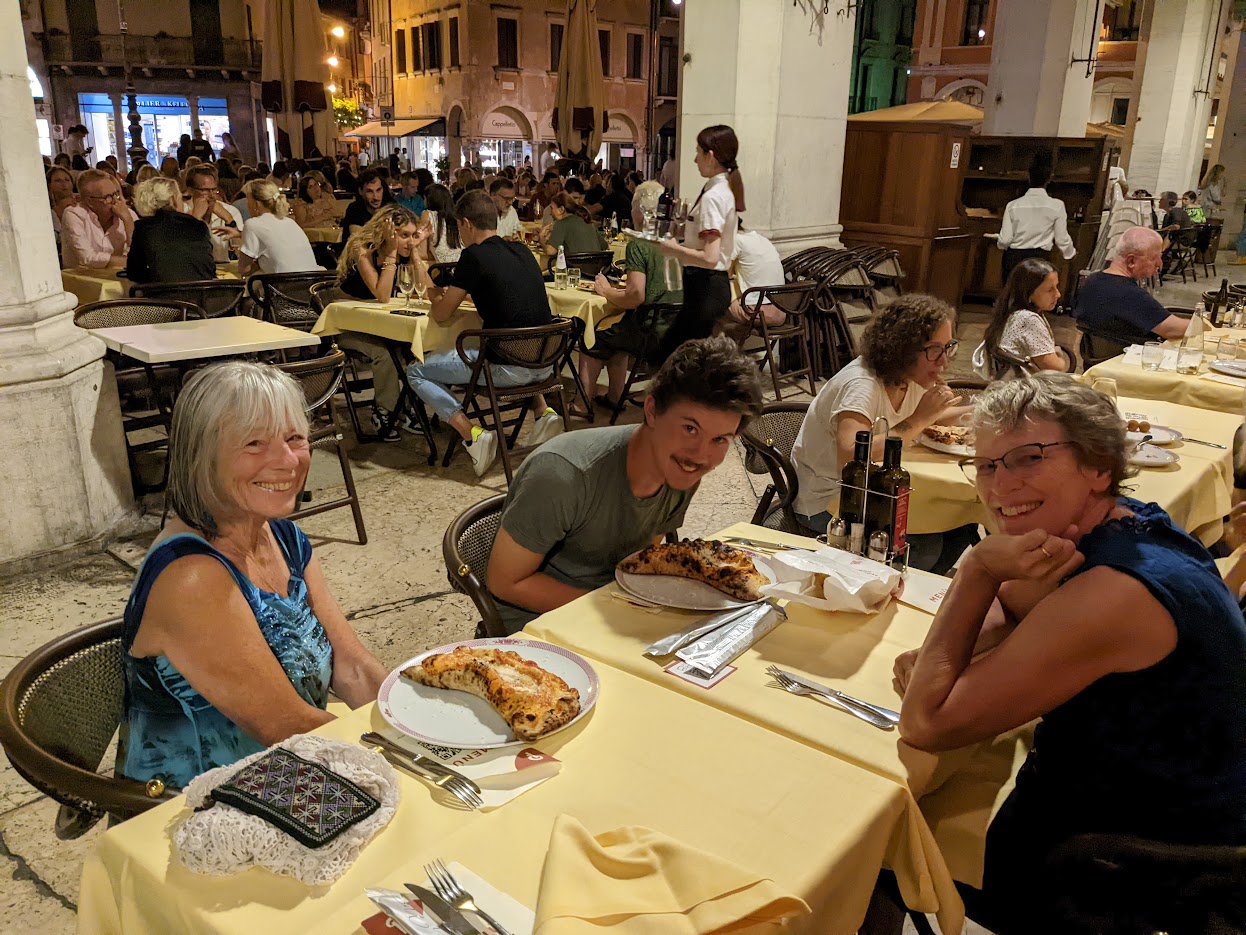
    And then when we got in the car with Bryan, there was so much to tell that somehow it didn't get told. And then we were in Treviso for the next three days, in a different kind of adventure, experiencing Italian cities, eating in outdoor restaurants, seeing churches, walking through streets.
                                                                                Photo by Bryan della Santina
The Alta Via 1 was tucked away in my memory 
somewhere, inaccessible, remote. 
    Finally, at home, rereading my journal and writing these blog posts, I began to retrieve the trip from my memory. The glorious mountain vistas. The steep climbs. The rifugios. The people we met. The challenges we faced and the joy of facing them. The strength of the body. The willingness of the feet to step into boots every morning, no matter how much they had hurt the night before. What great hiking partners Margaret and William were. How grateful I am to have been able to hike the Alta Via 1 with them.  How much I love the Dolomites. 

Sunday, October 2, 2022

Hiking the Alta Via 1: Day 10, First Half

From breakfast till noon: Rifugio Pramparet to a rest stop at Rifugio Pian di Fontana

     Anxious about the long day ahead, I was ready to eat breakfast and leave our rifugio long before breakfast was served. I sat at an outdoor table and read from my Kindle while the rough-looking climbers were milling about, putting on gear. To my delight, the black-and-white cat from yesterday's walk jumped into my lap and stayed there till breakfast was called.
                                                Photo by William della Santina
    We left immediately after breakfast, retracing our steps to the trail junction, and then starting the third of my favorite climbs. (The other two were the long steep climb to Lagazuoi on Day 3 and the steady switchbacks on the mule road to Rifugio Coldai on Day 6—oh, but I should probably include the rocky climb to the clouds of Nuvolau, too.) Today we were going up and up, not with switchbacks but on an angled, upward trail, mostly rock, across a mountainside,
Margaret coming up.                     Photo by William della Santina
then more steeply up an open-faced mountain slope, and, finally, at the top of that, up a very narrow spine, hand over hand, no poles. I followed William up, lickety-split, no problem. It was superb.
    Or that's the way I saw it. William and I waited at the plateau while Margaret and the man with the camera equipment, whom I mentioned on Day 5, waited a long time at the top of the climb for his wife. (On Day 5 I commented about the way he apparently ignored his wife, who, we found out later, was a having a hard time because she was afraid of heights—in the Dolomites, of all things!) When the man's wife finally appeared, he gave her a high-five and then a kiss.
                                                                            Photo by Margaret Della Santina
I decided he wasn't mean to her, after all, and that I shouldn't make judgements about people when I don't know their circumstances. And I was impressed with this woman for hiking in these steep mountains when she suffers from acrophobia and especially for making the narrow-rimmed climb she had just done.

    Somewhere before that tricky climb, somewhere on an upward, rocky part of the trail, I spied a rock I wanted to take home in honor of Mike. From every trail where I've scattered his ashes—the AV 1 is the 59th place—I have tried to bring home a rock. (Sometimes, for instance, on a cross-country ski trail in the snow, it was impossible to find a rock.) Those rocks outline my Zen garden. The one from today's trail was maybe too heavy to be practical, but it was beautiful, and it went in my pack.
                                                                             Photo by Margaret Della Santina
    After the hand-over-hand pull up the spine, the trail was still climbing, amazingly enough. Then it started dipping—steeply. Then more steeply, through grass-and-scree hills. Suddenly William cried, "Chamois!" I looked up to see a large herd of these goats of the Dolomites, grazing not on the grassy part of the hill but in the scree. We counted eight of them, spread across the hillside. We were close enough to see them well—how large they were, their dun or darker brown coats. Since chamois are supposedly shy, it was thrilling to see so many at once and for as long as we wanted.
    At the top of the next short rise we saw a sign, the only one of its kind on the Alta Via 1: "Warning. Steep and dangerous descent." I wondered what the people who posted the warning thought anyone would do at that point, since there wasn't really any alternative except to go down. So, okay, down we went.
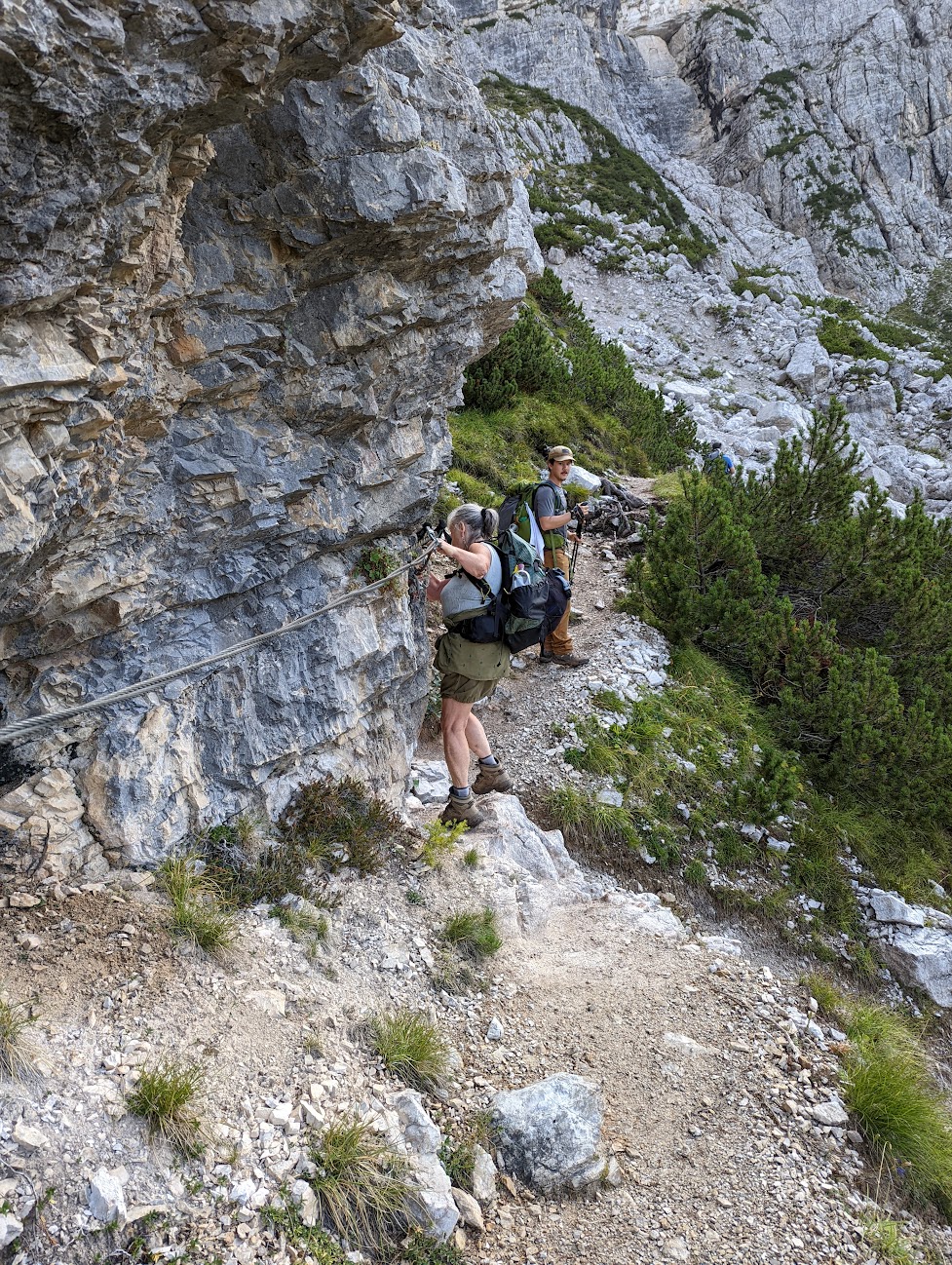
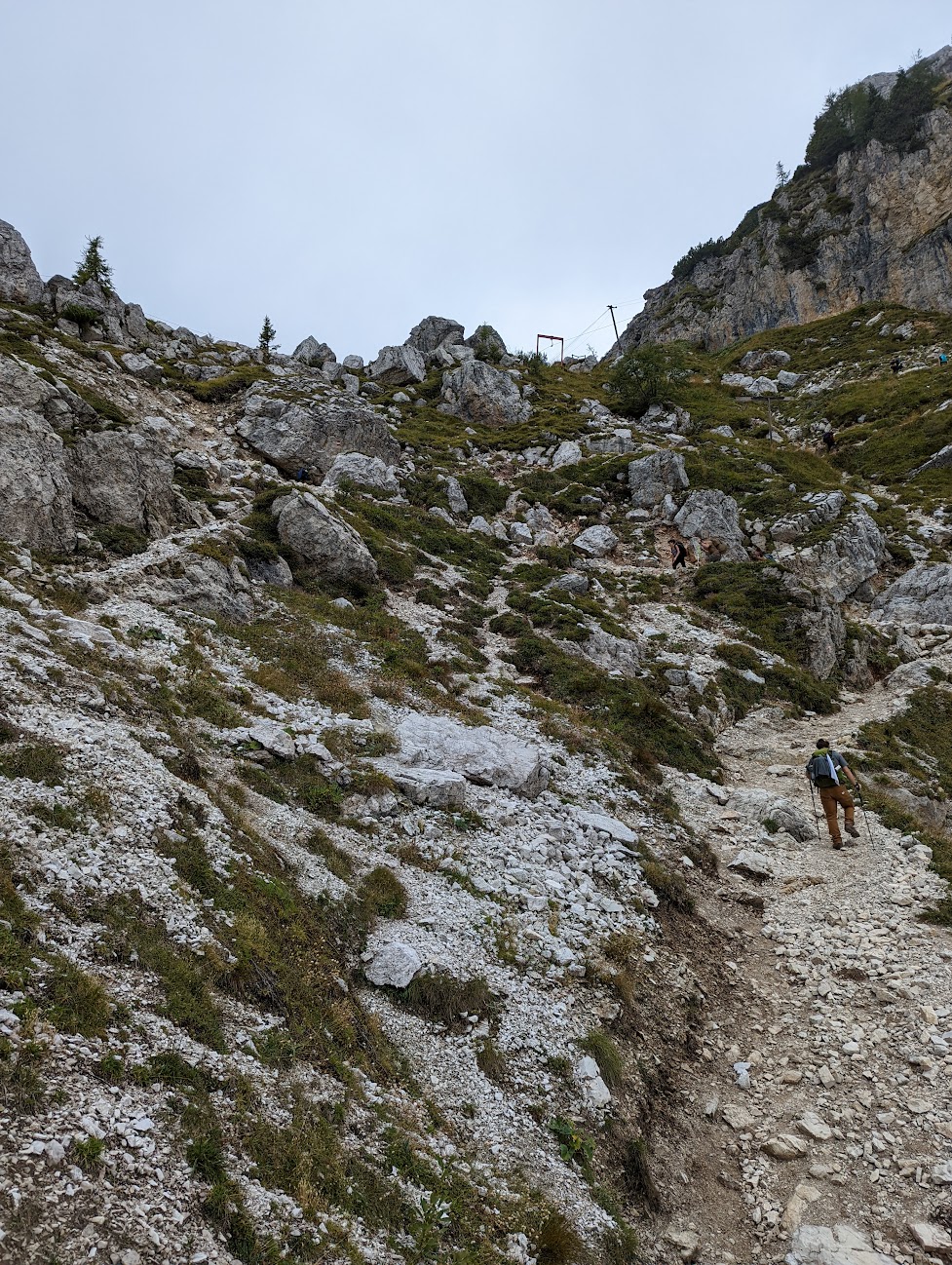
    The sign wasn't wrong. This was the "long difficult descent" we had decided, wisely, to avoid at the end of a long day yesterday by staying at Rifugio Pramparet instead of at Rifugio Pian di Fontana, which we could see, minuscule with distance, on a small flat, grassy spot at the bottom not of the mountain but at least of this long, long, unbelievably steep hike. In a couple of places there was cable for us to hold onto—via ferrata—to keep us from falling off the cliff.
Me, then William, on the via ferrata. Photo by Margaret della Santina
I was thanking our good sense for not putting this difficult trail at the end of a long, long day, as in our original itinerary.
    By the time we got to Pian di Fontana, my feet were aching for relief. I sat down on a rock wall and took off my boots for the duration of our half-hour rest stop, strictly timed, because for the first time on our hike, we were on a time schedule, as we were to meet Bryan at the trail's end between 4:00 and 5:00. We were already behind schedule. but, we agreed, we needed to take a half-hour break.
    After we had been at so many rifugios bustling with people, Pian di Fontana seemed almost deserted.
                                                                            Photo by William della Santina
Margaret and me almost the only hikers at Pian de Fontana
I saw a couple of men who seemed to belong there, and a woman walked by with a bucket and mop. One lone hiker was eating lunch on the porch. More would come by dinnertime, but at the moment the rifugio was eerily devoid of people.
    After thirty minutes, my feet had to go back in their boots, and we set off again, William first, then me, then Margaret, as we had hiked for the past two days.
    

Saturday, October 1, 2022

Hiking the Alta Via 1: Day 9

Rifugio Duran to Rifugio Pramparet. 5 hours,
    Breakfast at Rifugio Duran, served at 6:30, was unusual in that it wasn't a buffet but was served to us by the cheerful young student who had given us his room. We were on the trail by 7:40, our clean, dry clothes tucked into our backpacks.
    After a short downhill stretch on the paved road, we started uphill through the woods, where we were enraptured by many colorful mushrooms.


    We also passed some ruins of World War 1 barracks. The walls were partially crumbled, and plants grew in the dirt floors. The stonework was beautiful. It might not have been so great a place to live during the war, but like Wordsworth's Tintern Abbey, the ruins elicited nostalgia for the past even though the specific past for these specific ruins was not a time to be nostalgic for. It wasn't the history that created the mood—not the one-time use of the building—but the general lament that ruins inevitably evoke. 
                         Photo by Margaret Della Santina
    Maybe just as inevitably, the ruins precipitated a conversation about concepts of time. Eastern traditions, William, who has traveled in China, pointed out, consider time as circular, not linear, as we see it. In Anglo-Saxon England, I told him, the concept of time was neither linear nor circular but simultaneous. In an Old English poem called "The Ruin," the poet muses on the ruins of Roman structures in the city that once was Bath (and is again). The poet sees the past Roman times and the future apocalyptic times simultaneously present in present time. And whereas I was peopling the rock-wall rooms of the barracks with the ghosts of World War I soldiers, that poet was peopling the ruins in Bath with very Anglo-Saxon-like people not because he couldn't imagine that Roman people were different but because Roman times and Anglo-Saxon times were, in his way of seeing time, all one.
    We continued up the mountain, conscious, given the culture we live in, mostly of the present moment.
    At the top of one ascent that Gillian Price more or less accurately calls a "modest climb," in a spot of stupendous scenery, we asked a young German man resting there with his two companions to take a picture of us with the Applegater, our community newspaper back in Oregon that has a page dedicated to pictures of people reading the Applegater in distant places. He obliged us cheerfully, but to my disappointment he didn't express curiosity about the Applegater or the Applegate.
                                                                                        Photo by unknown hiker
    We arrived at Rifugio Pramparet in time for what would have been a late lunch, and a welcomed one, since we had had only a few bites of energy bars since breakfast, but this rifugio, old and very isolated from "civilization," didn't accept credit cards, so we had to pay for our new reservations in cash. Alas, there weren't enough euros let over for a beer and a strudel, much less for lunch for a teen-age boy. We just ate another energy bar, drank water, and ruminated on the big jar of pine cones marinating in spirits on the table in the sun, a local eau de vie. William, Margaret, and I took a casual walk down the trail and met a beautiful black-and-white cat on her way back to the rifugio. Later, I spotted a chair carved from a tree stump below the rifugio deck and walked down to investigate. As you can see in the photo, I was wearing the dress I put on every afternoon after a shower. It was extra weight in my pack, but I loved the feeling of wearing a dress after being on the trail.
                                                             Photo by William della Santina
    Pramparet is a beautiful old rifugio, part stone, very different from the upscale, comfortable rifugios such as Vazzoler or Staulanza. 
     Rifugio Vaxxoler                                    Photo by Margaret Della Santina
Accommodations were rougher. Rooms were down a stone walkway, as at cheap motels in the United States.
                                                                            Photo by William della Santina
Dormitory rooms are on the left, dining room on the right.
Our room had four bunk beds, so we wouldn't be the only occupants tonight. The two toilets were down the walkway 
(to the left of the angle between buildings in the picture), attached to the main building, where the kitchen, bar, and dining room were. There was no "men/women" designation to the toilets, and the sinks were on the other side of the stalls, so inevitably I ran into a man in the bathroom. The showers weren't working. 
    The dining room tables seated ten or twelve people to a table, except for one, which seated six, where Margaret, William, and I ate with a strong Italian girl with gobs of red hair, and with a young Spanish couple from Barcelona, Sara and Javier, who now live in Berlin, where she works for an NGO and he does tech for a non-profit. They were delightful company. I especially liked Sara, who was dark-haired-pretty and lively as a squirrel. Her eyes grew wide when I said I was a writer, although she could have been just as impressed with Margaret's literary and scholarly output. Sara and Javier had to catch a bus to Venice after they walked out tomorrow, so they were planning to leave at 6:00 am. The rifugio people were going to prepare a sack breakfast for them and leave it by their door.
    Also staying at Rifugio Pramparet was a large group of big, tough-looking men. They were climbers, not hikers. I was relieved that none of them stayed in our room. We certainly had bunkmates, but I went to sleep so soon after dinner and was up so early I don't even know who they were. 


Friday, September 30, 2022

Hiking the Alta Via 1: Day 8

 Rifugio Vazzoler to Rifugio Duran. 4 hours
    Here's today's journal entry:
    "How can I differentiate today's hike to Rifugio Carestiato, then to Rifugio Duran, from the other days' hikes? Up one mountain, down another…. Today, we continued down the gravel road we had taken to Vazzoler yesterday—already such a long descent!—and now on down we went until the trail left the road and turned towards the cliffs, climbing steadily, through forest and then becoming more rocky. We had a fun little bit of via ferrata on this part of the trail, helping us on a narrow path at the base of a rock wall.
Me negotiating a via ferrata. Photo by Margaret Della Santina

Margaret coming after me.    Photo by Diana Coogle
Up and up, across and across. Up and up and across and across, those remarkable spires to our left keeping us in shade.
                                        Photo by Margaret Della Santina
It wasn't difficult, but it was steady—up and up and across and across, always climbing. Sometimes boulder-hopping.
William on the boulders. Photo by Margaret Della Santina
Sometimes over red-mud trail. On and on, up and up, across and across,
                                    Photo by Margaret Della Santina
William waiting for me at what looked like the top. 
until finally we could see Rifugio Carestiato ahead on a cliff. We stopped there for a snack (or for lunch, depending on the appetite)."
                                            Photo by Margaret Della Santina
On the porch at Rif. Carestiato.
(Note that I have taken my boots off.)
    The porch of Rifugio Carestiato, in the sun, as well as the indoor dining room, was crowded with hikers. A family with two small children sat across the room from us. It wasn't the first family we had seen, but I marveled that they could take such small children on such a strenuous hike. 
    The descent from there to Rifugio Passo Duran C. Tomé was fairly easy, ending with a walk through cows grazing on the hillside. I was dismayed to see, as the rifugio came into view, a large number of cars and motorcycles in the parking lot. However, to my relief, most of the crowd had left by dinner time.
William hiking down to the rifugio.  Photo by Margaret Della Santina
        Because the rifugio was full, the wonderful young man at check-in, a student working there for the summer who wanted to live in the US for a year after graduation, told us he had given us the room he and his co-worker usually slept in.
                                                                            Photo by William della Santina
Our room is in the back, around the corner from the animals.
They would be fine in the trailer just off the porch, he said. "Oh, and don't be alarmed if you hear a donkey in the night," he added. "We keep them fenced in just outside your window during the night to keep the wolves from getting them." (I raised an eyebrow, but apparently there really are wolves in the Dolomites.) There was a bathroom with a wonderful shower for us to use, but "try not to use too much the hot water," he said.
    Margaret, William, and I took advantage of hot water and a clothesline to wash out underwear and socks, being careful not to use too much the hot water. It wasn't always possible to do a laundry at a rifugio (not enough time, no place to hang wet socks), so it was always good when we could.
    As we enjoyed an afternoon beer inside the now empty rifugio, we discussed plans for the next two days. The original itinerary was to do a six-hour day tomorrow, to Rifugio Pian di Fontana, but that would entail what seemed to be a treacherous descent at the end of the day, an especially bad idea if the thunderstorm William said was predicted materialized. We thought the better idea would be to stay at Rifugio Pramparet instead, which was closer to us than Pian di Fontana. That would mean a very long last day, but it seemed worth it for an easier and less dangerous day tomorrow.
    It seemed like a good plan for us, and, as it turned out, it would also be a good plan for a young German couple, Emma and Moritz, who were hiking from Innsbruck to Venice. They had wanted to stay at Pian di Fontana the next night but couldn't get reservations because the rifugio was full. We discussed the situation over dinner with them. If Pramparet had room for us, we could give our reservations at Pian di Fontana to them, and everyone would have a better hike.
    Miraculously, it all worked. Margaret contacted the two rifugios and was able to make reservations for us at Pramparet and to determine that Emma and Moritz could take our places at Rifugio Pian di Fontana. William, Margaret, and I would only hike as far as Rifugio Pramparet tomorrow, avoiding the thunderstorm, and the two young hikers would stay at Pian di Fontana, giving them more time to hike out the next day. Everyone was pleased.
    We didn't hear any donkeys that night, but the next morning we were delighted to make their acquaintance.

                                                 Photo by William della Santina


Thursday, September 29, 2022

Hiking the Alta Via 1: Day 7

Rifugio Coldai to Rifugio Vazzoler. 3 hours, 45 minutes. 6 miles.

    Breakfast at Rifugio Coldai was served at 6:30. In addition to the usual basket of breads, plates of ham and cheese, bowls for yogurt and muesli, there was a platter of scrambled eggs. You might think with all the walking I was doing I would be losing weight on this trip, but the good food undid the good of the good walking.  
    The highlight of this day, as far as I'm concerned, was a swim in Lago Coldai, a green gem at 7032 feet.
Swimming in Lago Coldai.               Photo by Margaret Della Santina
It was a delicious swim, across the lake to the boulder side and back to the rock-pebble shore, where William had carried my towel and clothes to a spot in the approaching sun. The water was refreshingly cold. 
    The next highlight was Rifugio Tissi, a worthwhile detour on a sharp, vertical, rock-step ascent. We sat on the deck and had a coffee in the presence of awesome Dolomite peaks. Just as we were leaving the rifugio to make the short climb above it to the summit, we ran into Dana and Neil, the couple from Colorado we had met the night before. As we parted, they promised to come ski with me in Oregon. 
    At the summit above Tissi we had a 360-degree view of those Dolomite peaks. Far, far below, straight down the cliffs, we could see a blue lake and a town, Alleghe, minuscule below us. We could see the ribbon of the river stretching from the lake into the green hills, with house-knots on the river-ribbon winding up the valley.
                                                             Photo by Margaret Della Santina
William and I lay on the edge of the cliff, looking down.
                                                                        Photo by Margaret Della Santina
    Here, I decided, was the perfect place to spread some of my late husband's ashes, he who had hiked the Alta Via 2 with me six years ago. The wonderful memories of that trip have occurred again and again on this one. He would have loved to be here with us. I faced away from the view of Alleghe, gorgeous though it was, because of the wind, and flung the ashes towards other peaks, wishing Mike good resting in the Dolomites.
                                    Photo by Margaret Della Santina
    From time to time along the trail we have been seeing memorials to people who died on Dolomites climbs. Today we came to a large memorial with a statue (Mary? Jesus? A saint?) and a plaque with photos and a dedication to Marco Anghileri, obviously a beloved climber, greatly grieved.
                                   Photo by Margaret Della Santina
When we got to Rifugio Vazzoler, we saw more photos of him and a plaque in memoriam. He was 32 when he died on a climb.
    Later today we came to a memorial for another climber—an open frame with a broken climber's axe in it. Very poignant.
    The Dolomites take their toll.
    The day ended with a very long descent down a rocky road which was hard on my feet and on Margaret's, which also suffer from arthritis. Finally, though, we were at beautiful Rifugio Vazzoler.
                                                            Photo by Margaret Della Santina
We were in time for a late lunch, which, for me, included a very good polenta and a pork-and beef sausage called pastine.
        You would think that Rifugio Vazzoler, after all the descending we had done, would be in a valley, but, in fact, it sits on a flat spot with enormous spires above it and plunging depths below it. The rifugio was picture-book beautiful, with red begonias in window boxes, sturdy picnic tables outside the building, magnificent mountain peaks above it, and a wildflower garden on terraces down the mountain, though, of course, nothing was in bloom at this time of year. 
                                                                                        Photo by Diana Coogle

                                                           Photo by Margaret Della Santina
    Margaret and I were sitting at one of the outdoor tables, writing in our journals, when one of the group of German climbers—they were here to do some via ferrata—at the table next to us asked if I would take their picture. What ensued was a lively exchange of banter and get-acquainted questions. (They were the only people we met who made a snide—or any other type—comment about Trump.) Later, at dinner, they were very loud, singing and joking, and in the morning, when I saw one of the women and asked how she was, she said, "Too much alcohol last night." I hoped she wasn't going climbing later that day. 
Me with the German climbers.         Photo by Margaret Della Santina


Wednesday, September 28, 2022

Hiking the Alta Via 1: Day 6

Rifugio Staulanza to Rifugio Coldai. 2 hours, 10 minutes.

     After yesterday's long hike we would have only two hours of hiking today, so we luxuriated in our luxurious quarters at Rifugio Staulanza until almost 10:00.
    From the rifugio we walked along the paved road, which we soon crossed onto a gravel road through a logged area with large piles of logs and slash. (We didn't see much logging in the Dolomites, but some.) Then we headed up a lovely grassy hill,
                                                              Photo by Margaret dell Santina
down the other side, and across a road to the last climb of the day to Rifugio Coldai.
    At the start of the winding, narrow, stone-and-gravel road to the rifugio, a World War I mule track, we passed a small house with a large flock of sheep around it.
                                                        Photo by Diana Coogle
Just then, a car passed us and went up the driveway. I caught sight of "Socorro Alpini" on the side door. Shortly after that a drone buzzed overhead as we were hiking. It hesitated a good long time over us, tipping slightly. At first we were annoyed by the intrusion and the noise, but then we realized that the car must have been a search-and-rescue operation and that the drone, sent to spot the person in trouble, was making sure it wasn't one of us. 
    I loved the hike up the road to Rifugio Coldai. Though the mountain was very steep, the road zigzagged at the perfect rate for my pace.
                                      Photo by Margaret dell Santina
William on the road to Coldai. 
I ignored all shortcuts between switchbacks and kept on with my steady ascent with no stops and no change of breath. The trail turned sharply uphill at the end, but my pace held steady to the top, where the road flattened just enough to lead to the rifugio.
    On the other hand, the woman hiking behind me was talking on her cell phone all the way up.
  Rifugio Coldai.                          Photo by Diana Coogle
    Although Rifugio Coldai is an old building, it looked new and modernized, as did all the rifugios we had been in so far. William speculated that the government, who owned most of the rifugios, took advantage of the COVID hiatus to make renovations.
    We left our boots in the shoe room, as at all the rifugios,
                                                             Photo by Margaret dell Santina
and ordered lunch in the dining room, which was very crowded. It amazed me that so many people would make that long, difficult trek for lunch here. The two outlets for charging cell phones were in high demand.
                                      Photo by Margaret dell Santina
    After lunch Margaret and William disappeared, while I stayed in the dining room, writing in my journal. After a while I disturbed the young woman at the outside end of the bench to go to the bar for a spritz. The bright orange Campari spritz that I returned with opened a conversation, and soon, in the way of hikers on the Alta Vias in the Dolomites, we had become friends. She (Dana) and her husband (Neil), who was sitting across the table, were 
from Colorado and had taken early retirement from their jobs as environmental lawyers. They were hikers and skiers. After this trip in the Dolomites they would be hiking in Switzerland. At dinner time William and Margaret joined us, and for the first time on our hike, we were sharing a table with  friends. Until Coldai, rifugios had assigned tables to specific guests. Ours was usually for "Della Santina" because Margaret had made most of the reservations, a task I was immensely grateful to have her do. On two occasions, though, I had made the original contact, so the reservation, for lodging and board, was in my name.
Our table at Lagazuoi. Photo by Margaret Della Santina