Thursday, October 12, 2023

A Getaway into the Red Buttes Wilderness

     I am pleased to say that it has been raining for days. I like to think the winter rains have started and that it will be wet and gray for months to come. Should we be so lucky.
    However, I am just as pleased to say that there was no rain Wednesday through Saturday last week because I was on a backpacking trip in the Red Buttes Wilderness Area, my back yard, with my friends Cheryl, Janet, and Sandy.
L-R: Janet, Sandy, me, Cheryl                             (selfie by Janet)
          The weather was glorious, as was the landscape. Mostly, we were hiking through old-growth forests, past true-giant cedars and pines. We laid hands on the big, shaggy-barked trunks, in veneration and gratitude. How we need these magnificent forests!
Me with a ponderosa pine.         photo by Cheryl
After a seven-and-a-half gradual climb up the Butte Fork trail, we made camp at Cedar Basin.
                                                                                                    photo by Janet
    Then we made a late afternoon hike up to Lonesome Lake, where I had my best swim of the trip, under the headwall, where the water was deepest, even though that part of the lake was in shadow by that time.
Me, preparing for a swim in Lonesome Lake    photo by Janet

                                                                                                        photo by Cheryl
Coming into sunshine after swimming under the headwall.
Azalea Lake is large but probably not even six feet deep and the pond at Sucker Gap is even more shallow and dotted with lily pads, but because we camped at both places, I could indulge in one of my favorite things to do: step out of my tent into a lake first thing in the morning.
    In some places, low-growing bushes gleamed umber, copper, burnt sienna, fire-engine red.
                                                                        photo by Janet

They were especially striking where they lined Azalea Lake, with the ghostly trunks of the burned forest behind them and their reflection doubling the color in the lake in front of them.

    What else? Well, the company. What great backpacking partners they were! Besides the talks and the stepping in to help when needed, all three had brought chocolate to share. And at our first lunch stop, Cheryl astonished me by handing 'round large pieces of spanakopita and baklava she had made the night before. Imagine having carried all that weight! I had no qualms about helping lighten the weight of her pack by accepting the lunch she offered. 
    Janet and Sandy both joined me for swims in the lakes. Cheryl picked mushrooms we found on the trail. Janet religiously stuck to her commitment to meditate every day. 
Janet meditating at Azalea Lake     photo by Cheryl
    It's hunting season, so we used brightly colored pack covers to keep us from being mistaken for deer. We did meet two sets of two hunters, all in their camouflage. Afterward, Cheryl told us of the days of her past when she used to hunt.
                                                                                                        photo by Sandy
    We misjudged the mileage of the last day's hike, so we were two hours early for meeting the person coming to pick us up at the trailhead. Janet, Cheryl, and Sandy looked through the woods for morels. I read a novel on my Kindle. I recited a few poems, while Cheryl and Janet danced. The lovely long afternoon was waning when our driver arrived, and we returned to the valley for pizza and beer in the Applegate and a toast to a great four-day getaway with friends.


Thursday, September 28, 2023

Swimming in the Upper Rogue

    As I said in last week's post about backpacking on the Upper Rogue River, Cheryl, Janet, and I were walking hard on the last day to walk the twelve miles back to the trailhead in time for dinner at the Prospect Hotel, so we set a faster-than-normal pace. Nonetheless, when we got to the only place on the river that looked possible for a swim, we stopped there. 

    The river was wide, and the current looked slow, but I don't trust rivers. Besides, the bank dropped so steeply into the river I didn't think I could safely get in. And if I got in, how would I ever get out?
    Janet thought she could do it. Holding onto the branch of a riverside bush, she carefully lowered herself into the water. Then lower. And lower. She sank up to her chest before her feet touched a strong root growing out of the bank, where she stood for a split second before letting go of the branch. Then she was swimming downriver with the current. Shortly she turned and swam easily back. Holding onto the branch, she pulled herself out. She was exhilarated.
    That looked wonderful! If she did it, I thought, I could do it, too. Cheryl and Janet assured me they could help me get out, so, holding onto the branch, I lowered myself into the river. But Janet is taller than I, and I sank to my neck before my foot touched the root. Then I let go and swam downriver.
    It was a great swim. Cold, yes, with a gentle current and an easy return next to the bank, where the current was slower. I thought about swimming down and back up again, but the cold was beginning to pound at the back of my neck, so I thought I should get out.
    Not so easy. The bank fell perpendicularly deep into the river. Even standing on the root and holding onto the branch, I couldn't scramble out, as Janet had done, so Cheryl grabbed one arm and Janet the other, and, as I scrambled for a footing in the slippery grass, they hauled me ashore. 
    Worth every moment. I'd do it again with the same help.
    

Thursday, September 21, 2023

Backpacking the Upper Rogue River Trail

    Few people backpack the Upper Rogue River trail because it is so easy to day-hike it in sections. I have hiked River Bridge to Woodruff Bridge and Woodruff Bridge to Natural Bridge many times. But when Cheryl, Janet, and I were on our way for a four-day backpacking trip in the Sky Lakes Wilderness Area last week, we stopped in Prospect to check on air quality and were told there was a fire in that area, just where we were planning to hike, so we just shifted plans. We would hike the nearby Upper Rogue instead.
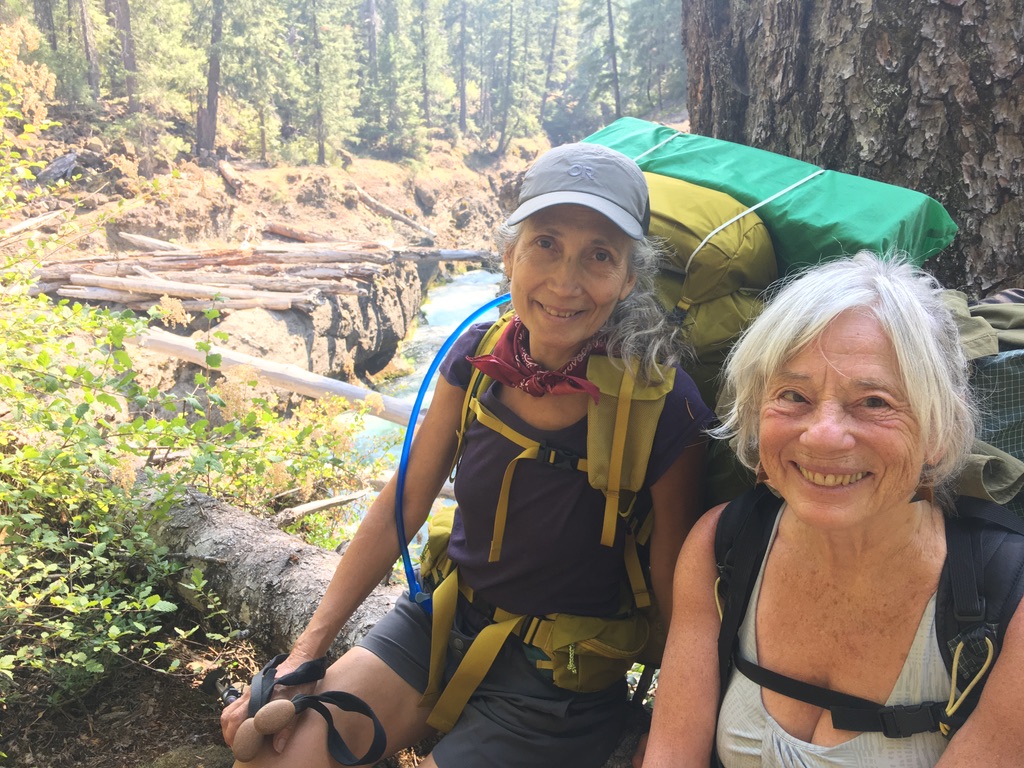
                                                (All photos by Cheryl Bruner)

    Starting at River Bridge, we decided, we would go as far as we wanted, then find a place to camp, do the same the next day, and repeat for the two days back. Pretty simple.
    We left my car at River Bridge Campground and hiked five miles the first day, from the trailhead past the Baptist Church Camp, where Cheryl's family used to have family reunions, through the beautiful Takelma Gorge, then across the road at Woodruff Bridge and onto the next section of the trail, where we found a sandy flat on the river for our first night's camp. After dinner I recited Robert Frost's "The Death of the Hired Man" while Janet danced an extemporaneous interpretation of it, the river dancing its own rhythm behind her.
    That was the first five miles.
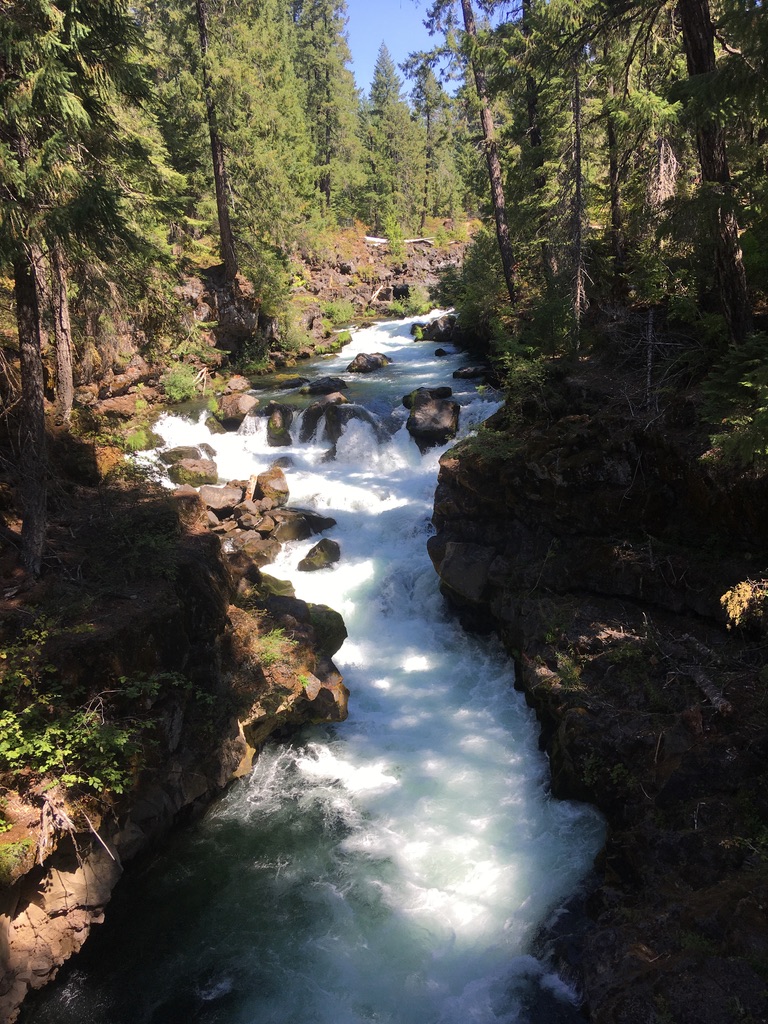
    The next day we hiked past a spectacular waterfall just before the Natural Bridge section of the trail. We stopped for lunch at a bench facing the lava cave, where the river famously disappears for a short distance. Three women with backpacks are an unusual sight on this popular section of the trail. Asked by curious tourists how far we were going, we said, "As far as we want."
    Once past the paved parts of the trail at the lava cave, I was in new territory. The trail began ascending steeply, through big trees and masses of viney maples just beginning to turn red.

The river, far below the trail, was mostly out of sight. The hiking was more difficult than it had been the day before, steeper, up and down, with several stream crossings. By the time we had hiked a seven-mile day and found a flat, sandy spot next to the river, we were ready to make camp. Before dinner, Janet and I took cold-plunge baths at the river's edge, holding on to willow branches to stay in the cup where the river lapped the shore.

    We woke up to an overcast sky. Rain was predicted for that night. We could avoid camping in the rain, we told ourselves, by hiking out the entire twelve miles. And if we did that and got back to the car in time, we further encouraged ourselves, we could have dinner at the Prospect Historic Hotel.
    Motivated, we hit the trail at a pretty fast pace. In spite of the press of time, though, we stopped at one of the few places on the trail where the river looked suitable for a swim, and Janet and I both swam. (More about that in the next post.) We had lunch at the same bench near the lava cave where we had eaten the day before, then put our packs back on our backs and headed down the trail again.
    At this point Cheryl took over the lead position and set an insane pace. Even moving at a faster clip than I normally would and ignoring my aching feet, I couldn't keep up. Janet, hiking behind me. distracted me from weariness and the difficult, rocky trail by telling me the trees were glad to see me again. 
    Twelve miles, and we were back at the trailhead, before 6:00, gratefully throwing our packs into my car and looking forward to dinner at the Prospect Hotel. First, though, I changed into the dress I had left in the car. Then, looking much fresher than I actually was, I drove us to the Prospect Hotel, where we toasted our adventure with a glass of wine and had a very good salmon dinner. Afterward, Cheryl drove us through the dark back to the Applegate.
    It wasn't Sky Lakes, but backpacking the Upper Rogue with Cheryl and Janet was its own satisfying adventure.
Cheryl

Janet and me


Friday, August 25, 2023

     Our perfect summer days, such as I wrote about two weeks ago, have come to an end. Now our skies are white with smoke. Visibility is diminished to my closest trees, and Humpy Mountain is obscured behind a veil of smoke. 
Humpy Mountain yesterday afternoon

Humpy Mountain in the idyllic days of summer

    But smoke is not as bad as fire. Although we suffer the lung-stifling effects of the fires in other places, the Applegate itself is not on fire. At least, not yet.
    It would help if we would roll back climate change. Get busy, damn it, all you politicians and lawmakers and industry CEOs who could be making a difference! 
    According to some thinking we should be thinning the forests of their century of fuel build-up. But there are problems there. One is that BLM, at least around here, seems to be taking advantage of "thinning for fire" to do some pretty damaging logging, taking large trees that are both carbon storers and fire resistors. Another problem is that logged-over land, often the result of "thinned" forests, is seemingly more susceptible to fire than our old-growth and large-tree forests. A third problem is that even if forests thinned of small trees (leaving big trees) would create slower and cooler fires, who's to say that those areas would be the ones to get the fire, so was that a good use of money? I'm no expert on fire or on forests, but I do see that if an agency says "for fire protection," the public falls right into line with whatever the proposal is and that not all such proposals are either especially for fire protection or actually protective against fire or, even, good for the forest.
    A couple of years ago the Devil Fire burned not too far my house. It was a ground fire, burning low and slow, doing the good work of forest health that fire does. So why didn't the Forest Service let it burn? If this is a fire-dependent ecology and if a century of fire suppression has put us in this quandary, then why put out fires that pose no danger? 
    Experts speaking in the documentary film Elemental (see if if you can) and elsewhere are advocating defensible space around structures as the only sensible way to approach fire preparedness. Fire prevention, of course, is preposterous, and fire suppression has been disastrous, but protecting homes and other structures from fire seems sensible. I love my trees, but I am ready to do what I have to do to defend my house from the fire that is as likely to be here as in Lahaina or in Paradise, California. I can only hope that the fire that is sure to come will hold off till I get that work done.

Thursday, August 17, 2023

Hiking in the Eagle Cap Wilderness Area in the Wallowa Mountains of Northeastern Oregon

                                                                                            photo by Scott Mattoon
     After seven days in the mountains, the twelve of us on this Sierra Club backpacking trip hiked 2 1/2 miles to the trailhead, found our cars, then reassembled for lunch in Joseph. Then we hugged good-byes and headed back to Pennsylvania, New York, California, Missouri, Illinois, and various places in Oregon. I drove to a sub-par Motel 6 in The Dalles, took a shower, ate some dinner, and lay down to sleep in a real bed again.
    But I couldn't sleep. I missed the hum and thrash of the river outside my tent. I missed the chill of the night and the warmth of the sleeping bag. I missed the other hikers who had been sleeping in their own tents near me, those eleven good friends who had been strangers to me only a week before. The mediocre dinner from the Indian-cuisine food truck had left me missing the amazing camp-food dinners Leah, trip leader, had prepared for us—risotto with three kinds of cheese and tuna, noodles with Thai peanut sauce, curry-and-rice. And I knew that whatever I found for lunch on my way home the next day couldn't match Nutella on lavage bread with dried bananas, mangoes, and turkey jerky. Such imaginative meals Leah had planned!
    I missed the mountains. Several days before, as I was hiking the 1000-foot elevation gain up 8540-foot Glacier Pass, then down the other side along the West Fork Wallowa River—
                                                                                            photo by Gabe Oprea
the steep slopes streaming with wildflowers, the river cascading white through black rock, the peaks rugged and stark above the narrow valley—I thought, "I have hiked in the Dolomite Mountains of northern Italy, in the French and Swiss Alps, in the mountains of Costa Rica and Corsica, in the Rockies, the Sierra Nevada, the Cascades, and the Appalachians, and I can say that this is world-class hiking." 
                                                                       photo by Mark Dumont
    Everywhere wildflowers amassed in stunning arrays—purple asters splotched with scarlet firecracker flower and Indian paintbrush, sunshine-yellow groundsel, sunflower-bright arnica—occasionally a rein orchid, catchfly, pearly everlasting. Horse mint scented the air. I grew dizzy trying to name all the flowers and finally gave up.
                                                                                            photo by Gabe Oprea
    We saw picas and mountain goats. At one campsite we were awakened by a large herd of horses galloping past camp. When it rained (and it rained a lot), we just donned rain gear, covered our packs, and kept on walking.
                                                                                        photo by Mark Dumont
    Was the best day the day we hiked up to Ice Lake, a good steady climb from camp at 5500 feet to the lake at 7849 feet, followed by a beautiful long swim,
Swimming in Ice Lake. I am behind Leah.    photo by Mark Dumont
lunch lakeside (watching mountain goats descend to the lake), then a walk halfway around the lake to a remarkable white-sand beach, where I swam again? 
                                                                                    photo by Mark Dumont
    
Or was the best day the day we climbed Glacier Pass (where I sprinkled some of Mike's ashes; see post on June 21, 2020, for an explanation), then hustled down the other side through that gorgeous scenery, on and on until it was starting to get dark and Leah and John, our leaders, found a possible campsite ("It would be miserable, but it would only be one night of misery"), which we rejected in favor of walking another two and a half miles in hopes of finding there a better place to camp? What a fast walk it was! But we got to a large meadow and threw up our tents just before dark.
                                                                                        photo by Mark Dumont
It had been a long, beautiful, and exhilarating day.

    The lakes were superb. I loved my swims, and the stream crossings, too, which I usually did barefooted. 
I am about to cross behind Traci, my boots in my hands. photo by Mark Dumont
    Have I mentioned the food? Did I say the leadership was great? Did I say the scenery was breathtaking (to say nothing of the breathtaking hiking)? Did I mention the company? We were teachers, a pianist, a farmer, an engineer, people who worked in tech, in non-profits, in academia. We spanned the ages of 39 to 79. Phenomenal hikers all.
                                                                    photo by Mark Dumont
Everyone is in this picture but Gabe, who is taking it. Note Leah, our leader, far right. She and John, assistant leader (4th from left), carried enormous packs.
    No wonder I had a hard time going to sleep that first night off the trail. My body was there in Motel 6, but my spirit was still in the Wallowas, among those wildflowers, in those lakes, with those friends.
                                                                                            photo by Gabe Oprea


Thursday, August 3, 2023

On a Perfect Summer Day I See My Fox

    Our summer days lately have been as beautiful as they come—warm but not overly hot, balmy, gentle, smoke-free. In fact, it has been something close to this all summer—no smoke, no triple-digit temperatures. I have been hiking a lot, with a 30-pound pack, training for a six-day backpacking trip in the Wallowa Mountains, in northeastern Oregon, but today I took a rest day and sat on the deck in my new swing, now my favorite place in the house, reading some, writing some, swinging gently.

    I looked up at a strange scraping sound in the yard in front of me, on a bare, flat bit of ground downhill from the house, between the woods and the apple tree . 
    It was my fox, rubbing his back on the rough ground. Then he sat up, glanced at me when I made a slight noise, then sat there, looking around, attentive but at ease, before loping off down the hill towards the woods.
    I see this fox from time to time, and I often hear him at night. Sometimes he stops twelve or fifteen yards from the house and barks his saw-blade-sharp arf. If I come out the door, he looks at me and barks again. I greet him with a few words, then go back inside.
    He is a gray fox, very beautiful in his red-and-gray lush fur coat and long handsome tail. 
    I know it's the same fox I see every time because he is lame in one foot. He limps on his right front foot, lifting the paw off the ground and trotting angularly, though swiftly enough. I thought at first the paw might have a temporary injury, maybe a thorn in it, and I imagined myself playing the part of the mouse who took the thorn out of the lion's paw in Aesop's fable. But I have seen the fox often enough that I think the paw is permanently injured. I doubt that it was caught in a trap; trapping isn't usual around here. I wondered if it were a birth defect. Maybe the mother fox sat on the foot when the kit was born. That happens sometimes with domestic animals.  
    I know better than to be sentimental about wild creatures, and I feel strongly about the wrongness of making pets of wild creatures. But I do love my fox. We are cordial, if distant, friends. It is between us as Emily Dickinson said:
            Several of nature's fellows
            I know, and they know me
            I feel for them a transport
            Of cordiality.
    So it is with my fox. 

Thursday, July 27, 2023

Running a three-day festival

  I apologize for having neglected my blog for the past month. I have been organizing Celebrate the Siskiyou Crest, a three-day festival of art, science, and culture, which took place last weekend.
    I fell into the job at a meeting of the Siskiyou Crest Coalition last fall when someone (I was told it was I) suggested an art show to bring attention to the Crest, since it is the goal of the Coalition to find ways to protect the public lands on the Siskiyou Crest. I enthusiastically suggested adding a day of poetry readings from local poets. Someone else suggested having panels of scientists speaking about the ecology of the Crest. The whole thing mushroomed. Keynote speakers. Well-known musicians. A day of hikes on the Crest. Everything free to the public.
    But no one was saying, "I'll organize it." If it were going to happen, someone would have to do that, so I said, "Okay. I'll do it." 
    Actually, though, I didn't organize everything. Someone took over the science part. Two people found business sponsors. Someone organized the art show. Someone coordinated the venue and found food trucks. Someone organized a raffle. Someone organized a reception for donors and participants. We wanted tribal participation, so someone secured a traditional ecologist from the Confederated Tribes of Siletz Indians as a speaker. 
    I wrote a grant proposal from the Carpenter Foundation. I worked on the art show. I wrote press releases and secured donated lodging for out-of-town participants. I asked David Rains Wallace, author of the award-winning book The Klamath Knot, to be our keynote speaker. I created a schedule of events and, in general, acted as coordinator and point person.
    To my horror, it fell to me to see that we had no tech problems.  It was a steep learning curve, but between the tech help at the public library and the folks at Best Buy, I learned. 
    In the end, it was all a huge success. Lots of people. Lots of excitement. Our food trucks bailed on us, but everyone stayed cheerful, and the snacks booth did a great business. We got great press coverage, including three articles in the Oregonian.
    Our goal had been to raise awareness about the special nature of the Siskiyou Crest—its amazing biodiversity, its special flora and fauna, its recreational opportunities (all those hiking trails!), and its beauty, which is both inspiration to artists and poets and economically important to the valley's wineries and other businesses. My sister Sharon, who came from Georgia to be at the festival, indicated the success of that goal when she told me, before she left for home, "Now I understand why you love this place so much."