Thursday, April 27, 2017

The Way My Brain Works

           Mike handed me his jumper cables and explained carefully how to use them, including telling me how the electricity goes from one car to the other because, he said, if he understands how a thing works – how or why – he is more likely to remember directions.
            But that's not how my brain works. I remember how to use the jumper cables by visualizing the scene – RAV4 on the right, Yaris on the left. Attach red to the dead battery (on the right), then red to the good battery (on the left), then black on the good battery (the left one), then black on the dead battery (on the right). I see it all as I repeat it: red to dead, red to good; black to good, back with black. How and why it works is no help at all. I don't even remember it. I visualize what to do, so I can do it. Words help, too.
            The difference in the way our brains work came up again when we played a game of "dictionary." We found some fabulous words: wittering (a token or hint), twire (to peep out), opsimath (a late learner), ponty-pool (relating to japanned metalware, not, as Mike would have it, the pool of water around the pilings of a bridge, or, as I would have it, the biggest stakes in a gambling game). Later when we tried to recall as many of those words as we could, thinking we might want to keep them in our vocabularies for future use, I was running through the words as they appeared in my mind, visualizing them in the column I had made of them, on paper, after the game.
            Mike said he didn't see written words in his mind. He just remembered them by remembering them.
            But I do. I see the column of words I wrote down. I see where on a page I was when I stopped reading. I see the written word when I want to know how to spell it. I see the jumper cables being put first on one car, then on the other, accompanied by the jingle. It isn't a photographic memory. It's just a visual memory, and it works best with words.
            I asked Mike what he saw when, for instance, there was a December 2016 date and an April 2016 date. How did he know which date came first?
            Okay, that was a dumb question.
          He knew which date came first because April comes before December. Yes, I know that, but I made a mistake recently, when the question was asked me (in circumstances that made it not such a dumb question as it sounds), thinking that December came before April because I see the calendar as a circle in my head: December (spelled out) at the top, April on the extreme right, July on the bottom, and October on the extreme left, the other months filling in the quarters. The year revolves clockwise around that circle. That seasonal calendar ignores the years, only referencing the months according to seasons. Therefore, when the question came up of whether December 2016 came before April of the same year, well, yes, in that calendar in my mind, which shows the months but not the years, December, being on top, does come before April. It's very rational.
            Curiously, this kind of visualization doesn't work with maps. I don't visualize the land as on a map, and I often get east and west mixed up. My internal compass doesn't orient me easily in the landscape, and I get confused. I asked Mike how he knew what was where, and he said he had a map in his head. If my brain can see words on a page, why can't it see formations on a map?

            This way of "thinking" isn't something I consciously decide to do because I think it would be helpful, for instance, to see the calendar as a circle of months or remember words by visualizing them. In fact, it's probably not a good idea, as the December-April example proves, and I see that although I have a rational explanation of why I made a certain mistake, other people can't know the rationale, and I look kind of dumb. Oh, well. I know that the thinking was perfectly rational, and whether it's a good way for the brain to work or not doesn't matter. It's just the way my brain works.

Thursday, April 20, 2017

Sin Crops


            The Applegate is going to pot.
           It used to be ranches and farms. When I first arrived, in 1972, the Krauses were still running cattle on Grayback Mountain, herding ten or twelve head twice a year up Thompson Creek Road, not on horseback but from their pick-up. That only lasted a few more years. The Applegate was mostly cattle and sheep farms then, and hay fields.
This is not in the Applegate, but you get the idea.
Farmers would get at least two cuttings of hay every summer. Bales would stand in the cut fields, ready for pick-up. Seeing them always reminded me of a home movie of my mother as a young woman, "helping" with the haying on my grandfather's farm. She is struggling to haul a bale to the truck, laughing, calling out, "Help me!" We can't hear her words, of course, but the shape of her mouth makes the words clear. In the Applegate the smell of dry hay used to permeate the air, as it did on my grandfather's farm.
            Before hay, tomatoes were king. When I arrived in the Applegate, they were just being phased out as the main crop. I worked one summer picking tomatoes at Messinger's Farm, the last commercial tomato field in the Applegate. When tomato was king, the air in the Applegate at harvest, I've been told, smelled like catsup.
            The main crop on my grandfather's Kentucky farm was tobacco. The barn, with its long leaves of tobacco curing in the rafters and its bales of hay stacked on one side, smelled of a rich mixture of tobacco and hay. When we were little and visiting our grandparents, my sisters and I used to jump from the top hay bales to the rumpled piles of broken bales on the floor, sending up poofs of redolent hay dust. After my grandparents died, the farm was sold, the barn torn down, and the fields made into a golf course.
            In the Applegate, after the tomatoes, came the hay and corn, and, more gradually, organic vegetable farms. But if there was an "after tomatoes," there was also an "after cattle and sheep, hay and corn," and what came after was grapes. Hay fields were supplanted by vineyards. Trees were cut down, and grapes went in. Wineries won awards and opened tasting rooms. People began referring to the Applegate Valley as another Napa.
Troon Vineyards, in the Applegate
           Then marijuana became legal in Oregon, and, more suddenly than grapes displaced corn, marijuana snatched up land. Suddenly landlords could raise rent on agricultural lands to such exorbitant levels that organic farmers were forced out.
Three guesses who'll be buying this property!
Suddenly large fences blocked the views of fields along the highway, and we all knew what grew behind them.
Suddenly greenhouses glowed with blindingly bright grow lights for indoor marijuana,
and the smell in the air at harvest in the Applegate was no longer either catsup of years gone by nor hay of recent years but the pungent odor, some say the skunk-like stink, of highly resinous marijuana buds.
            Maybe the Applegate hasn't entirely gone to pot, though. Sheep with their leaping lambs still dot the pasture down the road, and organic vegetable farms still thrive in the Applegate. Still, the money is in the sin crops: wine grapes and marijuana in the Applegate, tobacco in Kentucky.

Thursday, April 13, 2017

Hiking with the Feet I've Got


            Last weekend I hiked a new trail that ends, or in my case, begins, just up the mountain from my house. It follows an old mining ditch that contours for miles around the mountains, so the walking is level.
  I walked 14 1/2 miles along that ditch. When I came home, my feet were aching
            My feet had reason to ache. They have a number of problems.
            Problem #1: hallux rigidus: rigid big toe. The big toes don't bend.
           My brother, who also has hallux rigidus, had the surgery that is supposed to fix it, which fuses the bones of the big toe so it doesn't even try to bend any more. The success of the surgery was dubious. I'm not even considering it. My sister told me to stand with my toes on a piece of paper every day, gradually increasing the number of sheets of paper till my toes bend. Never mind that. I used to hang my feet over the end of the bed while I slept because they couldn't stand the slightest pressure, but gradually, over the years, the pain has diminished. I think the bones of my toes have fused on their own. Downhill hiking is still hard, and so is just walking for hours, as I found out on the Layton Ditch trail last weekend. But years ago I told myself that I would stop hiking when the pain was greater than the pleasure. I'm still hiking.
            Problem #2: On the right foot, Morton's neuroma – a sort of pinched nerve on the ball of the foot between the third and fourth toes that feels like walking with a pebble in my foot. On backpacking trips, when I start on a trail first thing in the morning, the pain level is about an 8 on a scale of 10. I tell myself that if I can just put up with it for half an hour, it'll stop hurting. As I walk I remind myself: "It's about a 6 now. Now it's at level 4. Pretty soon it'll be at level 2, and I'll be able to forget about it." It takes half an hour to work that pebble out of my foot.
            Problem #3: On the left foot, a bone spur. This causes the worst pain of all. It splinters with pain, like glass shattering. When that happens I have to stop immediately and take off my boot. Then I stand by the side of the trail, one shoe off and one shoe on, resting my foot like a horse resting with one uplifted leg, until, after a minute or two, the pain abates. Then I put the boot back on and continue my walk without pain – if the Morton's neuroma isn't placing that pebble in my foot and if my boots aren't irritating the hallux rigidus and if my feet aren't getting pounded on a steep descent. And if my bunions aren't hurting, either.
            Buying shoes is a nightmare. Shoes that fit in the toe are too big in the heel and give me blisters. If they fit in the heel, the unbendable big toes won't even go into the shoe. A shoe saleswoman at REI showed me how to tie my boots differently, to take pressure off the toes. 

I tie my boots as tightly as possible around the ankles, but to tie them too tightly worsens the hallux rigidus. It's a balancing act: tight enough but not too tight. I often have to stop and retie my boots. 

            It's a wonder I can hike at all. Hiking poles help. That I can ski is even more of a wonder. I have found ski boots I can wear, but in order for the toes to fit, the boots are slightly too big. In certain conditions that poor fit makes skiing difficult, if not dangerous. Traversing an icy slope, for instance, when the technique is to jam the metal edge of the uphill ski into the ice, step by step, I can force the ski into the ice as hard as I want, but then my foot slips in my boot, towards the downhill side, bringing the ski with it. It's not poor skiing technique. It's the condition of the feet. There is nothing to do but keep stepping and slipping all the way across the slope.
            The pain from the hallux rigidus, Morton's neuroma, and the bone spur is easier to deal with when I'm hiking. I can stop and take off my boots and rest my feet. Or I can always go barefooted.


Thursday, April 6, 2017

Twinkling

            Yesterday I saw a flock of tiny birds emerge from the top of a tree, as scattered as bread crumbs tossed into the air (only much, much higher). They twinkled as they crossed a grey sky softly striated like spun sugar: light, dark, light, dark, like a constellation of stars.
            Twinkled? What is this word, twinkle?
            We know it in stars. Because stars twinkle, we recognize in the word not only something that rapidly changes from dark to light with a shining to it, but also something with a hint of mystery or mischief behind it, something that teases the eye and pleases the imagination.
            A lemon-yellow alder leaf falling slowly through the slanted light of an autumn morning into the swift run of the river below twinkles as it falls, now full-color-forward, now on edge, now broad again, rapidly turning, catching the sunlight, like the light of stars. Like the birds, it is a tease to vision.
            A high mountain lake, gentian blue, twinkles with sparks of silver as a wind sweeps across its surface, stars on a liquid sky.
           The glint and shimmer of metallic paint and glittered surfaces make Christmas tree ornaments twinkle in the glow of the wound-around-the-tree lights. 
         Eyes twinkle, or so we say, equating eyes with stars even though to be starry-eyed is not the same as to have a twinkle in the eye. I think the phrase is more literal than metaphorical, that some thought of mischievousness or joy actually causes the eye to sparkle with rapid movement between light and dark, the visual effect we call twinkling.
            My online dictionary, so conveniently provided by Apple, lists as synonyms of “twinkle” glitter, gleam, and glint; glimmer and shimmer, flicker and flash, sparkle and shine and wink. Except for their absence of mystery and mischief, all these words come close to meaning "twinkle" except for "wink." I take issue with “wink.” You might wink with a twinkle in your eye, but the wink is something you deliberately do, whereas the twinkle is there through thought only, not because you put it in your eye. “Gleam” and “glint” imply a longer shining than “twinkle” does. “Flash” implies a stronger nano-second of light. “Flicker” is a purely mechanical motion with no connotation of mischievousness, as in eyes that twinkle, or of distant mystery, as in stars.
            Twinkle is its own magic.

Thursday, March 30, 2017

Return to the Classical Guitar

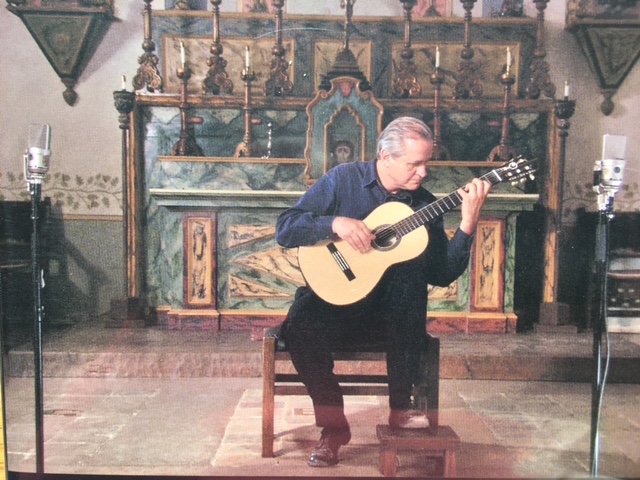
            Yesterday, after more than a decade of not playing my guitar, I had a lesson from my former teacher, Ray Reussner, who studied with Segovia in Spain and for many years thereafter. He led me to my familiar place by the window in the living room of his house, where he had set up two chairs with footstools and a music stand. Once again there was the familiar talk about fingernails, the stories about Segovia, the correction of technique, the beautiful sound of Ray Reussner on his guitar. I have at last returned.
 
Ray Reussner playing at Mission San Antonio in California
            The beginning of what I had returned to was almost twenty years ago when, realizing at last that I would never have a piano, I thought maybe a classical guitar would give me the same pleasure. The glow I felt when I walked out of the music store with a guitar in my hand promised as much
            I did enjoy it, but I became dissatisfied with my first teacher. There was something more I wanted from the guitar, but I didn't know what it was.
            When one of my students at Rogue Community College learned I played a classical guitar, he told me his father was friends with a guitarist in Williams who had been a student of Segovia. What a golden opportunity if I could take lessons from him! I asked for the name and phone number, but my student demurred. The man wasn't giving lessons or playing concerts or having anything more to do with the guitar than playing in his own home. I begged and pleaded and did everything but guarantee my student an A in the class if he would put me in touch with this guitarist until finally he got permission from Ray to give me his phone number.
            I called Ray at once and explained that I was new to the guitar and would like to take lessons from him.
            "No, no. I'm not doing that any more," he said, but then he relented – a bit. "Come on over and bring your guitar, and we'll see," he said.
            Was I going to have to audition for lessons from Ray Reussner? I worked up a piece to play for him, then put my guitar in my car and followed Ray's directions to his house.
            He greeted me at the door and led me through the vestibule and dining room into the living room of his beautiful house, which, I learned later, he had built himself. The footstool and music stand were ready. We sat down, and I played my piece.
            When I finished, he said, dismissively, "You play just like everyone else," and he took my guitar from me and played Mendelssohn's "Song without Words" on it.
            I almost fell out of my chair. This was it! This was what classical guitar was supposed to sound like. This was the way I wanted to play. I was ready to do anything to get Ray to agree to give me lessons.
            I think it was that reaction that did the trick: Ray accepted me as a guitar student. For years I came to his house for lessons. We would sit by the window in the living room and play guitars. He would tell Segovia stories. We would compare fingernails. He would play for me the latest piece he was working on. Taking lessons from Ray was like having a private Ray Reussner mini-concert at every lesson.
            I was crazy about my guitar. I practiced religiously. Unwilling to go three weeks without practicing, I carried my guitar to Sweden with me. 
I thought I would always be playing the guitar. 
Even when I started a Ph.D. program at the University of Oregon, I thought that, of course, I would keep playing. Soon enough, though, I realized that I couldn't be doing everything I had always done in my always full life and just add graduate school on top of it. Some things would have to be left behind. The guitar was one.
            Once I put the guitar down, it was difficult to pick it up again after graduation.  I knew how badly I would play. I knew my fingers were out of practice, that I had forgotten everything Ray had taught me. I knew I wouldn't be able to start again where I had left off, that I would have to go back to beginner's pieces. My fingers had become unwilling, and my pleasure stifled.
            Then at a gathering some time before Christmas last year, when people started playing music together, my son put a guitar in my hand. At first I couldn't remember a single chord. Then my fingers stumbled onto one or two. Other people left the room until only my son and I were playing together. As I played with him, the old pleasure began stirring in me. My New Year's resolution was to start playing my guitar again.
            That's all it took. Once I wrapped my arms around my beautiful guitar, the one Ray had made and that I had bought years ago, 

once I put my old music on my music stand (the one my son had made for me), 

once I heard again the beautiful tones of my guitar, I knew I had returned. The musicianship is rusty, but I have the best guitar teacher in the country, and I love my guitar and the music within it. Gradually, as before, Ray Reussner will help me coax that beauty into the world.


Thursday, March 23, 2017

The Golden Living Center That Belies Its Name


           Today is my sister Linda's birthday. She's eighteen months older than I, and she has Lewy body dementia. She lives in a facility in Georgia called the Golden Living Center.
Linda, behind me, in the North Carolina woods,
2009, the year before the onset of the disease
             I'll send her a card, as I do twice a week, anyway, a handmade card, on which I write a few lines – "Happy birthday," in this case, useless a wish though it is. I depend on her husband or another visitor to read it to her. 
I don't know how much of what I say registers with her. The idea is just to say, again and again, "You are not forgotten. I love you. I think about you. I am so, so sorry for what has happened to you."
Linda (center) with siblings in 2012, two years after the onset of the disease
            I put the card in an envelope and address it to her at the Golden Living Center.
           I choke every time I write those words. They are so outrageously inappropriate they're not even ironic. Golden living, indeed. There is nothing golden about Linda's life in that place. Her speech is garbled into nonsense. She is wheelchair bound, strapped in, even, because if she should try to stand (and who can blame her?), she is likely to fall, and a fall is so likely, I can't want her freed of that restraint, either. I cringe to think of her at the whim of some attendant or some visitor just to move from a bed to a wheelchair, from a spot in front of the television to a different spot by the window, though there is no view to look at. Then to sit there for hours, unable to talk or read or make her wants known. She spends hours in bed, hallucinating, sleeping, existing. None of those are golden hours.
            Nor is there any silver lining to the cloud hanging over her mind, unless being cared for in the most basic way – food, shelter, bathing – is enough to be thankful for. At least there is no abuse in this facility. At least the residents are kept clean and given adequate food. Is that the silver lining? Is that the best we can hope for at the Golden Living Center? What about a friendly touch? Someone to check in and say, "How are you?" Someone to bring her a glass of water, give her a massage, read my cards to her? That's a lot to ask for in a place like that, with over-worked attendants and demented patients.
Linda, seated, with sisters, in the first facility she lived in,
before the disease worsened (2014)
            How dare we call a place like that a "golden living center"? It doesn't even have flowers and bird cages, as at the first facility, along the back wall of the sunny porch, pictured above. There is hardly any space outdoors to wheel her around when we come to visit. I assume the healthy and well compensated people who named the place were thinking of the golden years of life, those years after retirement, before old age takes its toll. My sister falls within that time range, but there is nothing golden about these years for her. They are gray. They are the clouds without the silver linings, the dimness of daylight without golden sunshine, the fog of monotony, dreariness, and an empty mind. They are as dross.
            When I was a child there was a facility like this one, called the old folks' home. That's pretty bad, too, as though when one becomes old, that's what becomes of one. I visited the place with a Girl Scout troop once. An old woman in an upstairs room cried out in her delusions. Old men dozed in their wheelchairs on the porch. Would it be better to say they were at the Golden Living Center?
            I am sorry my sister is there. I am sorry her golden years have tarnished. I wish this disease had not chosen her. I wish there were some way to bring happiness into the grayness of her existence. I wish I didn't have to write "Golden Living Center" on the envelope when I write to her.
Linda at the "Golden Living" Center, with our brother and sister, 2016.
Maybe to visit her and wheel her in the sunshine to a small concrete patio
does bring her a moment of happiness.

Thursday, March 16, 2017

Balance


            Before I made a trip to Eugene last fall, I decided I should have snow tires put on my highway car, the Yaris. Because my bridge was being rebuilt, the Yaris was on the paved-road side of the creek, and I used my winter-and-trails car, the RAV 4, as a shuttle to and from the bridge site. I left it at the top of the muddy-muddy-muddy part of the road at the ford through the creek. When I came home from town, I would just park the Yaris on the paved road, cross the creek on a plank, and plow through all that mud to get to the RAV 4. I had been walking that way for two weeks. I didn't think I would have trouble carrying my snow tires with me across the creek on the planks to put them in the Yaris.       
            Two days before I left to have my tires changed, an all-night rain swelled the creek. I had to wade through water to get to the planks, and the creek was washing over them, too. The next morning, though, the water had subsided, so I managed easily enough carrying the tires across the creek to the Yaris and went on to town to have them mounted. But when the worker at Les Schwab started to put the tires on the car, he discovered that someone had slashed two of them with a knife. I didn't believe him at first – it must have been the claw of a cougar or the tooth of a bear. But the man was certain. He showed me the cuts. "Nothing but a knife could do that," he said.
            Who would have arbitrarily gone into my shed, way up here on the mountain, and slashed my tires? I don't know who, but someone did, some creepy, mean, malicious person. I left the tire shop upset, worried, and $335 poorer.
            By noon I was back at the broken bridge, carrying first groceries, then, one by one, my four highway tires back over the creek to the waiting RAV 4. When I still had two tires to carry, two teen-age girls, who live on the next property up the road but whom I had never met, appeared and offered to help me carry the tires. Gratefully, I gave one tire to one and the other tire to the other and followed them across the creek to the RAV 4. They charged up the road and through the mud as though they didn't have any burden at all, those strapping young country girls. Did I know, they asked as they put the tires in the back of my car, that their driveway went past their house and had a gate onto my road, up the hills, where the road leveled off? They would open the gate for me, they said, and until my bridge was repaired, I could use their driveway to access my own.
            My heart warmed towards these good neighbors. What can you say about a world with such good people in it?