Thursday, May 30, 2019

The Wedding, Part 2

      With such a beginning as the bride's arrival by canoe (see last week's post) and the beautiful procession of the wedding party, in various purples,

the children tossing rose petals in our path and then pelting us with them when we stood under the arch,

the wedding was propelled into a swirl of beauty and meaningfulness that fulfilled my goal to give people an experience that would make it worth their while to travel whatever distance they had come to be there. 
        "I don't know which part I liked best," people said later. (No one mentioned the big tent, provided by Mike's family, as the best part, but when it started raining, I was sure it was.) In truth, each part was wonderful. Below are descriptions of some parts, to give you the flavor of the whole.
The ceremony: Noel Chatroux told stories about Mike and me and how we met, then read John Donne's poem, "The Good Morrow," which begins, "I wonder, by my troth, what thou and I / Did till we loved," a very appropriate line. (Noel read the poem beautifully, and it's one I love, but no one  else mentioned it as a favorite.) Although Mike had particularly asked for some mention of the importance of community to marriage, Noel didn't talk about that. Instead he embodied it by asking the audience to join him in the proclamation of marriage by repeating after him, line by line,
                        "It is our honor,
                        here at the holy center of the universe,
                        in this crucible of love and truth,
                        with the blessing of our ancestors,
                        of the rivers, mountains, and forests,
                        and the support of all living beings,
                        to pronounce Mike and Diana husband and wife."
Our guests loved this part.
The vows: Mike and I had written our own vows. Each of us said, in various forms of beautiful words, metaphors, and sincerity, "I promise to listen to you, to love you, to be with you always." Some people said the vows were the best part of the ceremony. Certainly it was one of my favorite parts. I cherish those words.

The spiral: Another frequently mentioned favorite was the spiral led by my daughter-in-law, Leah.  After Mike and I had been pronounced, by the entire community, husband and wife, we walked to the center of the field, then turned to face the audience again. Leah told everyone to join hands – "Don 't let go!" – and make a big circle around us. Then she broke into the circle by taking the hand of the youngest child and leading her and, linked by hands, the whole circle of friends in a spiral closer and closer to Mike and me in the center. When she reached us, she reversed direction, still holding hands with the child behind her, and started back. In this way the entire line of people spiraled towards Mike and me, wishing us congratulations as they passed us.

Wedding music: I didn't hear Ela's music for the hour before the ceremony, of course, since I was up the river, waiting for my cue to set forth in the canoe, but people told me later how much they enjoyed hearing Ela play his Stamenphone and Metalphor and witnessing those sculpture-instruments. He played the tinkling little Rumitone during the procession, then the Stamenphone again for the spiral, accompanied by our friend Rick Faist on drums. Ela's music was another frequently mentioned favorite part.
The dinner: The lasagna pot-luck worked like all potlucks: some people got great food; others had different luck. But there was plenty of food and plenty of wine, and when I looked around at the tables of guests, I saw that the seating arrangements Mike and I had meticulously worked out were good. Everyone was having a good time.
The cake: Allegra, Mike's daughter, had made our cake: layers of chocolate cake with chocolate fudge frosting and orange cake with cream cheese frosting, the entire thing mounded like a mountain, covered with chocolate icing, through which wound a trail leading to two tiny hiker figures on top. Mike and I fed each other cake, as bride and groom would traditionally do, symbolic of our newly formed lives of sharing. The cakes were delicious.

My purple hair: The purple highlights in my hair were a hit of the evening. The children particularly liked this part.
The Flamingo: Our emcee, who was Mike's niece, Laura, announced that Mike had a hidden artistic side, that he had made the stained-glass sculpture of a flamingo people had seen by the cake, and that we would draw names from a hat to determine who would take the flamingo home. I, too, had an artistic side, she said, so there was a poem to go with the flamingo. Somewhat to my embarrassment, I drew Ela's name from the hat, but everyone cheered, and Ela was delighted. I read the poem aloud, which people enjoyed.
The Béoncé skit: As a surprise for Mike, I did a skit with my sisters about "if you like a thing, you should put a ring on it," from "All the Single Ladies," by Béoncé, ending with a Béoncé flash of rings with some of the girls at the wedding, then my thanking Mike "for this ring, this day, this rest-of-my-life happiness" and asking him if he would dance me to the end of love.
 The dancing: Leonard Cohen's "Dance Me to the End of Love" was the "first dance" Mike and I had picked out. Alice DiMicele sang it beautifully. I loved having this band play at my wedding! Their style of music was perfect for listening and for dancing, and Alice had chosen a repertoire of songs appropriate for a wedding. Mike and I had practiced a little extra twirl for our "first dance," which we pulled off perfectly. Other couples joined us, and from then on, the dance floor was always full.
The send-off: Included at each place setting at the tables was a small bag of lavender buds. As Mike and I passed through the crowd to the parking lot and our get-away car, our guests tossed lavender buds over us. The air was suddenly scented with lavender. Mike and I got in the car and were driven to the White House B&B in Medford, where we would spend the night, full of happiness, full of love, and full to the brim with the joy of such an occasion with so many friends and family.
Lying in the rose petals after the procession

Thursday, May 23, 2019

The Wedding Part 1: Bride's Entrance

        Last week Mike and I had the most fabulous wedding ever. Truly, I think that's so. Listen to this beginning (I'll write about the rest of the wedding in a later post) and see if you don't agree.
        Our guests and all the wedding party except for me (the bride); my brother, Lee; and my grandnephew Isaac; assembled at River Crest Ranch on the Upper Applegate River. If the sun wasn't exactly shining that day, at least it wasn't exactly washed out by rain, either. Mike's family had generously provided a large tent, anyway, so no one had to worry about weather. My son, Ela, was playing music on his Stamenphone and Mealphor as people gathered. At the appointed time, he gave a grand blow on the conch, and Mike led the wedding party, followed by all the guests, across the broad expanse of green grass and down a bank to the trail above the river.
        Lee, Isaac, and I were waiting in a canoe upriver on the other shore. When we heard the conch again, Lee cried, "That's it!" and we pushed off and headed down the river.
       The river was flowing fast. It had been so fast these past several weeks that Mike and I had worried about my going down it in a canoe, so the weekend before the wedding, we asked a friend who is a river guide to look at it for us.
        "There's no problem going down this in a canoe," he said, looking at the river, so the three of us took a practice run. Our successful landing assured Mike and me that the bride's entrance by canoe could be done.
        Before the rehearsal the day before the wedding, Lee, a practiced river runner; Isaac, a canoeing novice and enthusiastic bowman; and I made another practice run. We launched easily from the calm pool at the edge of the river, Lee facing the canoe upstream before turning it into the current. Down we went. The tricky bit came at the end of the run, when we had to swing into an eddy to keep from being swept into the rapids. The eddy would take us to the take-out place below the trail where all the wedding guests would be watching. Unfortunately, Lee started the turn into the eddy slightly too late and had to fight the current to keep us from being swept into the rapids. He managed to land us successfully, to everyone's relief.
        A few hours later, when we came down the river for the rehearsal itself, Lee underestimated the turn, and we banged into the large rock at river's edge, bow head-on, BAM! Lee backed us into the current, then turned onto the beach.
        The day of the wedding, Lee, Isaac, and I sat in the canoe at the launch site, waiting, I in my long white wedding gown, holding a gorgeous bouquet of colorful flowers, my bangs and the front edges of my hair dyed purple. (The wedding theme was lavender.) Lee was in a purple hat with a white feather, and he and Isaac both wore purple shirts. When Lee cried "That's it!" at the sound of the conch, Isaac cast off, and Lee turned us into the current. As the wedding guests caught sight of us coming down the river in our red canoe, they gave a great cheer. 

I waved my bouquet high over my head. The cheers increased. I was told later that I was beaming and that Isaac looked terrified as Lee made what turned out to be a very accurate turn into the eddy. His timing was perfect, and, to the cheers of the crowd, we landed gracefully on the beach.

        Mike, looking splendid in his tails and purple vest, was waiting there to receive me, his bride. He reached out his hand to help me from the canoe and gave me a big kiss before taking my arm and leading me through the crowd up the hill to the green lawn, followed by the wedding party. 

We waited at the edge of the green while the wedding guests took their seats.
        Then our flower-strewing attendants—Mike's four grandchildren, my granddaughter, and her cousin—spread rose petals in our path as we made our way across the green to the wedding platform to stand under the grapevine wedding arch Mike had made, its four legs anchored in a part of hiking boots and a pair of ski boots. Now flower-bedecked, it framed Mike and me as our attendants—my two sisters, Lee, and Isaac on one side; Mike's two daughters, brother, and nephew on the other; all in various purple garb—fanned on either side of us. The flower-strewing attendants threw the rest of their rest petals on us, and our officiant stepped to the microphone to begin the ceremony.

Thursday, May 9, 2019

Wedding Bells Will Ring

        Andrew Marvell said, in a poem to his coy mistress, "But at my back I always hear/Time's winged chariot drawing near." He was referring to his desire to make love to his beloved before she grew old, but the phrase echoes in my ear because, whatever does or does not get done, Time draws nearer and nearer with the big wedding day, May 18, in his chariot.
        There's a huge lot to think about and do—so many details! I had the final fitting for my dress this afternoon. (No picture; Mike reads my blog.) Mike has made the wedding arch, using grapevines and a firm foundation in old hiking boots and ski boots, illustrative of two activities we so much enjoy together and that brought us together in the first place.

We have met with the officiant to discuss his role. Mike's sister-in-law is doing such a great job organizing the lasagna-and-salad pot-luck dinner I've crossed that worry off my list. I'll let her deal with the gluten-free people and the vegetarians and the people who refuse to eat anyone else's food. A pot-luck might be strange at a wedding, but the alternative was to restrict the number of guests to a handful and provide a dinner. We chose to include many friends and ask them to participate. There'll be plenty of wine, thanks to a number of generous donors. 
        I've made all the food for the combined-family brunch at my house and put it in my freezer. The weed-eating and window-washing are scheduled four days before the brunch.
        The wedding will take place on the upper Applegate River. Everyone in the wedding has received a map of the land, showing were to wait, where to walk, and where to stand. My son will start the ceremony by playing his piano-wire-and-steel instrument, the Stamenphone, on the lower river trail. 
Ela, playing his Stamenphone at the Oregon Country Fair, 2009
All the guests will gather on that trail to watch the entrances. The groom and all the attendants—his brother, nephew, two daughters, and four grandchildren; my two sisters, my granddaughter, and her cousin—will come from one direction. My entrance, attended by my brother and grandnephew, is a secret but has been well planned. After all that, the children will strew rose petals in the path, leading the whole procession to the wedding platform with its wedding arch, by that time decorated with flowers and boughs. All the guests will join the procession.
        My vows are written. I will promise to love, and I will promise to honor, but I do not promise to obey. I do not promise to call the sun the moon just because Mike says it is. I trust that Mike will not try to tame me, and I will promise not to become a shrew because I wouldn't, would I? if I loved and honored my husband.
        My husband. The words sound thick on my tongue, just as thick as "his wife." It's such an enormous step I blanch. I understand the essay "How to Get out of a Locked Trunk," by a man who was about to get married. I've often wondered how his marriage turned out. I think about my friend who said he woke up the day after his wedding and thought, "I've just made the biggest mistake of my life." The excitement so many of my friends and even more distant acquaintances have expressed about my marriage is a little puzzling. Knowing how many marriages end in divorce, why all the excitement?
        When Mike and I talked about getting married, he said, hesitantly, "What would change?" I shrugged and said, "Nothing." On the face of it, that's true. Neither of us will move in with the other, so our living situations won't change. (Most people think this is strange, but one friend said, "I get it. Why ruin a good thing?") Somehow, though, I feel that something enormous will change when we are husband and wife. I'm not sure what it is, but I know there will be a difference. It's a difference that scares me, after being single all my life, but one I know, in the depths of my heart, is right.

Thursday, May 2, 2019

Tactile Diversity

        As we are all aware, the planet's rich diversity of botanical and zoological beings diminishes daily. MacDonald's and Taco Bell, neckties and blue jeans, rock-and-roll and its offspring endanger the diversity of cultures around the world. I mourn all diminishment of diversity, but these losses remain abstract because distant. I have been thinking lately about the loss of a different kind of diversity, something so individual and small it's easy not to notice. I'm speaking about the tactile diversity we lose when we go digital.
        I have been handling a lot of photographs recently, pulling them from my albums for various projects: my 75 favorite photographs, one of the items on my 75x75 list; 75 favorite hikes, a list I augmented with a photograph from each hike; a slide show of my past and Mike's to run as a loop at our wedding reception; wedding photographs of Mike's family and mine. For all these projects, I was using printed photographs. I touched, felt, and smelled them, besides looking at them. That's when I started thinking about tactile diversity.
        Looking at these pictures, I was fingering slick, cardboard-thick paper. When I held up to the light a picture of me with the dog of my childhood, I noticed its faint scallops of water stains in the upper left corner. I fingered the ragged edges of the picture of me on a glacial ascent in the French Alps. My hands, like my eyes, made adjustments for larger or smaller photographs as I pulled them from their places in albums. My sense of touch was as active as my sense of sight. Digital photographs give us the advantage of superior visual products, but the tactile experience is eliminated.
        Likewise, computer calculations eliminate the pen. We miss the action of flinging the pen into the wastebasket because it's out of ink. We miss the touch of the rounded edges of the hexagonal wooden pencil or the round contours of the cool metal pen or the tacky rubbery spots on the mechanical pencil with its tiny click when we need more lead. We miss the motion of the hand making figures and taking notes. Computers give us accurate calculations with ease while our bodies do nothing.
        As for books, there is something satisfying about opening a book and holding it to read it. Some books, like Disgrace, can be small and light to hold no matter the gravity of the words within. Others, coffee-table books like Oregon Rivers, can be so heavy they pull the hand down when we pick them up. Books might have hard covers with dog-eared edges or soft, slick covers. We hold books with two hands or with one, the edge of the book pressing against our thumb or finger as we read. All ebooks, though, look and feel alike. On an ebook device, we have no tactile relationship with what we are reading.
        When we use our digital devices, we reduce tactile diversity to one thing only: the fingers on the electronic surface. That's like having only squirrels and dandelions as our fauna and flora. I certainly don't think we should return to cameras with film and calculations with pens (though I should hope we never replace books!), but maybe if we are aware of losing tactile diversity, we might pay attention to tactile sensations elsewhere to compensate for their loss when we go digital.

Thursday, April 25, 2019

Who Barbee Heilman Was to Me

      When I was pregnant with my son, Ela, his dad and I joined our friends Hap and Barbee to live in a small cabin on the Cherokee Indian Reservation in the Smoky Mountains. (See the April 11 post for more tales about life on the Cherokee Reservation.)
Barbee
The cabin sat in lush greenery on the side of Noble Mountain, miles from any neighbors and without electricity or a telephone. The cabin's owners, who, like all the other Indians on the reservation, had long ago moved to the valley, were glad to see the family cabin lived in again. It was an especially nice arrangement for the four of us because Barbee was pregnant, too, and due about the same time I was.
         While Dan and Hap worked on the cabin and talked about the state of the world, Barbee and I did our Lamaze exercises on the cabin floor together, learning to breathe with the expected labor pains, fluttering our fingers in effleurage over our rounded bellies. We shared our pregnancy experiences, whispered secrets of the womb, talked about babies, diets, breast feeding. We would both have natural childbirth, but whereas Hap and Barbee opted to have their baby in the hospital in Knoxville, Dan and I would have ours there in the cabin. Dan would deliver.
        When the time came for Hap and Barbee to leave, I stood at the cabin door watching him help her across the yard to their car. Barbee turned around to wave to me, smiling over her pregnant belly. I waved back, smiling over mine. The world would be different when we met again.
        Dan and I stayed at the cabin and waited. I worked in the garden. I hiked up Noble Mountain. Dan made a baby bed. We weren't afraid to have a baby so far away from help. I was strong and healthy. We had read a lot of books.
       Ela was born on the morning of April 20, spurting into the world with wide-open, excited eyes. As soon as Dan felt he could leave, he drove into the valley to call Hap and Barbee, and when he reached Hap, Hap told him that Barbee was in labor. Their baby was born later that same day.
      A few weeks after the babies were born, Hap, Barbee, and their daughter, Apple, came home to the cabin. When I heard their car pulling into the driveway, I ran to the door of the cabin with my baby in my arms. Barbee was walking towards me with her baby in her arms. We met on the doorstep, and in our hug was the world of difference we had anticipated when we last parted.
      We lived together in that cabin for another couple of months, nursing our babies, learning to be mothers, strengthening the already close bond between us. That bond never weakened in the years since our life together in the cabin, even though Barbee and Hap remained in Tennessee, while Dan and I moved to Oregon.
At the cabin, about 20 years later. Barbee and Hap on the extreme left; Apple and Ela on the right. I am in the center.
 Barbee Heilman was one of the most beautiful spirits in my life. She died this past Easter Sunday, the day after the birthday of our "twin" children. She didn't die after "a long battle with cancer" but after a short, intense battle with cancer, during which she was the same smiling, gracious, beautiful person she always had been. She was Buddhist and more than anyone I know, exhibited the principles of Buddhism, as much in her dying as in her living. She was a sister of my soul. I am going to miss her more than I can say. 
Hap and Barbee, about a week before she died. 

Thursday, April 18, 2019

A Talented Docent Can Change the World


        You go on a tour of Oregon Caves, you visit the Heceta Head lighthouse, you go to a museum or historical house or battlefield, and a docent will tell you the story behind it all. And then you go to Montpelier, James Madison's home in Virginia,
and you find a storyteller so talented you not only feel the spell of history but leave a little wiser than when you came.
        Jeb Gray has a rare ability to feel the thrill of history. "In these very chairs, around this very table, sat the great men: Madison, Jefferson, Adams." To us the life-size cardboard silhouettes gave a simulacrum of a dinner at Montpelier,
but I had the impression that Jeb was seeing the actual people, hearing their conversations and debates about the country they were founding. As he told us about the important role Dolley Madison played in our history – arguably as important as that of her husband, James – he brought her powerful presence into our presence. I had been aware of how important Dolley was, but I never knew it, the way Jeb Gray knows.
        One reason his storytelling was so captivating was that he obviously loved his subject – history, yes, but James Madison, as subject, even more. He loved the man. When he told us of James's childhood – growing up on a wealthy plantation in Virginia, learning Greek and Latin and several modern languages before he was eleven – his admiration was palpable.
        But Jeb Gray did not let admiration prevent him from seeing truth, and the truth was that James Madison, that great man whose ideas about government by the people were powerful enough to build a nation, owned slaves. Jeb also did not let his esteem for Dolley Madison whitewash the fact that she sold her well-loved slaves, who had served her for decades, to pay the debts of her gambling-crazy son. Nor did he let "the consciousness of the day" excuse such acts. Nor did he stint on making it clear what owning slaves meant, even when the owners were kind, as the Madisons were, because in the end, a slave was property, and property could be sold, whatever the consequences to such "property," the human cost to love and family. In their life-times neither James nor Dolley ever freed a single slave. Without voicing his condemnation, Jeb Gray let hang in the air how reprehensible, unethical, and immoral such behavior is. Even from people he also revered.
        It was more than what Jeb Gray was telling us, though, and more than the implications he left for us to understand that made him a docent who could, in his own small-step way, change the world. It was his storytelling talent. In the room in which Madison died, next to the bed in which he died, Jeb told us about that death, spinning images that stuck vividly in our minds. He told us about Paul Jennings, the slave who was Madison's valet, picking him up in his arms and laying him in the bed as he was dying. Then Jeb read Jennings's written description of that death, letting us feel not just the impact of it on the devoted attendant, but the impact of such good writing on us. The account was movingly, beautifully written. Jennings had absorbed his education by being around Madison and could write like that! And was a slave. The impact of slavery sank onto us without Jeb Gray having to say a word about it.
        I've heard a lot of docents, but Jeb Gray is the only one who could not only bring the story alive in the imagination of the listener but let the moral significance of that story leave its effect on the listener's conscience. Being a docent seems like a small-impact job, but every one of us in the group tour at Montpelier that day left with a slightly stronger sense of the evils of slavery in addition to the image of a man who did great deeds while still perpetuating that evil. Can a docent change the world? One small step at a time.

Thursday, April 11, 2019

Basket-making with a Cherokee Indian Who Knows Her Craft

        In 1972 I lived in a cabin on the Cherokee Indian Reservation near Cherokee, North Carolina, as guests of Emmaline and Russell McCoy, who lived down the mountain, in the valley.  Emmaline was full-blooded Cherokee; Russell was part Cherokee. My partner, Dan, and I were living in the cabin with another couple, Hap and Barbee. Barbee and I were both pregnant when Dan and I joined them in the cabin. On April 20 the four of us in the cabin suddenly became six. 
      There was no electricity there on the mountain, and no telephone. There was a road to town, but we didn't take it very often. Mostly we were living the sort of cræfty life I talked about in my last blog: doing things the way they were done before motors and electricity. One day, for instance, Russell took all of us – the two couples and their two babies – way back in the woods to a bee tree he remembered from years ago, enough years ago that small trees had grown in the wide path we were using for a road. Russell kept having to get out of the car to cut them out of the way. But when we stopped, somewhere deep in the woods, his memory had served him well. There was indeed a bee tree there. Russell must have known that the bees were swarming then because it wasn't honey we were after but bees themselves. (Swarming bees don't sting.) Russell scraped an armload of bees into the hive he had brought, making sure he included the queen. Bees buzzed angrily all around us, but I don't remember that anyone got stung. We took the bees home in the back of Russell's pick-up and set up beekeeping.
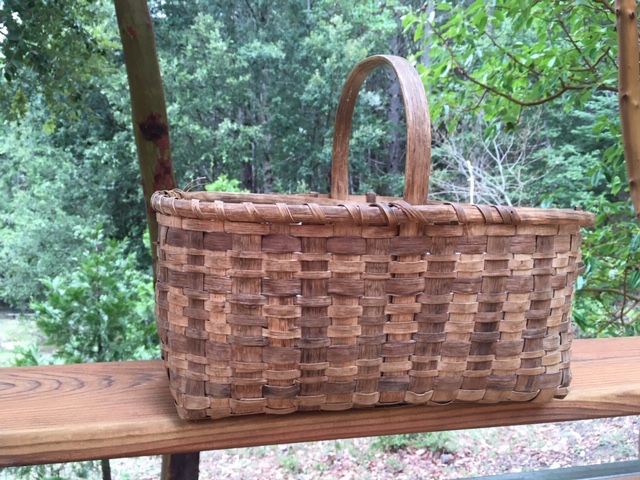
        Another day Emmaline took Barbee and me into the woods to find suitable white oaks for the baskets we had asked her to teach us to make. She showed us how to select good trees for making the splits. I don't remember what her criteria were or whether, after we selected a tree, we cut it down. Possibly Russell did, with a chain saw. When we got back to Emmaline's house, she showed us how to split the tree, dividing the pieces more and more finely, with a knife, until they parted easily into thin, pliant strips we could just pull apart. Emmaline used skillful, swift motions with her knife, starting at the top of the length of wood, then pulling it apart into two long, flexible slats. The pieces that would be the warp of the basket were about an inch wide, the horizontal weft pieces about a quarter inch. 
        After the strips were made, we boiled English walnut husks for a dye and dyed the pieces a dark brown. Some pieces stayed in longer than others and some absorbed the dye more than others, causing slight variations of color that, later, lent the baskets interesting rhythms of color. 
        When the wood was dyed and the dye had set, we put the long white-oak splits in water to keep them flexible and started weaving the baskets themselves. We were making rectangular baskets with a stiff rim and a stiff curved thick piece of white oak for a handle. It didn't take long to do the shaping and weaving. The finished baskets were sturdy and beautiful, and I loved having made my basket at Emmaline's tutelage, from gathering materials to tucking in the end of the last strip of oak.

      I used that basket for many years. I do still use it, for storing canning supplies, but my lack of skill in the craft showed where the oak splits broke at one side. Or maybe I was careless with the basket during one of my moves to a different location – from Cherokee to the Rogue Valley or from my first home there to my first house on this land, then, ten years ago, to the one I live in now. Always the basket went with me. It is a prized possession, not because it is a perfect basket but because I made it: from tree to materials to product.