Thursday, March 26, 2020

Coronavirus Stories

          I have been moved to tears by the ways people are helping each other during these difficult days. Players in the Rotterdam Philharmonic, for instance, put a video on youtube (google it) of each of them, unable to leave the house, playing with earphones so that they were all playing together. Of all wonderful selections, they played Beethoven's "Ode to Joy."
          Our joy will not be forgotten.
          In cities all over Europe people have come out on balconies and opened windows at 8:00 in the evening to applaud and appreciate their medical workers. Seeing this phenomenon online, hearing the tumult of applause, will bring tears to your eyes, too.
          Our gratitude will not be forgotten, either.
          The NPR program 1A closes each segment with a call from someone around the country with an uplifting story. A few days ago it was about a postman in a small town who gave $1200 to each employee of a beloved local restaurant. Many of my friends who don't normally use take-out are using it now just to keep their favorite restaurants in business.
          Our generosity will pull us through.
      I am donating back to the Metropolitan Opera and the New York Philharmonic the cost of my now useless tickets, since I won't be going to New York next month, after all, and the performances have been canceled, anyway. Same with my tickets to plays at the Oregon Shakespeare Festival that have had to be canceled. My priority is that our cultural institutions, large and small, like our restaurants and coffee shops, will still be here when we emerge from our houses.
          The most important thing I can do is to stay home, so I do, as much as possible. My husband's medical condition requires frequent trips to the hospital, but I stay in the car and knit while I wait for him.
          Trailkeepers of Oregon has asked that we not go on hikes, not because we can't keep social distance on a trail (though on steep mountain trails, that, too, becomes problematic) but so we don't take risks of twisting an ankle or getting lost or anything else that might use medical resources.
          So even though there's fresh snow in the mountains, I won't be cross-country skiing this weekend. The risk is too great. I'm not a flamboyant skier, but a friend's recent experience has made me think twice about my own behavior. A very good mountain biker and a normally cautious person, and super aware of not taking unnecessary chances during these times, he thought he could safely go for a short and careful ride, but when he got to the trailhead, he found the parking lot full. "People, this is not cool!" he thought, angrily. He decided to take a short, seldom used route before going home and was riding along, slow enough but emotionally distracted, when he crashed, tumbling down the mountain, his bicycle falling on top of him. Fortunately, he didn't have to call on medical facilities, but, see? We think we are safe; we undermine ourselves.
          I can see the distraction affecting me, too. For instance, my usual practice, when I'm ready to take a shower (I have an outdoor shower), is to hang my nightgown on the inside bathroom door and my towel on the door to the outside. After my shower this morning when I reached for my towel, I found that I had hung the nightgown where the towel should be and vice versa. Such unconscious action is a clue to distracted behavior.
          So I stay home, reading, writing, cooking, sewing, knitting, gardening, walking in my own hills. I've joined my yoga instructor's online class. And I stay buoyed by words of friends and family and by the examples that come through the internet of ways people are facing this crisis. Here is one such example, a poem by Donna Ashworth. May it give you the wings of hope we all need these days.

History Will Remember

History will remember when the world stopped
And flights stayed on the ground
And the cars parked in the street
And the trains didn't run.

History will remember when the schools closed
And the children stayed indoors
And the medical staff walked towards the fire
And they didn't run.

History will remember when when the people sang
On their balconies, in isolation
But so very much together
In courage and song.

History will remember when the people fought
For their old and their weak
Protected the vulnerable
By doing nothing at all.

History will remember when the virus left
And the houses opened
And the people came out
And hugged and kissed
And started again

Kinder then before.

Thursday, March 19, 2020

On the Mountain during the Coronavirus

          Day is just dawning. A crescent moon has slipped over the mountain, shiny white in a pale blue sky just beginning to throw off the night. When I stepped outside for a piece of firewood from the front porch, I heard the twitter of spring birds. The songbirds haven't arrived yet, but the early twitterers lift my heart. Humpy Mountain, west-facing, is still dark. Left-over snow patches its facade here and there. The sky glows softly behind the mountain.
          Nothing in nature cares that the human world is in the clutches of a cruel virus. (What nature does care about is climate change, but that's another story.) Everything up here on the mountain is as usual. Even that I am here alone is not unusual. I am reminded of the days I lived in my little house, here on the mountain, for so many years without electricity. When a storm hurled its power over my house, I was fine. With my kerosene lamps and wood-burning stove, I never knew when there was a blackout down the road. Life was as usual up here on the mountain.
          The difference now is that I do know that the coronavirus is playing havoc with people's lives down in the valley and collectively with societies all over the world. Like everyone else, I have been affected, not directly by the disease but by its effects. Mike and I had to cancel a planned trip to New Orleans for a stove convention for him, which he was sorry to miss, and, for me, a chance to see what New Orleans is all about. We will cancel our late-April trip to New York, too, since even if we ourselves felt safe, what would we do there, with restaurants closed and events canceled? The New York Philharmonic, the Metropolitan Opera, the off-Broadway play—tickets bought and money down the drain. And I was so looking forward to being in New York City.
          In the face of things, it's not a big deal.
          One person says, "Why are we bothering with all these cautions? We're all going to get coronavirus, anyway." Another person buys fourteen loaves of bread and packages of meat that will last a year. 
          I am at neither extreme, taking precautions without panicking. I wash my hands. I have adequate supplies. I have no need to go into town or take public transportation or be in crowds, which, I understand, don't exist anyway.
          I held a teleconference for the board meeting I chaired yesterday. I talk twice a day with Mike, who is stuck at his house in town (for other reasons, but that, too, is another story). I have my usual work and activities here at my house. I walk up and down the mountain every day. I watch the grouse flowers come into bloom, listen for the birds, take solace and inspiration from the mountain. My family is safe. There is a lot to be grateful for.

Thursday, March 12, 2020

Pushing the Ski-now Button

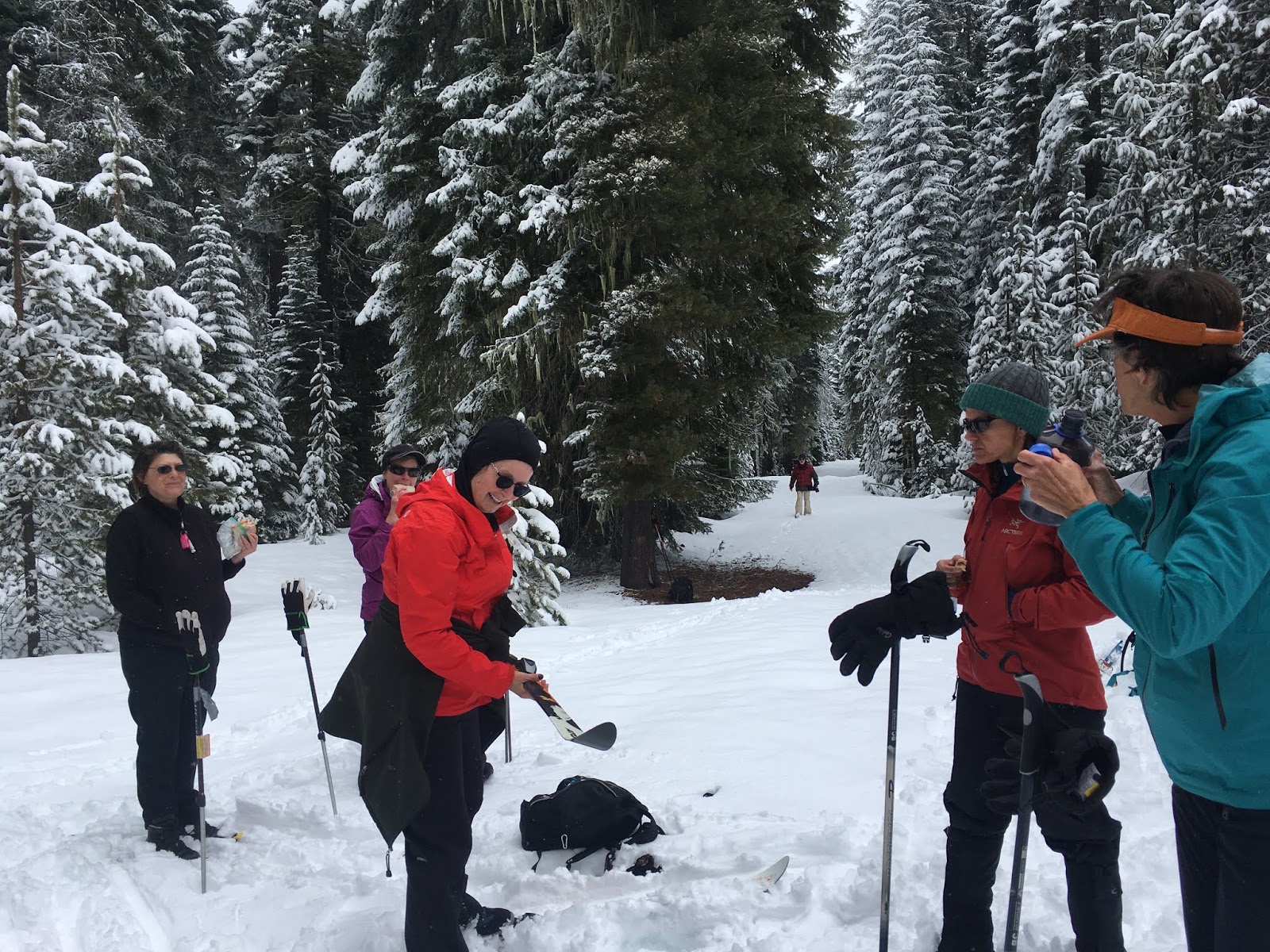
          The new-fallen snow was already six inches deep by the time the fourteen members of the Grants Pass Nordic Ski Club who had come to Lake of the Woods Resort for a weekend of skiing were strapping boots into skis and adjusting hats and gloves at the Pederson trailhead. After pizza the night before, we had walked from the restaurant into rain, which, overnight, turned into this beautiful new snow that had been pushing my ski-now button ever since I had waked up and looked out the window of my charming cabin.
My charming cabin
          Now I was waiting impatiently at the edge of a smooth white meadow. When Stacy took off in the lead, I pulled in behind her, too eager to wait longer, willing to yield as faster skiers caught up.
          Snow was falling lightly through the trees, padding thickly the ends of evergreen branches and turning inner limbs to lace.
Jan and Wendy just coming into view

When Stacy and I stopped to wait for the others, silence enfolded us. After a short time two skiers appeared, Jan, who had taken a moment to ski some small hills, and Wendy, who had been skiing with a maimed ski. Now that she had stopped, she pulled off the broken metal edge that had been dragging in the snow. No one else appeared behind us, so, after a reasonable wait, the four of us took off again.
          The whole group regathered where the trail met a road, untrammeled and white with new snow. We ate our lunches standing on skis.
Diana, Joan, Wendy, Stacy, Anne
After lunch, Joan, Dani, Anne, Ron, Paula, Tom, and Kathy took the road to return to the cars, while Stacy, Jan, Wendy, Magdi, and I skied farther up the hill before turning around for a superb float-on-skis trip back down to the lunch spot. There Stacy, Jan, and I turned into the woods to take the trail back to the trailhead, while Wendy and Magdi skied the road.
          First Stacy, then Jan, then I swept through the woods, separated by distance and a big silence. When Stacy and Jan stopped to let me catch up, we stood for a few minutes under the big trees with their snow-drooping limbs and dark trunks, listening to the whistling calls of small birds in the tree tops. Their tiny, occasional whistles pierced the silence like shooting stars in a dark sky blinking suddenly and going out.
          That night we crowded into Ron and Paula's cabin for Mexican-style hors d'oeuvres, then bundled up and walked to Joan and Dani's for burritos. The food was good and plentiful, amplified by margaritas and wine. We ate and drank and laughed and told stories. I read a piece I had written about cross-country skiing in the full moon years ago on the back side of Mt. Ashland because, before dessert at my cabin, we would also be doing a moonlight ski.
          Eight of us skied that night, under a nearly full moon, its light diffused by clouds. The moon turned everything into either white snow or black other. The forest was but charcoal strokes on white paper. We ourselves were black silhouettes. Dani's ski clothes are black anyway, but Anne's turquoise jacket, Stacy's red one, Jan's blue one, Magdi's and Joan's purple coats, even Wendy's bright red one turned black by the moon. I, in my white jacket, looked like the albino pigeon I saw a few weeks ago in a flock of dark gray pigeons. The moon occasionally broke through the clouds rewarding us with electric-bright light and sharp, deep shadows. Skiing in the moonlight, we sang moon songs: "Moonshadow," "Blue Moon," "Moon River." We skied till my feet were aching and I called for a return to the cars.
          The after-dark non skiers had, quite sensibly, not waited for us for dessert, so we took the remainder of the raspberry marzipan cake (Magdi's dinner contribution) to my cabin and had it and my marshmallow fudge brownies for our apres-ski treats,
Marshmallow fudge brownies
along with some port Magdi supplied. When my guests left, I filled the spa bathtub with hot water and a good dose of Epsom salts and sank into it.
          The next morning more new snow promised another superb day of skiing. Joan, Dani, Stefanie, Wendy, and Jan skied the moonlit route in daylight for nine and a quarter miles. I hated missing it, but my feet refused to go, so I put my skis in my car, scraped snow off its windows, and set out for home.
          If it was the last ski of the season, it was a good one. I could put away my skis well satisfied. In spite of too-warm weather and too little precipitation, the skiing has been great all season. Who knows? Maybe there is another good snowfall ahead of me yet to give my ski-now button one more good push.

Thursday, March 5, 2020

A Galaxy of Stars for the Siskiyou Crest

          For the past few days I was cross-country skiing in the Elkhorn Range of the Blue Mountains in Eastern Oregon, but I came home a day early, partly because I had skied all the trails at the Anthony Lakes Nordic Ski center and partly because Mike wasn't feeling well and couldn't ski. So, with a free day in front of me, I decided to hike up Charlie Buck trail in the Applegate today.
          It was a beautiful day for hiking. The sky was blue with lofty clouds. A wind kept me cool though I was sweating with the exertion of hiking that steep trail, and, when I got to the top of the trail, the Siskiyou Crest opened before me with its snowy peaks marching across the skyline. I couldn't get enough of staring at all that mass of mountainous beauty or walking in such spring wonders.
          At the top of the trail, just as I started across the broad open hillside to Baldy Peak, I met a man walking towards me. We chatted a bit, in friendly hiker fashion. He was Asian and lived in Washington, across the river from Portland. He was on his way to hike in Redwoods National Park and had stopped overnight in the Applegate to hike the Charlie Buck trail, which he had found on alltrails.com. He said it had been given a five-star rating, but he was disappointed because he didn't think it was a five-star trail.
          Not a five-star trail?! I spread my arms in an expansive gesture towards the snowy peaks of the Siskiyou Crest overtopping the steep green hills of our trail. "You don't think this is worth five stars?" I asked, incredulous
          He shrugged. "I would give it three stars," he said, "maybe four."
          I was so insulted! Three stars?! Four, maybe? For all of this?
          Then he went on his way, disappointed, and I went on mine, still enthralled by the beauty of the mountains all around me, the gorgeous spring weather, and the joy of walking, climbing, striding, exerting my body in nature. Later I watched two eagles circling and soaring over the canyons beneath me, their white heads and tails and black wings swooping against the sky. Only three stars? Only four?

         I had my five-star day. I'm sorry his didn't top a four.
         I didn't look up ratings for skiing at Anthony Lakes before I went there. I don't know what they might be on various websites, but for me, the skiing was perfect. It snowed the second night I was there, and that morning the sky cleared, creating perfect conditions: a couple of inches of fresh snow and a fiery blue sky behind the forest canopy. The needle-sharp peaks of the Blue Mountains, called Oregon's Alps, jabbed into the sky, glistening with their new snow.
There were no other skiers on the trails; I had the entire trail system to myself. I skied every trail at Anthony Lakes that day, some trails twice, always in that perfect solitude that amplified the beauty of the surroundings. The trails were groomed, so the skiing was free of dangers: no icy spots, no narrow passages, no trees to run into, the roads wide and smooth, the snow fresh, and I began to ski absolutely freely, climbing the hills, then free-falling on the descents, skiing fast, making graceful turns as I descended because everything in such conditions was graceful. The solitude in the forest and in the snow was magnificent. How many stars would I give those three hours of skiing? The entire Milky Way.
          And then someone would come along expecting something more from such a starry rating than, perhaps, he was getting, and instead of enjoying the experience would grumble that this wasn't worth such exuberant ratings.
          Maybe Mr. Asian Man would have enjoyed his hike better if he had opened his eyes to what was there instead of thinking it should have been something else. My five stars might be your three, but I'll take my galaxies of good times without caring how you would rate them.

Thursday, February 27, 2020

Literature and Lanscapes

        In the library to find some poetry by William Blake the other day, I passed an irresistible book on a new-books shelf called Literary Places. Its cover—copper-shiny lettering over a painting of a red-roofed Greek city at the edge of a blue sea—was as enticing as its title. I took it home, of course.
        What a wonderful book! Its premise—that to travel to a place made vivid in fiction is to relive that book in that place—is the same as that of my first lecture for the Oregon Council for the Humanities' Chautauqua Lecture Series, "Swedish Literature and Landscapes." I chose novels and poems in which the Swedish landscape is as significant as the characters, such as Vilhelm Moberg's The Emigrants, set in Smaland, and, most strikingly, sta Berlingssaga, by Selma Lagerlöf, the first woman and the first Swede to win the Nobel Prize in literature. That novel's vividly evoked Värmland is the perfect backdrop for such a wildly romantic tale of 18th-century Sweden. Driving through it in the summer of 2015, I could easily imagine the wolves running alongside Gösta's sledge as he carried away the beautiful Anna Stjärnhök. I could see the Burlita Cliff, where Major Fuchs refrained from using a silver bullet to kill the great bear so the sexton could do it and thus win the hand of the lovely Fröken Faber. The novel's dashing romanticism, its bargains with the devil, the loves lost and won, the cavaliers so goodhearted and so worthless, the struggles to do right in a world where passion and human weakness work against the desire to do the right thing—such tales are rightly placed in such a landscape.
        How could Sarah Baxter, who wrote Literary Places, have left out Gösta Berlingssaga? How could she, in fact, have left out My Antonia, in which the characters' lives and personalities are formed by the Nebraska prairie; or Jack London's The Call of the Wild, a novel in which landscape is character if ever there was one. Marjorie Kinnan Rawlings's young adult novel, The Yearling, depicts the Florida landscape in so much detail that my son and I made a relief map of it, placing the house, the bear hunt, the swamps and roads and fields of the book exactly in place. Albert Camus's The Stranger is so intricately involved with the landscape of Algeria that Camus described Mersault, its protagonist, as "a citizen of France domiciled in North Africa, a man of the Mediterranean, an homme du midi yet one who hardly partakes of the traditional Mediterranean culture" because he is so much a part of Algeria. The cities and deserts of North Africa are so well depicted in Paul Bowles's The Sheltering Sky that they become characters themselves, powerful forces in what I found to be a horrifying work of psychological terror. How could Liertary Places have left out these significant landscape-and-literature books?
        But that's the way with book lists, isn't it? Someone is going to have some favorite that the list-maker omitted. Baxter did include many books I would have included, the omission of which would have been egregious according to anyone's list: Victor Hugo's Les Misérables (Paris), Elena Ferrante's My Brilliant Friend (Naples), Charles Dickens's Oliver Twist (London), Gabriel Garcia Márquez's Love in the Time of Cholera (Columbia, though I would have chosen 100 Years of Solitude instead), and, above all, James Joyce's Ulysses, with its descriptions of Dublin so detailed I could walk Bloom's entire day's journey, from book's beginning to book's end, when I was in Dublin in 1967; and Emily Brontë's Wuthering Heights, a book whose characters could not be imagined anywhere except on those wild, windswept, cloud-glowered moors of northern England.
        You're probably wondering how I could leave out your favorite landscape-and-literature book. My reason is no doubt also Baxter's: There is a limit. One has to stop somewhere.

Thursday, February 20, 2020

Swallows in Chimneys, and Yet the Skiing Is Good

          A friend who lives on the Oregon coast posted, earlier this winter on Facebook, a photograph of a bird at his bird feeder that he said was a winter bird he doesn't see there often. "Is this a cooling trend?" he asks, tongue, I think, in cheek.
          In early January, my husband, who owns Home Comfort, a stove store in the Rogue Valley, was installing a new stove in a customer's house and found in the chimney a new swallows' nest. Swallows are protected birds during mating season, so their nests cannot be disturbed. The installation had to be postponed. The customer was fine with the delay. Let the birds raise their young, they said. When the babies fly away would be a good enough time to install the new stove.
          But swallows nesting in January? Didn't they know it was still winter? What were they thinking, that pair of swallows, starting their family in January?
          Is the trend towards warmer winters? Or is there a cooling trend? Think about the snow we had in the Rogue valley at the end of September. September? (And birds nesting in January?) With such a beginning, I looked forward to a wonderfully long cold winter, skiing every weekend and wearing my beautiful wool sweaters and lovely scarves.
          I sulked, then, when that promising beginning was followed by a long warm autumn. What happened to the cold winter I like so much? A snowfall just before Christmas seemed to promise its beginning, but then the temperatures rose again, and I pouted and fretted and complained again. A foot and a half of snow at my house in January sent me into ecstasy, but it melted all too soon, and we were back to autumn (if I'm being optimistic) or already welcoming spring (if I'm pessimistic).
          Somehow, though, in spite of too-warm temperatures, the skiing has been fabulous. 

On Lollipop Loop, at Fish Lake, Oregon (I'm in the red hat.)
The temperatures at higher altitudes have been just low enough to make rain down below snow up there, and the snow has been just enough on the weekends to make a soft cover over a hard-packed base. 
            There have even been days cold enough for me to wear my Uggs.
          A few weeks ago the temperatures dropped into the low twenties. Oh, it was beautiful! The trees were frosted white. Each branch, and each twig on each branch, was etched into sharpness. The fields were white. The hard grip of Old Man Winter was upon the land. Remembering that the snow didn't start till February last year and that even at that late start, we had plenty, not only for good skiing but also for summer water, I remained hopeful.
          Hope is rapidly waning.
          Is there a cooling trend or is there a warming trend? Winter birds show up on the Oregon coast as they used to do, but swallows build nests in January thinking it's spring already. It snows in September, then acts like spring, then turns ice-cold in February. What are we to make of such contradictory evidence?
          (1) We can admit that weather is not climate.
         (2) I can set aside my petty responses, realizing that for me cold weather is just a matter of what I like, not, as for native people of Alaska, for instance, a matter of life as they know it.
          (3) We can leave the predictions and interpretations to people who know a whole lot more than we do. (They say the globe is steadily and rapidly warming.)
          (4) I can like what I get, since both snow and warm, balmy days are beautiful.

Thursday, February 13, 2020

Valentine's Day

          The first Valentine's Day that Mike and I spent together after we were, I thought, securely sweethearts fell on a Monday, a night I was already spending at his house on a regular basis. 
          All disappointments come from expectations, so I'll admit that because I was looking forward to some small recognition of our sweetheart status, I was equally dismayed when nothing seemed forthcoming. Finally, I mentioned that this was Valentine's Day, somehow adding a subtle hint about Valentine gifts. 
       He was nonchalant and dismissive. He said he thought Valentine's Day was just some commercial trick, another way to make people buy things, and that it didn't deserve any attention.
          I was stunned. I said—well, I probably wailed, "I think it's an opportunity!"—an opportunity to say, "I love you," to recognize each other as sweethearts. "Don't you think of me in that capacity?" I asked—or, probably, wailed. 
           Oh, yes, yes, of course, he reassured me. But he hadn't thought it was necessary to give me something for Valentine's Day to say so. 
          I didn't say anything more, and we went to bed together as usual, but I was still upset. I was probably repeating the "opportunity" line, until finally Mike said, defensively, "But you didn't give me anything."
          "Oh, but I do have something," I said. "I didn't give it to you when I realized you didn't have anything for me because I didn't want to make you feel bad." But since I had already made him feel bad by being upset, I got out of bed and brought him his present: a wedge of Rogue Creamery's Rogue River Blue cheese, at that time one of the top sixteen cheeses in the world (and now judged number one, the best blue cheese in the world) along with a copy of the essay in my book Wisdom of the Heart that talks about chocolates and cheeses and ends with this paragraph: "Chocolate speaks for the heart. 'I love you. See? I brought you chocolates.' But any good food can speak for the heart. Maybe a wedge of Rogue River Blue would work as well. 'Here, sweetheart. Have a taste. C'est mon coeur qui parle.'"
          "It's my heart that speaks," I translated as I read the essay to Mike, there in bed. It was my heart speaking to him through my Valentine's Day gift, taking advantage of the opportunity that Valentine's Day gives us to let our hearts speak.
          We were reconciled, then, and fell asleep with love in our hearts. 
          You can be sure that Mike has never neglected Valentine's Day since.
          And, of course, I've built a box around myself because there's no way I can neglect Valentine's Day, either, after making such a big deal about it the first time. But that's all right. I like having an opportunity to do something special for Mike, something that is a voice from my heart. Tomorrow night he's coming over for dinner. I'll spend the day preparing: cooking, setting the table with my Provencal tablecloth, lighting candles, dressing in a black lace skirt with a black top and a red silk scarf. Mike will arrive with wine. I'll serve figs and arugula wrapped in prosciutto for hors d'oeuvres and, for dinner, pork tenderloin with carmelized pears, a three-cheese baked spinach, and wine-braised olives. For dessert, I'll set before him a mousse-filled chocolate heart, a little heart-shaped sandwich of white and dark chocolate filled with luscious chocolate mousse. When Mike says how beautiful everything is and how good the dinner, I'll say, "Yes, sweetheart. C'est mon coeur qui parle." Then I'll give him my present, which is the same thing I've given him for the past three years: a hardbound book of my love poems to him. Here is the last poem in this year's book:

Valentine Book of Love Poems, 20920

Bigger than ever
is this year's Valentine Book of Love Poems.
No wonder.
Fear of losing you to cancer spurred love into writing poetry.
The sunshine explosion of "cancer-free"
was a bigger reason yet.
Your placing a diamond ring on my left hand
set my pen scribbling at a zany pace.
Our wedding and honeymoon alone
were reasons enough for a hundred poems
and the fraction of those that emerged on paper
were as big with love as all one hundred.

Bigger than ever
were the reasons
to write love poems this year
but the biggest reason of all
is my love for you:
constantly growing
bigger than ever.