Thursday, August 26, 2021

What's Ahead Climate-wise


   The whole way home from my hike in Mt. Rainier National Park last week, I drove through smoke. Southern Oregon was especially bad. Those fires again. And hot as blazes again. The sun is a red ball of fire in a steel-gray sky. Apocalyptic images.

    As I drove I listened to the New York Times's radio program, "The Daily." The discussion was about the United Nations' latest report on climate change. The reporter made three points:

    (1) The report states definitively that the earth is growing hotter (fairly obvious to everyone on earth by now, I should think) and that the increased temperature is human-caused, that we have fouled our own nest.

    (2) Even if we stopped all carbon emissions immediately, we are stuck with the effects of climate change for thirty years—the fires, floods, hurricanes, droughts, and other extreme weather events that have so horrified us for the past decades. That means that for the rest of my life I'll see these unbearably hot summers at my home and these raging wildfires that stink up the air and destroy our forests and our homes. I have probably already seen the last of the heavy snows at my house (and how I loved that snow!), and it will become increasingly hard to find good skiing within a couple hours' drive. This summer's drought will be repeated, year after year. I'm afraid that the world as I knew and loved it is already over.

    (3) However, if we stopped all carbon emissions tomorrow (yesterday), we could turn things around after those thirty years. That is to say, there is a chance for my granddaughter to eventually experience a better world, in spite of the apocalyptic conditions my generation, and those before it, have brought to her. 

    Do we have the "political will" to make that change? Ask me personally: you bet! I'll do whatever it takes to renew our world in thirty years. Driving less, certainly. Maybe no more hiking in the Dolomites, as I would so love to do. Finding a way to take the bus—maybe there would be a service with a stop in the Applegate. Maybe we'll be given carbon rations—if you bicycle to work every day, you'll save enough carbon tickets to be able to drive to the beach on Saturday. Inconvenient, yes, but I'm willing. I'll do whatever is asked of me, to make those kinds of sacrifices to compensate for the selfishness I have indulged in, without knowing the harm I was causing, by my normal living. 

    The hitch is that we all have to be willing to make those sacrifices. Mine are meaningless unless they are matched by everyone else's. And I'm afraid the COVID pandemic has shown that many people in our country have very little concept of doing something for the common good. If people won't even get vaccinated, when the results are so immediate and so obvious, what will it take to get them to change drastically their way of life for results they'll never see, for a better life for the children's children they don't even know? If they won't even accept the government's efforts to make us wear masks to keep us safe—much less to shut things down for the same reasons—how will they ever accept restrictions on our use of carbon?

    We could avoid the collapse of all civilization, but are we willing to do what it takes? 

    I am. 

    And you?

Wednesday, August 18, 2021

And Then the Hike Itself

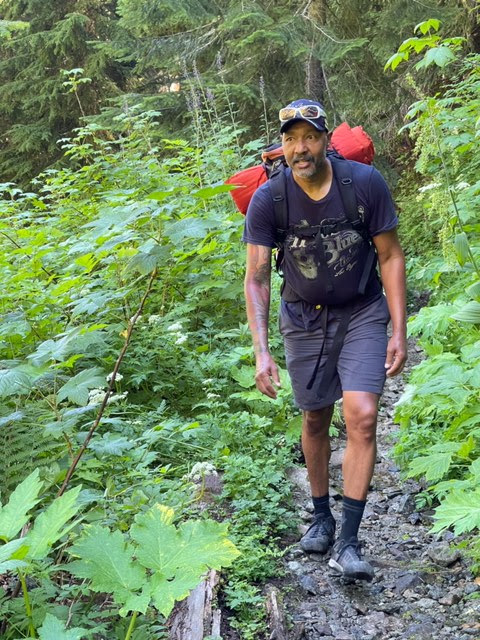
     Last week I did the much anticipated two-night backpacking trip on the Mother Mountain Loop at Mt. Rainier National Park with my son, Ela, and his friends Steve, Micala, and Lucius. My two previous posts expressed my anxiety about being able to do it, so now I'm obligated to tell you how I did.
    I did great. 
Photo by Lucius Williams
    And it was a great trip.
    The beginning was easy—car camping at Mowich Lake, with a good dinner of non-freeze-dried food. I swam in the lake, and, later, we all took a walk along the shore, where Ela played his bamboo flute,
Ela playing his flute high on the mountain.
Photo by Lucius Williams
sending that native-American sound 
meandering around the rock cliffs and floating over the broad expanse of the sunset-red lake.
    The next morning I was up at 6:00 for another swim. In the early-morning light I had that whole big beautiful lake to myself.
Photo by Lucius Williams
      With an eleven-mile hike ahead of us, to Ipsut Campground, we were on the trail by 8:30. 
     For the first few miles the trail humped its way, now gently, now steeply, through beautiful big-tree forests. Undergrowth was lush and the waterfalls jaw-droppingly beautiful. At the first waterfall we marveled at the long, thick ribbon of water, sunlit at its top, a hundred feet or more above us. But that was only prelude to the sight awaiting the nerves-of-steel hiker who, with all caution, crossed the two thin logs spanning the gushing river to the opposite shore,
A nerves-of-steel river crossing
     
 Photo by Diana Coogle
where the full waterfall came into view—the long free-fall before the water hit the rocks and spread out in a veil before coalescing into a river again. 
Micala and me at the waterfall Photo by Ela Lamblin
    At each river or creek crossing, usually on a flat-cut log with a pole railing on one side,
Micala on bridge            Photo by Lucius Williams
I stopped to admire—worship—the fullness of the water, streaming, cascading, gushing through greenery and rock. Yet in the back of my mind I knew that that force and gush of water that I loved to see was coming from the too-sudden, too-fast melt of Mt. Rainier's precious glaciers. 
    One bridge over a surging, silt-filled glacial river was especially daunting, as the water splashed over the bridge at the far end and boulders bumbled against each other in the tumbling current under the bridge.
Photo by Lucius Williams
    Whenever we emerged from the forest or rounded a curve in the trail, the glaciated bulk of Mt. Rainier, magnified by closeness, came into view—its rounded gray top, its thick white glaciers, its rocky sides. Always awesome.
Front to back: Me, Micala, Steve, Ela
Photo by Lucius Williams
    Around midday we emerged onto the high altitudes of Spray Park, a long series of flower-filled meadows. If I had loved the waterfalls, I loved no less the purple-red--yellow-and-white meadows
Photo by Lucius Williams
stretching through the rocks to the near edge of the world, beyond which were the Cascade peaks—Glacier Peak and Mt. Baker and all the lesser mountains in between. And, unforgettably, even when it was hidden over our shoulders by the nearer mounds, Mt. Rainier.
    The descent was long and beautiful with meadows,
Front to back: Me, Micala, Ela, admiring a flower
Photo by Lucius Williams
creek crossings, rocks, and trees. After taking off my boots to cross a creek, I walked barefooted for a mile or so on duff-soft ground. When the trail turned rocky again, I put my boots back on and, immediately around the bend, came upon Ela, Steve, Micala, and Lucius sprawled on the trail, leaning against packs, feet up, taking a good long rest. I was glad enough to join them. After that, for the rest of the way down the interminably descending trail, I never fell behind.
Front to back: Steve, me Micala, Ela, awed by a waterfall
                         Photo by Lucius Williams
   When we finally got to Ipsut Campground, eleven miles from Mowich Lake, I found a spot on the river where the water was less silty and just deep enough for me to sit in, then lie on my back, then turn over onto my stomach, bathing my entire hot-and-sweaty body. The campground was at the end of a road, now closed but still passable by bicycle, so two other friends, Ann and Todd, had bicycled in to join us for the night, bringing beer and wine with them.
    The next morning the prospect of the intimidatingly steep Ipsut Pass loomed ahead of us. Nonetheless (or maybe therefore), breakfast was leisurely, but I was anxious to get started, so Ann, Micala, and I headed out while Ela, Steve, Lucius, and Todd were still talking around the breakfast table. 
    Up through the forest, always up, but not steeply. I was hiking well. Many creek crossings. More waterfalls. After a couple of miles, Ann turned back; she and Todd had to bicycle back down the road. Micala and I continued up, mile after mile. 
   And then we were out of the forest, and the rock side of a mountain loomed ahead of us, vegetation dropping from it like a waterfall. The up turned steep. Steep and hot. We stopped in the shade of a solitary tree for water. Then on up, steep and hot. Another tree, another swig of water. Then on up. And then, suddenly, two more switchbacks and we were on the pass. High-five!
    I don't want to say it was easy, because it wasn't really easy, but what I want to say is that I did it without difficulty. All that training of the past two weeks—Ipsut Pass was a cinch. Micala and I sat on the pass for a long time, like a congratulatory committee for hikers as they came up. Ela and Steve came charging up, throwing sweat and beaming with the exultation of exertion. Ela perched on a high rock and played his ocarina, to the delight of hikers coming up. ("I knew the top wasn't far when I heard that music.") 
    After a bit Steve went back down the pass to check on Lucius. Pretty soon Steve came huffing back up the pass, fast, just for the fun of it. Lucius was fine. He would be here after a while. He's a photographer and was carrying heavy camera equipment and stopping frequently to take pictures.
Lucius Williams            Photo by Ela Lamblin
    Ela and Steve waited for Lucius, but I was ready for a swim, so Micala and I headed down the trail to Mowich Lake, where I slipped into the cold blue water for a good long swim under the snowy bulk of Mt. Rainier.
Coming in after a swim in Mowich Lake, facing Mt. Rainier 
       
Photo by Lucius Williams
Micala explored the trails a bit. Ela, Steve, and Lucius soon arrived and sat on a log, dangling their feet in the water. 
    Finally it was time to load packs in the car and go home. Hugs and good-byes all around, promises to do another trip together. 
    "You kick ass," Steve told me, as we parted. 
    "Well, I'm no Tara," I said modestly—Tara, the ultra-runner who had organized this trip and then was unable to come. Steve, Micala, and Ela always say, "Tara kicks ass."
    Steve wouldn't let his praise be deflected. "You're who Tara wants to be when she's your age," he said. 
Mt. Rainier, on the Mother Mountain Loop.     Photo by Lucius Williams


Saturday, August 7, 2021

At the Coast, Among the Redwoods, and in the Applegate—Still Training

     I had a very good time visiting my friend on the Northern California coast last week. I enjoyed Luffenholtz Beach

and did a lot of hiking, with a backpack, as I was still training for my upcoming, strenuous, two-day backpacking trip in Mt. Rainier National Park. I hiked through the  beautiful redwoods, up hills and down.  

On my way home I stopped at Jedediah Smith State Park to hike the five-and-a-half-mile Boy Scout Tree trail, with my backpack.
   It was early morning as I drove the curvy, one-lane, gravel road through the redwoods at the park, brushing so close to the giant trees I might have stroked them in passing and passing no cars at that hour. The only other people at the trailhead were a carful of young Asian men, who started on the trail while I was still putting on my backpack. I soon passed them, as they were stopping to take pictures and walk up logs and generally cavort in the forest. For the next hour and a quarter I walked through the prehistoric redwoods, alone in the forest. I sank into the scale of massive trees and enormous ferns, of vast silence and ancient eras. After an hour and a quarter I came to the hand-carved sign, "TREE" with an arrow pointing to the right—like some kid who was being a wise-ass: "In case you can't see a tree, here's one"—but I knew to climb up the hill where it was pointing to the Boy Scout Tree.

    It was as I remembered: astonishingly huge. I took off my pack, sat down, and contemplated the tree, remembering when Mike and I had come here two years ago so I could hug this tree, as part of my 75x75 project. Remembering the pictures he took of me hugging it all the way around and the photo-shopping my son did to turn that picture into one.


Remembering Mike. Reading a poem I had written when we hiked through the redwoods on our honeymoon in Trinidad two years ago. Spreading a small vial of his ashes at the foot of the Boy Scout Tree. 
    I was lucky with those few minutes of solitude, as I met quite a few hikers on my return to the trailhead. One woman asked why I was carrying such a heavy pack. I told her I was training for a backpacking trip at Mt. Rainier National Park. I said I hoped I was ready. She said, with great confidence, "You'll do fine."
    Now, how would she know that? She had no idea how many miles I would be hiking, how steep the trail was, how fit my hiking partners were, or, as far as that matter goes, how fit I am. It was a statement of false confidence that had me shaking my head in puzzlement all the way to the car. 
    Yesterday I made the last training hike. With my friend Margaret, I climbed, with my backpack packed as for Mother Mountain Loop, the Horse Camp trail, the steepest trail in the Applegate, four miles, with 3500 feet of elevation gain. Up and up and up we went, relentlessly up, Margaret said. I kept on climbing. I didn't stop till we got to Echo lake, where I took a well earned swim,
Swimming in Echo Lake

and we had a bite to eat. Then, with my pack lightened by the weight of one cucumber and a bit of cheese, we hiked another quarter of a mile up the cliff to the Pacific Crest Trail. From there it was an easy two more miles to Cook and Green Pass, where Margaret's husband had kindly left us a car so we wouldn't have to make the horrendous hike four miles down the Horse Camp trail.  
    Somewhere along the PCT, in view of Mt. Shasta and the surrounding mountains, I did another ashes ritual for Mike. As it's my practice to bring a rock back from each place I spread ashes, I picked up one here. Margaret picked up another for me and said she would carry both rocks. That was so kind! I was happy enough not to replace the weight of the cucumber with even heavier rocks. 
    I left the trail well satisfied with my last training hike. This much I could do. Now for Mother Mountain.    

Just before the end of my last training hike


Thursday, July 29, 2021

How to Prepare for a Backpacking Trip

     A few days ago I got an invitation from my son: How would I like to join him and a small group of friends for a two-night back-packing trip? 
    YES!
    Then I read further. The proposal was to hike the Mother Mountain loop trail in Mt. Rainier National Park in two days. We would camp at the trailhead the first night. Day 1 on the trail: 11 miles, 3115 feet of ascent, 5644-foot descent. Day 2: 6 miles, 3250 feet of ascent, 500 feet of descent. And then we're done.
    Ooh. Intimating, especially considering that my hiking partners are all a generation younger than I, and mountain bikers and trail runners, to boot. 
    My knees began wobbling. Could I do such a thing? I'm a good strong hiker, but I haven't been backpacking for two years (COVID, Mike's death). 
    The invitation implied a trust that I could do it. Better get ready!
    I started by filling my backpack not quite full and taking my ordinary hour's walk, up the mountain and down. Easy as pie.
    The next day I had planned to hike to Deadfall Lakes and up Mt. Eddy with a full backpack, but there was too much smoke on the south side of Siskiyou Summit, so I gave up on that trip and stopped instead, on the way home, at Collings Mountain, at the Applegate Lake, and climbed 1040 feet in four miles. It took about an hour.
    So far, so good. The next day I climbed up Mt. Elijah: six miles, 1028-foot elevation gain, four hours and a little more. Full pack. No problem.
Meadows on the trail to Mt. Elijah

    I wasn't anywhere close to the demands of Mother Mountain, but I was doing so well I decided to up the ante faster than anticipated and climb Stein Butte the next day.

That is a 10-mile hike, steeply up, then fairly flat, then steeply up again to the top, then down the same. 2331 feet of elevation gain, doubling what I had been doing the past three days. I usually do it in less than five hours.
    With my full pack, it took me six hours, and I was totally worn out by the time I got back to the trailhead. My feet were killing me. My hips hurt from the weight of the pack. I drove home totally exhausted—but grimly satisfied. I still wasn't doing a Mother Mountain equivalent, but I was getting closer.
    The next day I rested.
    The next day, yesterday, I drove to Crater Lake National Park

and hiked the one-mile trail down to Fleetwood Cove with only a day pack. I took a good long swim in that most beautiful of all lakes, then hiked back up, 700 feet, all in one go, no stopping, pretty easy, and drove to Mt. Scott. I put my full pack on my back and started up.
Photo from hikeoregon.net

    Mt. Scott is a five-mile hike, up and back, with an elevation gain of 1500 feet. The sign at the trailhead rates it "difficult" and says it takes three hours, and that's what it took me, even with a full backpack. I got to the top in an hour and forty minutes, spent twenty minutes looking at the view, and was back at the car an hour later: three hours. If my math is right, I was climbing around 800 feet an hour. Dividing the first day's climb on Mother Mountain approximately equally for time (as long to hike the shorter uphill portion as the longer downhill portion)—though I have no idea if that's the case—I was doing approximately on Mt. Scott what I would be doing on Mother Mountain, at least for elevation gain. For hours on the trail—nowhere close.
    I hike the trails checking my preparedness. Cardio-vascular: excellent. Stamina: pretty darn good. Legs: strong to begin with and getting stronger. Hips: have to learn to bear more weight. Knees: no problem. Feet: hurt on the downhill! Nothing to do about that except bear the pain and stop when I need to. Back: very strong. Attitude: excellent.
    I'll do all right. I'm not there yet, but I'm getting there. I still have time for more training. I think I'll do just fine. And I am so looking forward to it!
    

Thursday, July 22, 2021

Journals from the Past

 In the midst of my spring housecleaning last week (okay, I'm a little late), I came across a long shelf of journals. I didn't glance inside them as I dusted around them because I didn't particularly want to revisit days of angst and the dramas of youth. Some of my journals were store-bought, blank-page books. Others were my own hand-bound books, but there was one book I didn't recognize. The cover said, The Bronze Bow, a young adult novel. Curious, I looked inside. By covering the pages with gesso, an artist's medium (whiting in glue) usually used to prepare a wooden surface for painting, I had created the blank pages of a journal. 
   The first page reads "Journal 1992." I would have been 49 years old. The next page reveals the purpose of this journal: to help fulfill my New Year's resolution "to push my creative self to its utmost."
    The next page is a painting.
    This is not a journal of "what I did today" or a diary of secrets or a record of the weather. This journal is full of poems, paintings, drawings, pithy meditations, and artistic explorations on abstract qualities: honesty, understanding, thrift, acceptance. On some pages I play with handwriting or with the words on a page of the novel. Another page has a drawing of Table Rock and four haiku written on a hike there. 

I play with the placement of my poems on a page, sideways and otherwise. I make a drawing of lines and patterns with colored pencils, all in greens and blues. I paste a folded picture on a page and write a dedication on the front side: "Sweet Denise, Thanks for the green love beads." Unfold the paper to see the picture. I draw a mandala with colored pencils and on the facing page write a poem: 
            North hunkers down in winter
            Till: ecstatic lift of birdsong.
            How sad to live in southern climes.
 

    On another page I ink out most of the words to create an erasure poem with the words left on the page. On another I use the colored pencils feely in writing poems: 
            Caged-in dog [in red]
            Barking, howling, turning [in brown]
           What difference to him that the plum tree blooms? [in blue]" 
    On another page the wide circle of a face swirls into more loops down the page. In every loop is a poem.

    It doesn't matter how good, or not, the art is, or the poetry, or how deep the thinking, All that is irrelevant. The journal exults in an imagination free to ramble. Rereading this journal, I can see the limitations on creativity imposed by the computer. There is no play with calligraphy in a Word document, no freedom on the page. I do no drawings when I write poetry now that I write on the computer. I have no interaction with line and color and medium, placement on the page, small bursts of poetry. Glitter on some pages, 
pasted-on pictures, erasure poems, wise quotes cut from another text and pasted onto a page, with my glosses. "Be silent and your heart will sing," says the text, and I add "How can you hear the singing of your heart if you are not silent? How can your heart sing if you are not still?" A contemplation on the Tarot card of the Fool, with a drawing to go with it. A dream I wrote down. I could write down a dream with the computer, of course, but I couldn't accompany it with a drawing.
   "The medium is the message," Marshall McLuhan said. The message here is that the medium makes a difference.  If I want to push my creative self to the utmost, I see now, I must take up a pen, some drawing pencils, and a blank book and let my imagination, unhampered by the computer, run free again.
    (And then, as serendipity would have it, just after writing this, I received in the mail a birthday present from my sister: a beautiful hand-made journal, blank pages ready to receive the freed-from-the-computer expression of my imagination in 2021.)
Note the beautiful binding


Thursday, July 15, 2021

The Madeleine Cakes in My Library

    Although the Cleaning Crew is coming in a few days to do a "deep cleaning" at my house, I have taken on the task of taking every book off every shelf to dust the books and polish the shelves, maybe because I don't think they'll be that thorough and maybe because once I start, I enjoy looking again at my library.
The library

    I began, reasonably enough at the top two shelves, which hold English novels, chronologically arranged—those wonderful eighteenth-century novels I taught at the University of Oregon a few years ago: Moll Flanders, Tom Jones, Tristram Shandy; nineteenth-century novels, including three or four Dickens' novels; Wuthering Heights, with my teaching notes in the margins, read so many times it is held together by a rubber band; and all of George Eliot's novels, just to read the titles and handle the bulk of which fills me with pleasure. The same thing happens with James Joyce. I probably won't ever read Ulysses again (three times is enough), but to cull it from my library would do a grave injustice to one of world literature's best novels. I couldn't be so crass as to throw it out.
    Below those books are the American novels, chronologically arranged: Hawthorne, Willa Cather, Twain, Hemingway, et cetera through the centuries, including every novel Faulkner every wrote, some of which are also held together by rubber bands. Contemporary novels, English, American, and South African, spill onto other shelves.
    And then two shelves of nature writing. Dusting Bartram's Travels, I remember again the alligator attack and shiver again. Winterdance puts me back at Island Lake, in the Siskiyou Wilderness, where I read that book aloud to Mike, beside and then inside the tent, both of us laughing ourselves silly. Thoreau, Terry Tempest Williams, the Sierra Club's annual series of best American nature writing, Loren Eisley, Barry Lopez, eight books about swimming and rivers….
   Adjoining shelves hold novels in translation: Italian, Swedish, French, German, Arabic, Spanish, Icelandic, Russian, Norwegian, Portuguese. Below that are my dual-language dictionaries of French, Swedish, Latin, and Italian and books in the original languages: Latin, Swedish, French. I may not be able to read those books any more, but having them on my shelf reminds me how much I once delighted in those languages and those literatures.
    There are books on language and linguistics, on art, music (like that wonderful, little-known book, Music and Women), Bullfinch's Mythology, sixteen books on gardening and crafts and flowers by my sister (Laura Martin), other books by other friends. There is a whole shelf of drama, dominated by Shakespeare. Other shelves witness my literary obsessions: every novel Nabokov ever wrote, plus the two-volume biography by Brian Boyd, a biography of Vera Nabokov, and a wonderful book of Nabokov's lepidopteran travels called Nabokov's Blues. There's a whole shelf of food writing, every issue of the Best American Essays series from 1988 to 2017, and a pretty thorough collection of books by that best of American prose writers, John McPhee. The Norton anthologies of English literature, world literature, and short fiction take up a lot of space, but they blossom with teaching memories, especially in the marginalia.
Top shelf: drama.. Left: Norton anthologies. Right top: Contemporary novelists.
Right next: Food books. Bottom: MacPhee, Best American Essays

   I hope this isn't boring you. I love reading the spines of books in another person's house. When I discovered the whole history of English literature in a stranger's house, I felt an instant affinity with whoever that English major was who lived in that house. Maybe if you studied Old English, you would get the same delight reading the titles of books on one entire side of one of my bookcases, dedicated to Middle and Old English literature and Anglo-Saxon culture—its gardens, dress, food, art, architecture, daily life, and language. I have ten Beowulf books. Chaucer. Old English poetry. Icelandic sagas. Handling each book as I removed it to dust behind it, then repositioned it more firmly among its comrades, brought fond memories of my graduate studies only ten years ago. And there, among the other books, is my dissertation: As the Anglo-Saxon Sees the World: Meditations on Old English. I am especially fond of that little book.
    There are two shelves of poetry, including 101 Famous Poems, the vary same book I read and loved as a child, and Spencer's The Faerie Queene, which I adore, and, you know, Robert Frost and Mary Oliver and Robinson Jeffers and Rumi and Seamus Heaney and Edward Hoagland and on and on. There is a whole shelf of maps, mostly of wilderness areas, many of them with trails outlined in red that I have hiked.
Showing the loft with its books

    In the loft are the nonfiction books and children's books. History and biography are well represented including a very old book called Around the World on a Bicycle that I picked up from my parents' shelves and read when I was a teenager. Science, I'm sorry to say, takes up very little space on my bookshelves. The children's books are pretty tattered. Most were bought used when Ela was a child and I had so little money, and then they were read again and again because they are treasures. To pick them up now is to relive the pleasure I had reading to Ela for all the years of his growing-up. 
    All these books are more than their covers and their pages, and they are more than the stories they tell, the language that gives me such pleasure, or the facts and wisdom they contain. They are storehouses of treasures, each a magic carpet on which I sail through various parts of my past. Just to handle them enriches me again with their art, their characters, the memories they evoke. The tactile experience and the title together are the madeleine cakes that take me back to those rooms in my memory where that book resides.
    There is no madeleine cake in a Kindle.
Reading in the library


Friday, July 9, 2021

A Driving Tour of the Siskiyou Crest

    The mountain view from the Dutchman Peak fire lookout above the Applegate watershed of the Siskiyou Crest stretches three hundred and sixty degrees around the peak. Slowly a small group of ardent Applegaters encircled the lookout


 as Luke 
Ruediger, who had invited us on this driving tour of the Siskiyou Crest, named the peaks, pointed out the watersheds, showed the connections between them, identified which parts were protected, which forests were in the hands of commercial interests, which were public lands, and how increased protections would make a connectivity for wildlife, recreationists, and other dwellers and users of these lands. The map of the Siskiyou Crest and surrounding areas was alive before me.
   And how beautiful it was, that circle of mountains with its jumble of peaks and valleys and the knot of mountains where the Klamath Siskiyous meets the Cascade Range at Mt. Ashland. 
    Dutchman Peak was the first stop on this driving tour on back roads, country roads, mountain roads, and increasingly rough roads. As we walked from the gate at Observation Gap up the gravel road to the lookout, Suzie Savoie, co-tourguide, named wildflowers for us—fleabane, owl clover, wild buckwheat, bee balm, yarrow, balsam, scarlet gilia, Oregon sunshine, the Applegate's very special split-hair paintbrush, and, with special reverence, Henderson horkelia, which grows in eight places in the world, seven of which are in the Siskiyous.  

    Several redtail hawks circled around Dutchman Peak. A kestrel landed in a tree further down the slope above Silver Fork, which was named, we were told, for a man named Silvee, corrupted into Silver, who lived at Donomore Meadow, where we stopped later in the day. The largest spread of mules' ears Suzie knows of in the Siskiyous (and Suzie knows her flowers!) massed at one end of the meadow, which then dropped a level to stretch to the distant forest beyond and the Pacific Crest Trail in that forest. 

    We were on the Siskiyou Crest itself. We drove through hemlock forests and Shasta red firs, broke the trees into more overlooks of the Siskiyous on both the Applegate and the Klamath sides. We could see the Red Buttes Wilderness Area, Preston Peak, Scraggy Peak, Kangaroo, Humpy Mountain and Grayback Mountain (between which I live), and numerous other peaks. For a brief period, when the smoke lifted, we caught a glimpse of magnificent Mt. Shasta. We were in the forests of the Siskiyous and viewing the wonderland of its watersheds. We stopped to view rare wildflowers: Jaynes Canyon buckwheat and Douglas's buckwheat, in addition to the aforementioned split-hair paintbrush and Henderson's horkelia. 
Stopping to view split-hair paintbrush on Dutchman Peak

We drove on narrow roads through deep canyons, where rock cliffs loomed above us and massive evergreens stuck roots into the soil so the trunks could rise vertically as the earth slanted sharply beneath them to unseen depths at the bottom of the canyon. Our road was a narrow shelf cut into that canyon wall. We also drove through acres of house-tall mullein and masses of thistles on land owned and logged by Fruit Growers Supply. It was sobering to contemplate that this ruined land is what these other forests would look like if they were sold to timber interests. 
    Home again, my head was aswirl as I tried to grasp the momentousness of what I had seen. These are the Siskiyous, my mountains. This is the home of rare plants found in few other places in the world. This is the home of the raptors and butterflies I had seen that day, of the Pacific fisher that only the front car on our five-car caravan was lucky enough to see, of the bears, cougars, bobcats, ringtail cats, and numerous other fauna species I have seen at my home. These are the Siskiyous, my mountains, which I had seen that day from a different, entirely encompassing perspective. These are the rare and beautiful Siskiyou Mountains.
    I love my mountains.


(Above photo by Liza Crosse. All other photos by Suzie Savoie)