Friday, January 28, 2022

A Fantasy of Canoeing down the Susquehanna River in 2022

The new year is a canoe embarking, say, on the Susquehanna River
early in the new year.
    (The Susquehanna because I like its sound
    and because its newness-to-me matches a new-to-me year.)
I paddle eagerly.
When I pass the Halls of Congress (which are not on the Susquehanna, but never mind),
I hear harmonious strains of murmuring voices working towards a common goal of public good.
In the cities I see hospitals with enough beds to care for the ill—
    no COVID cases, no sufferers of mass shootings.
I pass people of all tones of the human-skin rainbow picnicking at riverside parks.
I hear in the cafes such a chatter of multiple languages it rumbles like the river.
Around one bend I glimpse a pack of wolves,
    around another a cougar, then a herd of elk
    passing through wildlife corridors on their expanded ranges.
When the Susquehanna winds through forests, I am welcomed by birdsong, not chased away by
    chainsaws' roar.
When it passes through meadows, where dragonflies flitter across the bow,
    I witness a mass migration of monarchs, headed for Mexico.
The sky is so clear I can see, when I look behind me, condors in California skies.
When I turn my binoculars towards Asia, I see herds of elephants, prowling tigers, and unicorned
    rhinoceroses in flourishing populations.
I navigate with skill the rough-and-tumble rapids the canoe takes me through.
When the river runs calm, I slip into its silky clean water and swim.
Inevitably, I pass through hurricanes, fires, and snowstorms, patterns of nature brought back to scale by
     common-sense responses to climate change.
Rain falls on the canoe in the Susquehanna year, but the river doesn't flood.
When the sun shines, it is not a ferocious, moisture-sucking fiend but a gentle embrace.
When I come to a mountain near year's end, I stop to ski on an abundance of perfect snow.

One more bend in the river, and the canoe noses onto shore.
I disembark, thinking not how much I liked the new year
but how much like years ago
I'd like the new year to be.


Thursday, January 20, 2022

Hiking by the Light of the Full Moon

    I was coming off the East ART trail late Saturday afternoon when I passed two people just starting their hike. "It's awfully late," I thought, "to be starting a hike." Then, in a flash, I understood. They were going to do a moonlight hike.
    What a brilliant idea.
    As soon as I got home, I called the two people who had planned to hike the Mule Mountain trail with me the next day. What about if we started our hike at 2:00 pm instead of 9:30 am, I suggested, which would put us on Baldy Peak around 5:00, and we could hike back to the trailhead under the full moon? 
    They thought it was a brilliant idea.
    As we started on the trail, the late-afternoon, waning sunshine cast a lovely light for hiking. Farther up the trail, we stopped to watch a hawk circle and soar in the canyon below us, then climb, circling, into the sky. As we watched, I recited Gerard Manley Hopkins's poem, "The Windhobver": "...dapple-dawn-drawn falcon, in his riding/ of the rolling, level, underneath-him-steady air/and striding, high there/ how he wrung upon the rein of a wimpling wing." Hopkins's words and rhythms matched the soaring hawk before us. 
    We got to Baldy just as the sun was going down over the still-snowy points of the Siskiyou Crest.

The golden globe poised full over the peaks, then sank, spreading pink into a few wisps of clouds over Grayback Mountain and a deepening yellow all along the Crest. Turning around, we caught the moon just rising above the nose of Baldy, full, large, already silver-brilliant.
    In the suddenly chilled air, we put on wool hats and warmer jackets, then sat on the hillside to eat our snacks, reveling in the wild beauty of our surroundings. (Wordsworth: "'Tis a beauteous evening, calm and free/…The broad sun is sinking down in its tranquility.") It was close to 6:00 when we started back down the trail.
    At first we had both the vestiges of sunlight from the afterglow on the horizon and the ever sharpening white light of the moon, enough for us to make out the rocks and rough spots on the trail. As the sky darkened, Orion twinkled over the Siskiyou Crest. Long striated clouds began to accumulate from the east, glowing in the moonlight. The moon behind the bare branches of oak trees threw grotesque shadows on the hillside. The tops of one clump of bushes glowed so whitely in the moonshine they looked like blossoms. When we left the open hillside and entered the deep forest, we were plunged into darkness and reluctantly turned on our headlamps, sacrificing the magic of walking in moonlight for the safety of better vision. 
    We stopped frequently to marvel at the beauty of the mountains in the full moon. I thought how rare this was, to be so deep in the mountains in winter moonlight. We heard a barred owl far across the canyon. We watched the glittering stars, the clouds moving in, the mountain ridges hulking dark under the bright lights in the sky. Once Margaret, who was in front, stopped, perplexed by two pinpoints of light ahead. Were they animal eyes, reflected from our headlamps? The eyes stared, disappeared, came back, went away, reappeared lower—owls turning their heads, looking over their shoulders, then back at us. We passed respectfully under their tree.
    It was after eight when we got back to our cars. There was frost on the trail. We said quick good-byes and drove off. As soon as I got home, I took a long Epsom salts bath, had a beer, went to bed, and slept dreamlessly for many hours, as I had already been traveling a magical, moonlight dream in the Siskiyous.


Thursday, January 13, 2022

Was That All the Winter I'll Get?

     I know it's just the middle of January, but already I am thinking past tense: "We had a wonderful winter this year—two and a half feet of snow on the ground at my house, skiing for three days from my back door, another weekend of superb backcountry skiing with the Grants Pass Nordic Club in the Cascades between Medford and Klamath Falls."
The snow was deep and cold enough to stick heavy on the trees.


    It was over in two weeks. Already, it feels like the end of March. Every day clouds amass, then dissipate in a blue sky. Day after day the temperatures hover in the forties or above, and no precipitation falls. The next time I skied with the Nordic Club, the following weekend from the great ski just mentioned, the warmer weather had already set in, there had been no new snow, and skiing conditions were terrible. After good skiing up the open road,
On the road, just before heading downhill on a narrow trail

we entered the woods for the downhill return. The trail was narrow, with hidden ice clumps under the snow and treacherous icy stretches under the trees. Skiers were falling, one after another. In one place, we took off our skis to get down the incline, but stepping thigh-deep in the snow wasn't easy, either. One skier called it the worst ski ever. 
Another said that to call it technical was an understatement. (I did kind of like the challenge to my skills, though, and was pleased that I was one of the two who didn't fall.)
    Since then—no snow, no rain. I expect any day that trees will start blooming and birds returning. It all feels wacky.
    Many years ago, I heard an interview with an Aleut woman who talked about how the warming weather was affecting the migration patterns of the caribou herds her people depend on. "Global warming for you," she said, "means you have to go farther to find a place to ski. For us, it's our livelihood."
    If the winter of '21-'22 has passed already, we in southern Oregon are in as much trouble as the Aleuts. Snow is, yes, the skiing I enjoy so much, but it is also our livelihood. Lack of snow means a lack of water in the summer. It means drought. It means fire. 
    And yet the same weather pattern continues as far into the future as the weather seers predict: sunny, partly cloudy, sunny. No precipitation. As one day drops off the left side of the spectrum, a new tenth day appears at the right with the same sun and half-sun icons. This is winter only by the calendar.
    I used to enjoy the blue-sky days of early February. After continual rain in November and December, after our one or two heavy snowfalls, it put a lilt in the heart to see the sun. I loved those sunny, crisp-cold days, which are not what we're getting now. We're getting sunny, dry, too-warm days, and the sun doesn't feel like a reward for undergoing the hardship of cold but a bitter told-you-so.
    Am I worried? Yes. Do I despair? Yes. Do I see hope for a return to good weather patterns? Not much. I will do whatever is asked of me to avert the disasters of climate change, or, at this point, to mitigate the damage. But it seems that nothing is asked of me except to give up skiing. 

Thursday, January 6, 2022

Taking Care of My Spiritual Self

      Over a cup of coffee at my favorite coffee shop, a let's-get-acquainted friend talked long about the importance of Buddhism in his life. Then he said, "What is your spiritual path?"
    A long pause.
    I hated to admit I didn't have a spiritual path, that I didn't even know what a "spiritual self" is. I shed the  Methodism of my childhood long ago. I flirted with Buddhism while a hippy, but it didn't stick, any more than Methodism had. When I was asked, years ago by a proselytizing evangelist if I were saved, the question struck me as ludicrous. Saved from what? From sin? None of us is saved from sin. We all sin.
    I do know what worship is, though—not necessarily religious, but a sense of reverence, extolment, praise. Worship is what I do—the feeling I have—when I stoop to admire a gentian; when I step under a treetop roof of bird twitters; when I ski through woods with snow-dots on dark trunks and a fire-blue sky patterned through snow-dipped tree tops. When I watch the mist come and go on Humpy Mountain. When the ringtail cat greets me on my back porch or a western tanager flashes red and gold through the woods. When the rain falls long and sweet. When a not-yet-risen sun silvers the long frost-laden tips of a pine tree. 
    Although I cringe when I am told to "have a blessed day," I also know what a blessing is. November blesses me with the brilliant bronze of the Oregon ash just off my deck. This morning I received the blessing of a snow-coat on Humpy. On a hot summer day, I enter the blessing of maple-shade as I walk by the creek. I feel blessed when I have the rare experience of seeing a wolverine in a meadow.
    I know baptism in a high-altitude, cold-water lake. I know ritual in the turn of the seasons. I know hymns in the birds, and the word of God in the bark of the fox. 
    Years ago my sister and brother-in-law came to visit me in my little hand-made house where I lived without electricity for so many years. Bruce was an ordained Methodist minister who taught religion in a Catholic high school in Atlanta. When he returned to Atlanta he told  his students, wanting to expand their idea of religion beyond Christianity, that I lived a religious life. Nature, he said, was my religion.
    I think he was right, but I didn't say as much to my friend at the coffee shop because to say it out loud sounded flippant, and I shied away from a longer explanation. I mumbled something inappropriate, changed the subject, and kept my spiritual self private.
 

Thursday, December 30, 2021

And Then It Snowed

     It snowed. And then it snowed and snowed and snowed. When it stopped, the earth was white with two feet of snow and the tree limbs bowed low with heavy snow burdens. Then it snowed again, another six inches or more. 
The first snowfall, before it got deep
    I was ecstatic.
    The electricity went out—no internet, no cell service, no email, no cookstove. The outdoor shower had frozen, but the water was still running, so I could shower indoors, in my beautiful bathroom.

I filled the bathtub with water in case the holding tank emptied. The landline phone had gone dead earlier but was working now. The house would stay warm with my wood-burning stove. 
I had already driven my car the quarter-mile downhill distance to the paved road. I was comfortably snowed in.
   I knew, from experience, that the snowplow would have just about buried the car, which was parked by the side of the road, so I was anxious to dig it out while the snow was still soft, before it froze. So, on the first day of the two-foot snow, I decided that that would be the day's task.
    First, though, I should make sure the snow was skiable. 
    I put my skis on at the back door, then skied down my driveway. My skis sank deep into the soft snow with each step. I didn't want to stop. I skied through the woods to an old logging road, then on up the mountain. It was tough going, breaking trail through such deep snow. I struggled up the mountain till the road flattened, and then I still didn't want to stop. I kept on going, up and up, till finally I came to my senses. The day's task was to dig the car out. I ought to go home.
    Even downhill, even in my tracks, I had to push through snow, so it was still slow going. By the time I got home, I had been gone three hours. I ate a hurried lunch, grabbed the car keys, and tied a shovel to my pack, fastening it securely. Then I put on my skis and started down the road, with the shovel sticking two feet above my head.
    I was skiing downhill on fairly steep hills, but the deep snow kept me from going too fast. When I saw a small tree ahead of me, bowed down over the road by the snow, I stopped for assessment. I could ski around it on the far side, or it looked like I could ski under it, too, maybe without even ducking my head. I decided to ski under it.
    I forgot about the shovel.
    Thunk! The shovel hit the tree trunk, and down I went, as in a slapstick comedy.
    I struggled to standing, with my pack and its shovel still on my back, picked up my hat, dusted off the snow, then skied on down the hill to the road, where, as suspected, my car was snowed in. 
    Just as I started to dig out the car, a big pick-up drove past, going down the mountain. The driver stopped to tell me he would give me a hand when he came back up the road, after picking up his stepson. 
    Then the snowplow came up the road. Seeing what I was doing, the driver swung the plow as close as he could to my car and pulled away about half of what I would have to dig. I waved a cheerful thank-you. A few minutes later he came back and swiped a whole patch of snow away from the front of the car. Way helpful!
    Next the postman came by. He stopped and opened the back door of his car, saying, "I've got a package for you." He handed me my package and drove on up the road.
    That was all I saw of other people for a couple of hours. I dug and dug and dug at the snow, carrying it by the shovelful to dump in the woods. I pulled snow away from the tires. I pulled it away from the side of the car. I shoveled and shoveled and shoveled, and just as I was almost done, the man in the pickup drove by again. His stepson jumped out, grabbed the shovel, and finished the job for me. By this time I was glad enough to stand around and chat with him while he worked. His name was Brennan. He had moved here from Los Angeles last July, with his wife and child. They live in a small house just across the road. 
    "If you ever need help," he said as he handed the shovel back to me, the job done, "just knock on my door."
    I left the shovel in the car, put my pack, with my package in it, on my back, and skied up the hill, ducking easily under the tree, thinking how fortunate I am to have such kind neighbors. 
    I cannot tell you how tired I was when I got home. Physically beat. Unable to take a long hot bath, I had the last of the eggnog and brandy instead. I heated dinner on top of the wood-burning stove, then ate by candlelight. Later, as I was walking up the stairs to the bedroom, carrying a flickering candle in its brass candlestick holder like a character out of Dickens, I thought what a good day it had been.
Skiing the Layton Ditch trail from my house the next day


Thursday, December 23, 2021

'Twas the Night (or Two) before Christmas

     I have been cooking all morning, making a Moroccan style beef short rib tagine, lemon spinach couscous salad, and orange-chocolate pot de creme. That, along with the pear-fennel soup I made last night, was the menu for Christmas dinner.
    I was also going to make a chocolate angel food cake to take to the dinner I was invited to for Christmas Eve, following the family hike I was also invited to join.
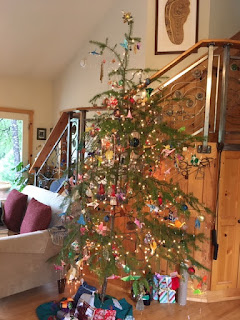
    My son and his father and stepmother were going to be here on Christmas Day to share the dinner with me, so a few days ago, when the snow had almost but not quite melted, I went out with my bow saw to look for a Christmas tree. The one I found looked pretty scrawny when I got it home, about eight feet tall but delicately limbed, to say the least. There were so few branches I thought I wouldn't be able to get all my ornaments on it. Now, however, fully decorated, it must surely be one of the best Christmas trees ever. (My mother, every Christmas: "It's the best tree ever!")

It is slender, so it doesn't take up a lot of room. I don't knock ornaments and tinsel off branches when I go to the bathroom, and I don't have branches dangling over my shoulder when I sit on the couch. It looks lusciously decorated, with all my ornaments—yes, I used them all—draped from every possible branch.

    And then, after all that, after the cooking and the decorating and the buying of spirits and gifts, no one will be here to celebrate with me. I will not make the chocolate angel food cake because I won't be joining the other family on Christmas Eve. It's all because it'll be a white Christmas for me in my little house on the mountain.
    Snow is predicted, at this altitude, practically non-stop, starting at 5:00 this afternoon (Thursday). All plans have crumbled. Ela is not coming down from Vashon. Dan and Tracy wouldn't be able to get up my road so won't be here, either. The Christmas Eve plans with friends have been canceled.
    Instead, I will drink eggnog with Kahlua in front of a cheerful fire in the stove. I will eat my good dinner and open my gifts. I will do Zoom calls with my family. And, if predictions hold true, I will watch snow fall, hour after hour, all day long. I will watch the snow fall for days. I will watch it pile up in great heaps of white loveliness. I will take the car the half-mile down the road to the paved road, which stays plowed, then will walk back up the road in the snow. Maybe, as it keeps snowing, I will be able to put on my skis and ski up the mountain. I will miss the planned and eagerly anticipated celebration, but there are worse things than being snowbound for Christmas.

Thursday, December 16, 2021

It Was the Bear's Fault

     "This is the bear's fault," I thought as I drove home Monday night, after dark and through snow.
    I had left home in a light and intermittent snowfall in plenty of time to have snow tires put on my car and then to do a few quick errands before heading home. I should have been home well before dark. But when I got back in the car after the final errand and saw that the "low tire" signal had come on, I headed right back to Les Schwab.
    The receptionist thought it was just a matter of turning the light off and called someone right away. The store was busy. It was a long wait. Finally a technician came in, squatted in front of my chair, and said, sympathetically, "One of your tires has a slash in it. We would think it had been done with a knife except that it's on the inside of the tire."
    "Ah," I thought. "The bear."
    Last spring I left my snow tires on the inside of the car port (roof but no sides), leaning against one of the posts. One day last summer I was puzzled to find one of those tires outside the car port, leaning against the same pole. The other three tires were still propped against the pole on the inside of the car port. There was no shredded plastic. Very mysterious.
    The only thing I could figure was that a bear had moved it, though I couldn't understand why he would do that. Now, faced with more substantial evidence, I envisioned the scene again. Curious about the bright yellow something that was my tire inside the plastic bag, he must have picked it up, slashing the tire with a claw as he lifted it to his nose. Then, deciding it wasn't edible, he pivoted and dropped it. It happened to land upright, leaning against the pole. The last piece of evidence was a slight rip in the plastic I had noticed when I put the tire in the car. Just a small hole. Just big enough for a claw.
    I had to buy two new tires, of course, because these days, if you ruin one tire you have to buy its mate, too. 
    I made it home through the dark and the snow, stopping halfway up the hill to clear the road of branches dragged down by the snow, using the headlights for light, but I was still grumbling at the bear. We get along pretty well, in general, but this time I think he owes me about $300 for the tires.