Saturday, September 24, 2022

Hiking the Alta Via 1: Day 2

 Day 2: Sennes to Lavarella. 4 3/4 hr.
    Breakfast at Sennes, as at all the rifugios, was buffet style and, as at most of them, consisted of cafe au lait, yogurt with either cornflakes or muesli, cheeses and hams, and a variety of breads. Breakfast was at 7:30. We were on the trail by 8:30.
    At first we were walking down a wide World War I-era road that stretched upward,
Margaret on the porch at Sennes, overlooking the WW I road
photo by Diana Coogle
but we soon turned onto a trail,
William on the trail.
Photo by Margaret Della Santina
then back on the road and back on the trail and back on the road, always descending, until finally we were on a "knee-jarring white dirt road," as guidebook writer Gillian Price calls it, built by the Italian military in the 1960s. It zig-zagged steeply between dramatic, vertical, gray-and-pink cliffs
             Me and William                       Photo by Margaret Della Santina
into a distant valley, where we could see, far below us, the large Rifugio Pederú, set in a parking lot filled with tiny-as-ants cars and buses. The number of vehicles explained the large number of people we met on the trail, who were puffing up this very strenuous road we were coming down. Some were families with small children. I was impressed. What fortitude these people have!
    We shunned the busy-ness at the rifugio, but we did stop at the clear-as-glass stream next to it, where I took off my boots and soaked my aching feet in the ice-cold water. From my point of view the descent was more foot-pounding that knee-jarring!
    From there the trail took us up the other side of the valley, along with crowds of other people.
                                  Photo by Margaret Della Santina
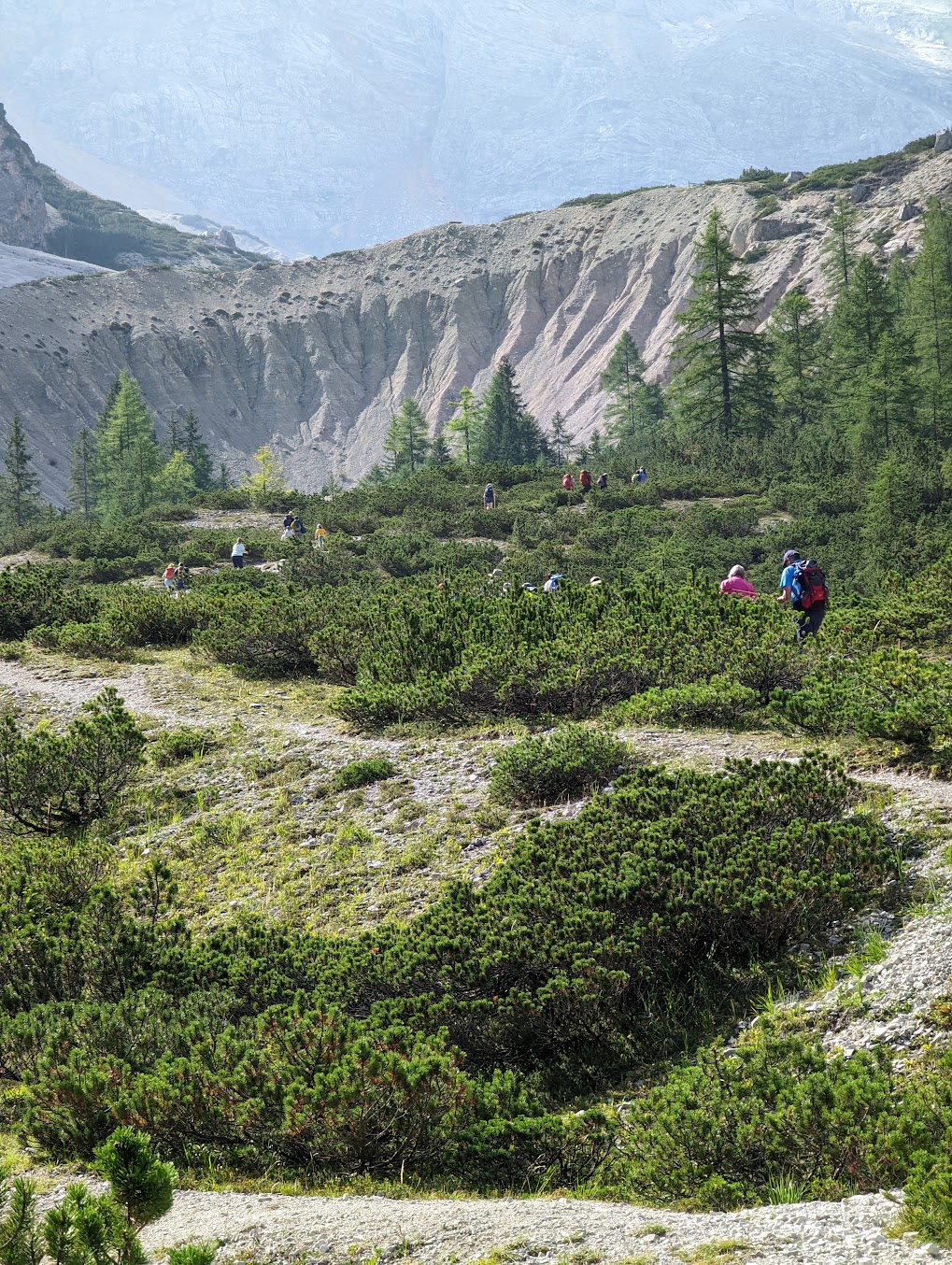
Many of those hikers passed me as I trudged upward. Margaret and William were far ahead of me but waited from time to time as I kept on with my tortoise-style, slow-and-steady pace which got me to the top without stopping—except, surprise! it wasn't the top, after all, and the trail was still going up and up and up, through a miniature forest of stubby pines and under pink-and-gray striped cliffs and peaks.
                                                Photo by William della Santina
    Big clouds accumulated, separated, came together again.
    Finally we came to the turn-off to Rifugio Lavarella, where we were to stay the night. Lavarella is a beautiful rifugio, set under the gray-stone peaks beside a shallow but wide stream with cows musically grazing in the grassy fields. It was lovely.
                                                                                        Photo by Diana Coogle

    Lavarella is a family-run rifugio that brews its own beer (a very good brew), makes sausages from farm-raised chamois (also delicious), and offers, among other items on the dinner menu, spinach dumplings with tomato sauce "from Mama's recipe," which is what I had. There was polenta, a staple on every menu, as we were to learn. However, this is the only place where we had beer ice cream for dessert.
William had polenta for dinner, frequently served at the rifugios
Photo by William della Santina
    My journal notes say that I was in bed at 8:00. And that I slept well.

Friday, September 23, 2022

Hiking the Alta Via 1: Day 1

Lago di Braies to Rifugio Sennes. 4 hours, 4 1/2 - 5 miles
    After four splendid days in Venice, Bryan (Margaret's husband and William's father) drove us to Lago di Braies, where Margaret (60) and William (18) and I (78) would begin our ten-day hike on the Alta Via 1. Bryan walked with us half-way around the lake to the trailhead. The lake was aqua blue; Dolomite domes leapt above it, and by the time we got halfway around the lake, the sun had warmed the beach. It was irresistible: I went for a swim. The water was 51 degrees.
Swimming in Lago di Braies
Photo by Bryan della Santina
I was enjoying it so much I didn't want to leave the water, but I was delaying our start on the trail, so I finally pulled myself out, got dressed, and the three of us bid Bryan good-bye and started up the trail.
Me with Margaret and William, on the trail.
Photo by William della Santina
    Though the trail wasn't nearly as steep as some we were to tackle in the coming days, it went up for a long time, climbing 2,925 feet from Lago di Braies (at 4,908 feet) to the high mountains. We climbed through beautiful rocks, then across meadows, still up, then over a rocky trail, always up, steadily up. 
Me, William. Photo by Margaret Della Santina
On one cliff of rocks we came upon our first via 
ferrata, a cable to hold onto as we carefully tread across the cliff.
You can see that I'm holding onto a cable.
Photo by Margaret Della Santina
    On the downhill Margaret and William, with a faster pace, got far ahead of me as I picked my way down the rocks, then up a steep grassy slope and over and up and across and down and across and up. I was hiking in all that splendor without another person in sight. It was glorious and expansive, though  it wouldn't have felt so glorious if I hadn't known that William and Margaret were ahead of me.
Margaret waiting for me on the trail.
photo by William della Santina
    At last we came to Rifugio Sennes, a beautiful, large, chalet-style building with cows grazing on the hills below the rifugio, their bells tinkling musically. Everything in the rifugio looked new and spiffy. Accommodations were pretty cushy.
                                              photo by Margaret Della Santina
Because a number of trails led to Rifugio Sennes, the chalet was buzzing with hikers, among them a woman from Ashland whose son had gone to the same high school that William attended and whose mother used to listen to me on the radio. Amazements never end.
Rifugio Sennes is in the background
photo by Margaret Della Santina

Thursday, September 22, 2022

Hiking the Alta Via 1 in Italy's Dolomite Mountains

   I have just come back from hiking in the Dolomite Mountains for the second time. The first time was six years ago, with my late husband, on the Alta Via 2. (See posts between September 21 and October 27, 2016.) This time I went with my friend Margaret and her eighteen-year-old son, William, and we were hiking the Alta Via 1.
William, me, Margaret. Day 5 on the AV 1. Photo by another hiker
The AV 1 is seventy-five miles long and generally takes eleven days. However, even though we started making reservations in February, some of the rifugios were already booked full, and we had to adjust the recommended stages to do the hike in ten days. 
    Starting at 4908 feet, at Lago di Braies, the AV 1 peaks at 9029 feet.
View from Lagazuoi, the highest rifugio on the AV 1
photo by Margaret Della Santina
Its lowest point, at the end of the last day, is 1470 feet. Total elevation gain is approximately 21,833 feet, but that doesn't mean much, since any particular day might gain and lose and gain again many hundreds of feet of altitude. Our shortest day was two hours. We had two long, eight-hour days. 
We stayed in nine rifugios, sometimes in a private room, sometimes in a room with six or eight other people, sometimes in a room for four without a fourth person. 
We had dinner and breakfast at the rifugio and generally ate extremely well; breakfasts were substantial (cafe au lait, yogurt with either cornflakes or muesli, cheeses, hams, breads with jam or Nutella, sometimes eggs, too), and the dinners—prima (first course), secondo (second course), and dessert—lots of pastas, polenta, sausages, hams, and Italian sauces—were usually very good.
Photo by William della Santina
We met many hikers and made quick friends—a couple from Colorado who promised to come ski at Crater Lake with me, a young couple from Spain now living in Germany, a couple from North Carolina, and three women who had stolen a week from their families to hike together in the Dolomites. Except for the last group, who were hiking the opposite direction from ours, we saw these people at different rifugios along the way.
    Having hiked in the Dolomites before, I knew, more or less, what I was in for, so I spent as much of the summer as possible hiking. I chose the steepest trails I knew and hiked with a pack. I hiked and hiked and hiked, and then the day came when I was flying to Italy and all preparations had to be sufficient. 
    And they were. I was so glad I had done all that physical labor! No matter how steep and long the trail, my legs never cried out for a stop, my muscles never ached, and my breath was adequate. At Rifugio Lagazuoi, the highest point on the trail, at the top of a very long, steep climb,
Note how far away the rifugio is. Photo by Margaret Della Santina
a woman complimented me on my hiking style, telling me she had hiked behind me and was impressed with how steadily I climbed. Margaret said she would have been even more impressed if she had known I was 78. 

    By my observation, I was the oldest person hiking the entire AV 1, and William, at 18, was the youngest. There were young children on various parts—and on some impressively difficult parts—but it didn't look like anyone younger than William was hiking the whole trail.
    Because of arthritis in my feet (hallux rigidus, bunions, bone spurs, neuromas), downhill is more difficult than uphill, and no amount of training could make that any easier. At the end of each eight-hour day, I flung myself down, took off my boots, and just let my feet throb. On the whole, though, I was highly pleased with my body and what it did for me. 

    Margaret and William were great hiking companions. We shared rooms easily; no one complained about anyone's sleeping habits, and we agreeably went to bed and woke in the morning in sync, ready for breakfast when it was served and for the trail shortly after breakfast. In addition, Margaret took care of all the logistics—booking the rifugios, speaking Italian, handling the monetary exchanges. I couldn't have found better companions for the Alta Via 1. Both William and Margaret hiked faster than I, but they sometimes let me go first, anyway, and they sometimes hiked ahead of me but waited at every junction for me to catch up.
William and Margaret, hiking ahead of me
On the last very long day, with its steep and interminable descent, I hiked between them. William would hike way ahead, then stop to wait for us to catch us (and take a nap, I think; he certainly had time for it). I kept suggesting to Margaret that she could go in front of me because she hikes faster, but she said she liked the pace. 
    I loved this trip on the Alta Via 1 with Margaret and William. I love the Dolomites. For the next ten days I will post a day-by-day account of this hike, hoping to give you a glimpse into why.

Saturday, September 17, 2022

"The Queen Is Dead; God Save the King"

     Elizabeth II was crowned Queen of England in 1953.
                                                                                    photo from Parade, online
I was nine years old and enchanted by the romantic aura of real-life characters from fairy tales. I watched the coronation on television and kept a scrapbook of coronation activities, smitten by the beautiful young queen and the ceremoniousness of her coronation.
    Six years later, when my family stopped in Victoria, BC, on our camping trip from Atlanta, Georgia, to Fairbanks, Alaska (see posts on February 4, 2017, June 30, 2017, and May 17, 2018), I saw the queen herself. Having just come from Butchart Gardens, the family happened to be in the crowd when Queen Elizabeth passed by in her car, waving the famous royal wave to the excited onlookers. I had out-grown the fairy-tale aspect of the royal family by then, but I was thrilled to see her in person, still young and beautiful.
    Between 1966 and 1968, living in England as a Marshall Scholar, I learned that one toasts the queen first when drinking wine—"To the Queen," followed by any other toast. Prince Charles, now King Charles, the patron of the Marshall Scholars, wasn't among the many dignitaries attending the welcoming reception when I arrived in London, but I was invited to a Marshall Scholars' reception for him in Washington, DC, years later. Alas, my budget didn't give me the means to travel across the country to meet a prince.
    Queen Elizabeth died on September 8.
                            At her Platinum Jubilee.               Getty images
I was two days off the trail, after a ten-day hike in the Dolomites, and would fly home the next day. 
I felt a twinge of personal sadness when I heard of her death. During a long layover at the Heathrow airport in London, I watched the large-screen TV, witnessing hundreds of people in mourning, thousands of flowers laid in honor, on-the-street interviews with people remembering their queen, a speech by King Charles, and many of the endless ceremonies and rituals attendant on the transferral of the crown to the new king. It was not unlike watching the coronation ceremonies of Queen Elizabeth in 1953.  
    Queen Elizabeth II, who lived long and reigned long, is dead. Long live King Charles. 


six years 

Thursday, August 18, 2022

Not Every Hike Is a Good Hike

     In preparation for an 11-day, hut-to-hut hike in the formidable Dolomite Mountains of northern Italy, I have been hiking strenuously day after day. Last week I decided to do the Mule Mountain trail, not far from my home. At 4.7 uphill miles, 9.4 round trip, it makes a good training hike.
    At the trailhead, another woman was just setting out, with her poodle. She asked if I had done this trail before, and I said, "Many times. It's one of my favorites." I stopped to adjust my boots, and she walked on.
    She must have thought I was daft. The trail was a nightmare. Weeds overhung it. I kept having to stop and pluck foxtails and burs out of my socks and shoestrings. I had to thread my way through poison oak. 
    Pretty soon I caught up with her where she had stopped to consult her guide book. Her dog was covered with burs. He looked like my socks. I explained the trail to her and passed on by, telling her she could pass me when she caught up with me.
    I never saw her again. She must have turned around. Smart woman.
    The trail left the shade of the forest and crossed a large open hillside, with patches of shade from a single tree every now and then. The temperature was over 90 degrees. I was hiking directly into the sun. I had lost my hat. Sweat poured in rivulets down my face. My shirt was soaked. The trail hadn't been maintained for years. Stiff arms of shrubs commingled across the trail, their pointed branches poking, scratching, and bruising my arms as I busted through them. 
    And then, suddenly, a reprieve from misery: a coyote appeared on the trail, just ahead of me. We looked at each other for several long moments before the coyote turned around, trotted a few steps, and disappeared downhill. 
    Finally I could see the trail's end, half a mile ahead, uphill. There was one tree between me and that goal. "If I can get to that shade," I thought, "then I can get through the open area beyond it and to the trees at the trail's end." 
    But it was beastly hot, and I was still having to battle through shrubs. I thought about turning around, but I reminded myself that if I were in the Dolomites, I wouldn't have the option of turning around.
   Then I thought. "I'm not in the Dolomites." Abruptly, I turned around. 
    When I was a child, I used to play a hand-motion game of going on a lion hunt, my hands imitating walking, slogging through mud, swishing through grass, climbing a tree, seeing a lion, and running back through all the obstacles with the same hand motions, now in high speed. That was what it was like on the Mule Mountain trail that day: faster now, through the bushes, through the poison oak, through the burs, and at last back at the trailhead with as much relief as the hunter in the game.
    My hat was sitting on a fencepost at the trailhead.
    "In the Dolomites," I thought, "I would be at a rifugio, sitting on the deck with a beer."
    At that, I drove into Jacksonville for an ice cream.

Thursday, August 11, 2022

Wildflower Spectacles

     This past June I was hiking in the Swiss Alps during the peak season of wildflowers. (See post on July 29.)  I could hardly grasp the beauty I was walking through.
On the trail from First to Schynige Platte, Switzerland

Wildflowers of many varieties flowed like ocean tides. At the highest elevations they were close to the ground but still carpeted the 
earth. Lower than that, but still high above the valleys, they grew knee-high. Some species I recognized, though they were different there—giant blue columbines? Yellow gentians? Some I identified with my Alpine flower book—Alpine rose, bladder campion. Others I enjoyed without calling them by name. As proud as I am of Siskiyou wildflowers, I thought I could never brag to the Swiss about wildflowers in the Siskiyous.
    But maybe I was wrong.
    This summer there has been a superbloom of wildflowers in the Siskiyous. Is it because, in the wake of the Slater fire, the flowers are loving the ashy soil? Or is it because of the late spring rain? Whatever caused this superbloom I would love to bring some Swiss hikers to the Siskiyous and go with them to Bolan Lake, for instance, or on many of the trails I love. The wildflowers have been stupendous.
Me on the way up Bolan Mt. in the Siskiyous    photo by Margaret Perrow

    The Siskiyou wildflowers are just as beautiful as the Alpine displays, but different. In the Alps, above tree line, the flowers carpet the hillsides. Everything is flowered. In the Siskiyous, they climb up rock walls, crowd together in small spaces, share space with trees and bushes. In the Alps the whole hillside is a flowing mass of various colors from the flowers alone; in the Siskiyous the flowers swirl in colors within outlines of rocks and trees, in small meadows and beside streams. 
On the trail to Oregon Caves, Siskiou Mountains

    There are 3000 plant species in Switzerland. The Siskiyous contain around 3500 vascular plant species of which 215 are found nowhere else in the world. One thousand of Switzerland's 3000 plant species are endangered, according to a sign in the Alpine Garden at Schynige Platte. One hundred and eleven are at risk of extinction, and 55 are already extinct. 
    The sign in the Alpine Garden goes on to say that "the large biodiversity is because of many different elevations, diverse climate conditions, geological diversity, and long periods of traditional and sustainable agricultural management (alpine farming)."     
    The great botanical biodiversity of the Siskiyous is the result of the east-west orientation of the range, which created stopping points for plants migrating north and south, and of climatic and geological influences from the desert on the east side and the ocean on the west, which created a variety of soils and conditions in which a wide variety of plants could find a home. There are also, of course, elevation changes in the Siskiyous, though maybe not as extreme as in the Alps, but still affecting the plant life. Agricultural practices play no part in the Siskiyous, except, maybe, forestry practices, which have generally been detrimental.
    The most astonishing difference between the Swiss Alps and the Siskiyou Mountains is the trees. The Alps don't support many trees, whereas 36 different species of conifers grow in the Klamath-Siskiyous, more than in any other temperate forest in the world.
    In the end, I think I would be proud to bring a Swiss botanical friend to my home. Like the Alps, the Klamath-Siskiyou mountains are a showcase of beautiful flowers. Unlike the Alps, they are also a showcase of beautiful trees.
    
On the Silver Fork trail in the Applegate (Siskiyou Mts)


Friday, August 5, 2022

Birthday at Crater Lake

     Sometime last spring my friends Barbara and Jeanette and I decided to spend the night at the lodge at Crater Lake National Park for my birthday in late July. It was a great plan, but we were about two years too late. All rooms were booked for two years.
    The day before my birthday Barbara called. She had been checking the Crater Lake lodge web site daily, and, miraculously, there was a cancellation. Did I want to take it?
    Yes!
    And so I spent my birthday at the historic Crater Lake Lodge, after all. Barbara and I shared the room, which had a view over the lake of course; it's not worth being at the lodge in a room overlooking the parking lot. Jeanette, unfortunately, was unable to come.
    Once we got to the Park, Barbara and I drove halfway around the lake on the Rim Drive to Cleetwood Cove and walked the steep 1.2-mile trail down to the lake, where Barbara sat in the shade of a pine tree, while I took a long, royal-blue swim in Crater Lake, one of my favorite things to do in the world.
Swimming in Crater Lake. Note the snow.       Photo by Barbara Holiday

    It was a hot day. I let go of plans to hike up Garfield Peak before dinner, slowed the pace, and consequently had time to stop at some overlooks and take some short hikes I had never done before. It was beautiful to see the lake from these new vantage points.
Phantom Ship from Sun Notch trail.   Photo by Barbara Holiday

    Back at the lodge we shared a glass of wine before dinner, standing, not sitting, on the deck overlooking the lake because the usual Adirondack chairs were missing because the roof of the lodge was being repaired. The lodge, the tour boat, and other buildings at the Park had suffered damage from the late and heavy snows last spring. 
    The next morning I woke up at 5:00 to a spectacular sunrise. How grateful I was for a room with a view of the lake! Horizontal stripes of red, orange, and gold lay above the lake.

Moving quietly so as not to disturb Barbara, I quickly pulled on the dress I had worn to dinner, grabbed my phone, and tiptoed barefooted downstairs to the veranda. I watched the colors change, took pictures, then decided to walk along the asphalt path which ended, I knew, at the trailhead up Garfield Peak. When I got there, I saw that the trail was fairly sandy, so why not walk up the trail until it got too rocky for my bare feet? 
    It was very beautiful to be alone on that trail in the dawn light. The flowers
the lodge at such a distance, highlighted by the rising sun,

and the sun itself splashing color on the peaks around the lake as it rose—

it was all so beautiful.
    I walked about halfway up the peak before a combination of increased rockiness and a sense that I should get back for breakfast with Barbara sent me down again. But it had been a beautiful, solitary, sunrise hike.
    After breakfast Barbara and I drove back up the east side of the Rim Drive to hike to Plaikni Falls, another place I had never been. The wooded, one-mile trail took us to a stunningly beautiful, long waterfall that fell into a meadow of wildflowers on the steep banks of the stream with butterflies flitting through them.     
    Finally I had to face the fact that I had obligations at home. It was time to make the drive back.
    It had been a perfect birthday.